

You step off the plane at Faro Airport, see the taxi rank, and realise the usual options won't work for your chair, your family, or your luggage. That's the moment when wheelchair-adapted vans stop being a nice extra and become the difference between a smooth arrival and a stressful one. For travellers heading to Albufeira or anywhere in the Algarve, the key question isn't just how to get there, it's how to get there safely, legally, and without improvising at the kerb.
Accessible Van Transfer Overview
A proper carrinha adaptada para cadeiras de rodas is not just a van with a bit more space. It's a vehicle planned around safe boarding, secure travel, and a transfer experience that doesn't force the passenger to transfer out of the chair unless they choose to. That matters at Faro Airport, because the trip usually starts the moment you leave arrivals, and any mismatch between vehicle and mobility needs shows up fast.
Portugal's accessibility framework gives a useful clue about how seriously this is treated. Visit Portugal states that all Portuguese airports have adapted sanitary facilities and transfer services for people with special needs, while rail assistance through CP's SIM service is available 24/7 every day of the year and some urban reduced-mobility services require advance booking by the day before travel (Visit Portugal accessibility overview). For a traveller, that means accessibility isn't limited to one transport mode, it's part of the system.
A practical place to start is to understand your chair, your transfer distance, and your boarding needs before you book. If you want a plain-language explanation of transporting a powerchair safely, the DME Superstore powerchair guide is a useful reference point, especially when you're comparing vehicle types and securing methods.
Practical rule: if the booking form doesn't ask about ramp type, wheelchair type, and luggage, it probably isn't set up for a serious accessibility transfer.
Understanding Wheelchair Adapted Vans
A wheelchair-adapted van starts with one simple goal, let a passenger board and ride without being forced out of the chair unless they choose to transfer. In practice, that means the vehicle is converted to create a flatter entry path, more headroom, and a stable interior space where the wheelchair can be secured. For a traveller, the difference is easy to feel. The vehicle either supports the journey from the first step or it makes every movement harder than it should be.
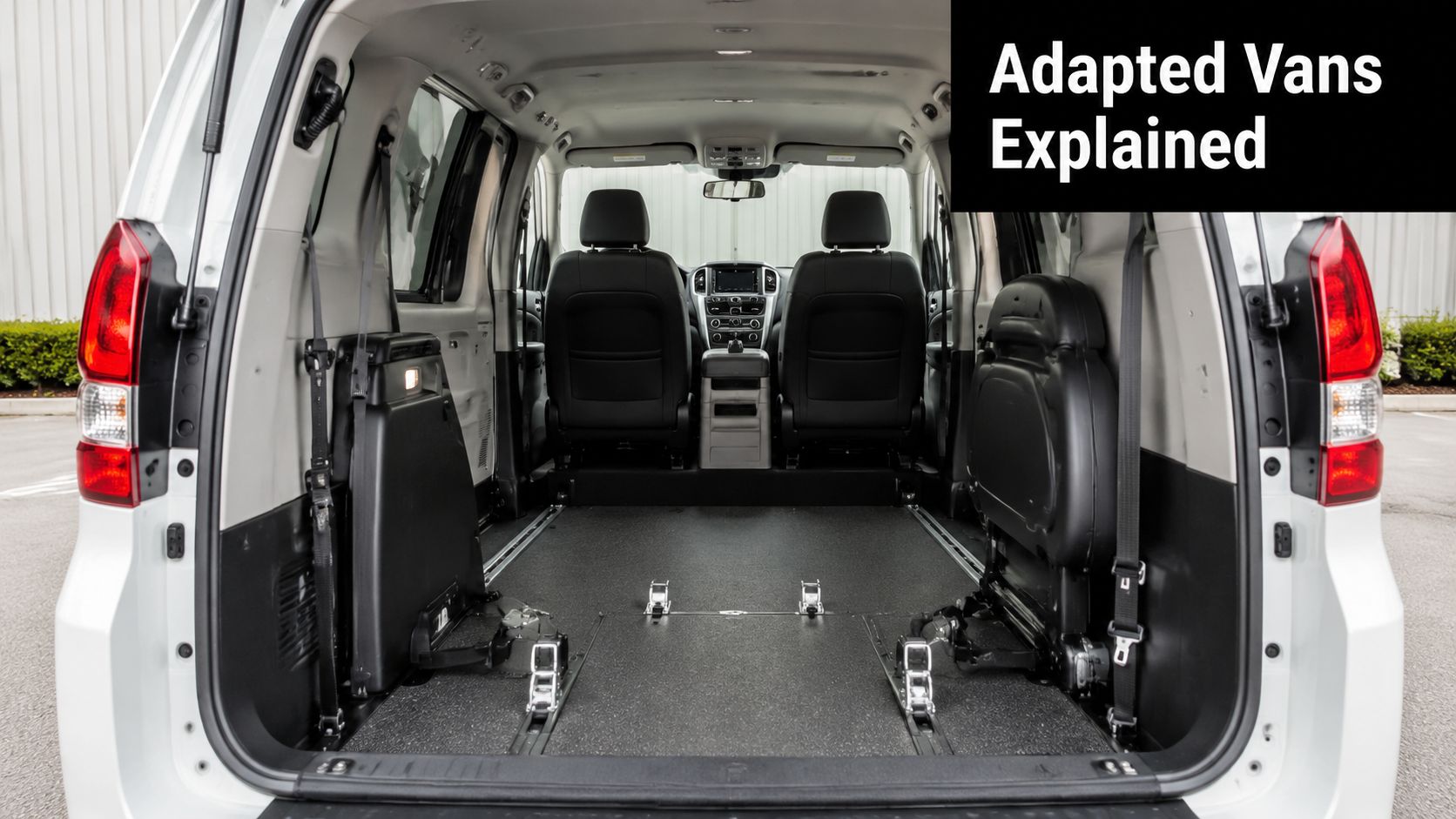
Portuguese guidance describes the conversion in practical engineering terms. The rear floor is lowered by about 20 cm below the standard line, the structure is reinforced, and the welding has to preserve torsional resistance and stability. That may sound technical, but the traveller-facing meaning is straightforward, the van should stay steady, avoid flexing, and keep its structure consistent over bumps and corners.
What to look for in a real adapted van
A proper conversion usually brings several features together, not just one. The access system may be manual, electric, hydraulic, lift-based, or crane-assisted, depending on the chair and the help available. The ramp or lift has to lock firmly during travel, and the wheelchair must be anchored to the vehicle structure so it does not shift when the road changes under it.
Holiday travellers in the Algarve should pay close attention to that detail. Airport pickup points, resort roads, and hotel entrances leave little room for improvisation, and a van that looks spacious can still be a poor fit if it lacks a flat entry, proper securement, or enough internal clearance for the chair and posture needs.
A standard family MPV is like a dining table, fixed in place and built for a general layout. An adapted van is the same room reorganised for wheelchair movement, with access, positioning, and safe travel built into the arrangement itself. The difference is not cosmetic, it changes whether the passenger boards with dignity and stays secure through the journey.
A van can look “accessible” from the outside and still fail the basic test inside, safe entry, safe anchorage, and enough room to ride comfortably.
For a broader look at vehicle-lift access systems, addressing Michigan access problems offers a useful parallel, even though the use case is different. The principle is the same, access only works when the lift, the structure, and the operating method all match the user's needs.
Comparing Van Types and Capacities
Not every adapted van is built for the same job. Some are designed for a single wheelchair user and a small group, while others are closer to a compact transfer shuttle that can handle more passengers and luggage. For Algarve airport transfers, the right choice depends on whether you're travelling solo, as a couple, with family, or with a group that needs a wheelchair slot plus suitcase space.
Portugal's accessible transport market is built around practical capacity. CP's SIM listing identifies adapted taxis in Lisbon and Porto, and the market also includes vehicles that can accommodate up to 8 seated passengers plus 2 wheelchair users (CP SIM adapted taxis PDF). That's the kind of capacity planning that helps when you're booking private transfers Faro Airport or a return Albufeira to Faro airport journey.
Wheelchair-Adapted Van Comparison
| Van Type | Passenger Seats | Wheelchair Slots | Luggage Capacity |
|---|---|---|---|
| Standard adapted van | Small group focus | 1 | Limited to typical holiday luggage |
| Mid-size adapted van | Family or medium group | 1 to 2 depending on layout | Better room for bags and mobility equipment |
| Large adapted van | Larger family or group transfer | Up to 2 | Strongest option for combined luggage and chair transport |
The table is a planning tool, not a promise of a specific fleet. The important point is that capacity and layout need to match your wheelchair profile, especially if you're travelling with beach equipment, golf bags, child luggage, or extra mobility aids.
How to choose the right size
A few questions make the choice much clearer.
- How many people are travelling? Don't count only the wheelchair user, count the full party, because seating layout affects every row.
- How much luggage do you have? A transfer that fits the people may still fail if the boot can't take suitcases and the chair together.
- Do you need one chair space or two? That changes the vehicle class immediately.
- Will the chair stay in the van or fold separately? Folding chairs need different handling from powerchairs or postural chairs.
For many holiday arrivals, the van needs to solve both mobility and holiday logistics at the same time. That's why a private transfer from Faro airport to Albufeira price is only useful if the operator can also explain how many chairs, seats, and bags fit without squeezing the booking.
Legal and Safety Standards in Portugal
A transfer can look simple from the curb, then become complicated the moment a wheelchair needs to board, lock in place, and travel safely on local roads. Portugal's adapted-vehicle guidance exists to prevent that mismatch. It turns safety into visible design features, such as a lowered rear floor, reinforced structure, and proper wheelchair restraint, so the vehicle behaves like a fitted support system rather than a normal van with a ramp added on.
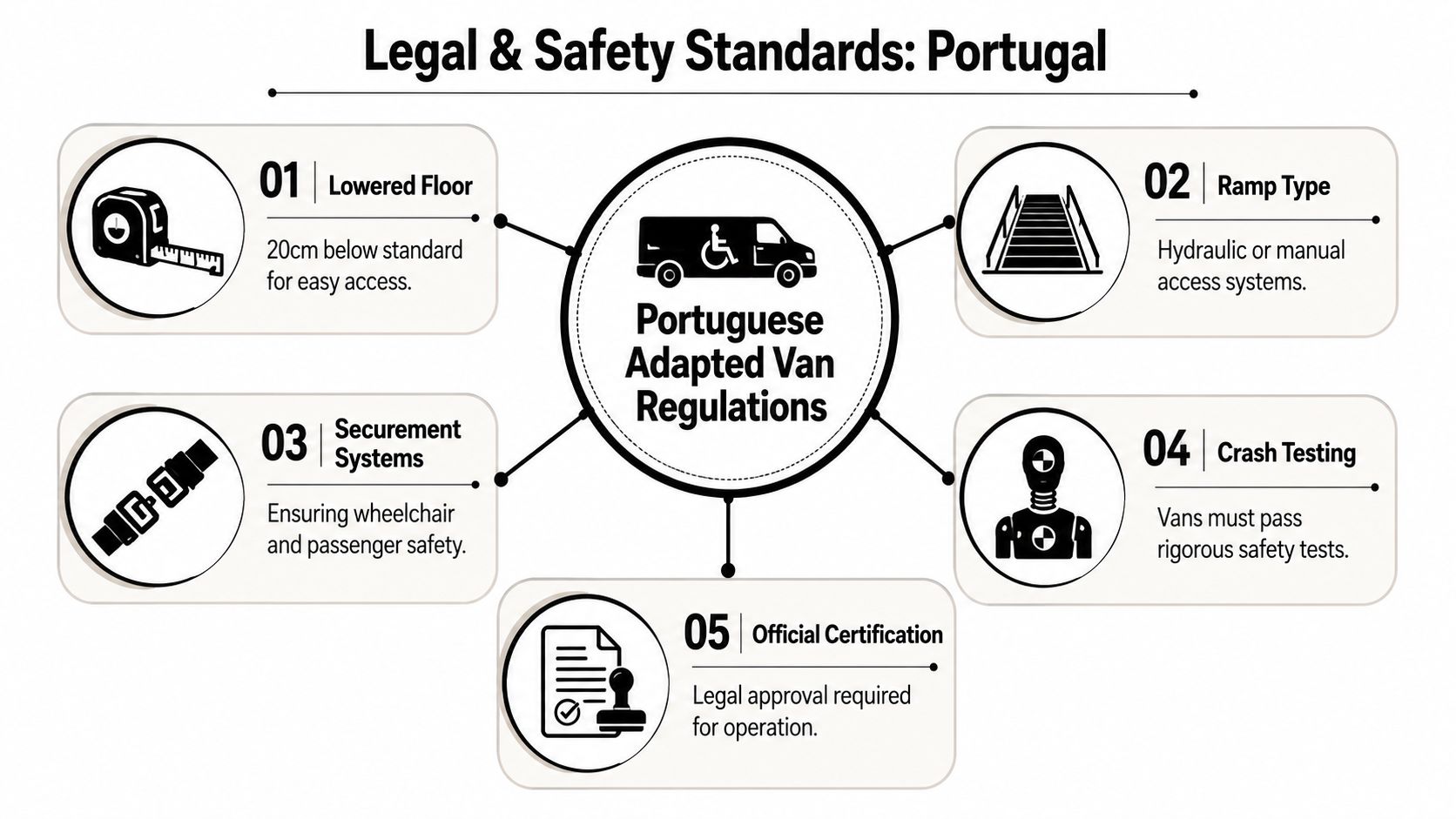
The MAPFRE Portugal guidance says the rear floor should be about 20 cm below the standard line, with a reinforced structural box, proper welding, and an access system that locks firmly during movement (MAPFRE Portugal guidance). It also says the wheelchair must be anchored to the vehicle structure so it does not shift over bumps or through corners. For travellers, that is the difference between a van that merely fits a chair and one that is designed to carry it safely.
What these standards mean in practice
The practical questions are usually the same, even if the vehicles differ.
- Can I stay in my chair during the ride? The anchorage system is what makes that possible.
- Will the chair move on bends or uneven roads? It should not, if the securement is done properly.
- Is the boarding system suitable for my chair type? Manual chairs, electric chairs, and postural chairs can need different access systems.
- Does the vehicle feel stable when loaded? Proper reinforcement is designed to keep the vehicle structurally sound.
Those details matter on holiday transfers because airport-to-resort journeys often begin with tired passengers, luggage, and a tight schedule. A legally compliant vehicle does more than satisfy paperwork. It reduces the chance that boarding, securing, or load balance will turn a short transfer into a stressful one.
That is also why regional booking pages need to explain these points clearly. The Algarve Experience's reduced-mobility taxi page helps fill that public-information gap for holiday travellers who need to check whether a van, ramp, and restraint setup match their chair and their route before they book.
Practical Booking Checklist and Tips
A good booking starts with the details the operator needs, not only the destination name travellers usually remember first. A wheelchair, a bag, and “airport” are not enough on their own. If the company knows the chair type, boarding method, luggage volume, and arrival timing, it can send the right vehicle the first time.
A transfer on the Faro Airport to Albufeira route works better when the booking is made early, the flight number is shared, and the destination details are clear. That guidance appears in Transfeero transfer guidance, which also points travellers toward giving the operator enough information to match the driver and vehicle class. For accessible travel, that matters because the wrong van size, ramp type, or pickup timing can turn a short transfer into avoidable waiting.
The details worth sending before you pay
- Wheelchair measurements: Share length, width, and height, especially if the chair is power-assisted or has fixed armrests.
- Ramp or lift preference: Say whether a manual ramp is acceptable or whether you need hydraulic access.
- Passenger count: Include everyone, not just the wheelchair user.
- Luggage and equipment: Mention suitcases, folded walkers, sports gear, or beach items.
- Assistance needs: Say if you need help with boarding, loading, or terminal meeting.
- Flight information: Provide the arrival number so the operator can track changes.
A booking form should also make room for payment and support details. Transfer services may offer different vehicle classes, such as economy, executive, and van, plus extras like child seats or additional luggage support, and driver contact details after payment. That is the kind of information travellers should expect to see confirmed before the booking is final.
Booking rule: if the operator won't confirm the vehicle class before you pay, don't assume the van will fit your chair.
For travellers comparing search results, finding a chauffeur service near me helps frame the questions to ask before confirming a ride, especially when accessibility is a strict requirement.
A reliable Algarve airport shuttle is easier to secure when the transfer is pre-booked. It reduces guesswork after landing and lowers the risk of being offered a standard car when an adapted van is needed.
Booking with The Algarve Experience
Official accessibility guidance often stays centred on Lisbon and Porto, while holiday travellers arriving in Faro need a transfer that works at the destination, not only in the capital region. That gap is exactly where regional booking clarity matters, especially for people searching for Albufeira airport transfers, Faro airport to Albufeira transfer, or best airport transfers Algarve with mobility support (Navegante accessibility information).
The Algarve Experience provides dedicated wheelchair-friendly transfers across the Algarve without advance regional constraints, and that makes it a practical option when you need door-to-door movement rather than a generic taxi search. The company's accessible transfer service is presented on its wheelchair adapted cars page, which is where travellers can check the format of the service before booking.
What that means for the traveller
The value here is not a slogan. It's the ability to book a transfer that is planned around the passenger's mobility profile, the destination, and the arrival process at FAO. That's especially useful for families, older travellers, and anyone comparing cheap Faro airport transfers with a vehicle that can handle a chair safely.
A sensible booking flow looks like this.
- Confirm your arrival time and destination.
- Share your wheelchair type and luggage details.
- Ask for the vehicle class and access method.
- Check whether meet-and-greet is included at the terminal.
- Keep your driver contact details handy after booking.
That sequence is what turns a generic transfer into a usable one. It also helps when you're comparing Albufeira Faro airport return transfer options, because the return leg often needs the same mobility planning as the arrival.
Conclusion and Next Steps
The safest choice for carrinhas adaptadas para cadeiras de rodas is the one that matches the traveller, not just the route. In Portugal, the important signs are clear, lowered floor, reinforced structure, locked access, and secure anchorage. Add a detailed booking checklist, and the journey from Faro Airport to Albufeira becomes a lot more predictable.
If you're arriving soon, book early, send the right measurements, and choose a provider that already understands accessible airport transfers in the Algarve. That's the simplest way to protect comfort, time, and dignity on arrival.
A CTA for The Algarve Experience.
Related posts