

You've landed at Faro Airport, your bags are somewhere on the carousel, and the driver waiting for your Faro airport transfer is working from an arrival time that may already be wrong. A flight tracker real time service can show where the aircraft is, whether it has landed, and whether the estimated arrival has moved. It can't tell you exactly when you'll clear passport control, collect luggage, or walk into the arrivals hall.
That distinction matters on the Faro Airport to Albufeira transfer, where the airport and resort are commonly described as being about 36 to 46 km apart, with a normal road journey typically taking around 35 to 45 minutes (route guidance for Faro to Albufeira). Used properly, live tracking helps your driver adjust to the aircraft. Used blindly, it can still leave you waiting, rushing, or paying for a poorly timed pickup.
Why Real-Time Flight Tracking Matters for Your Algarve Arrival
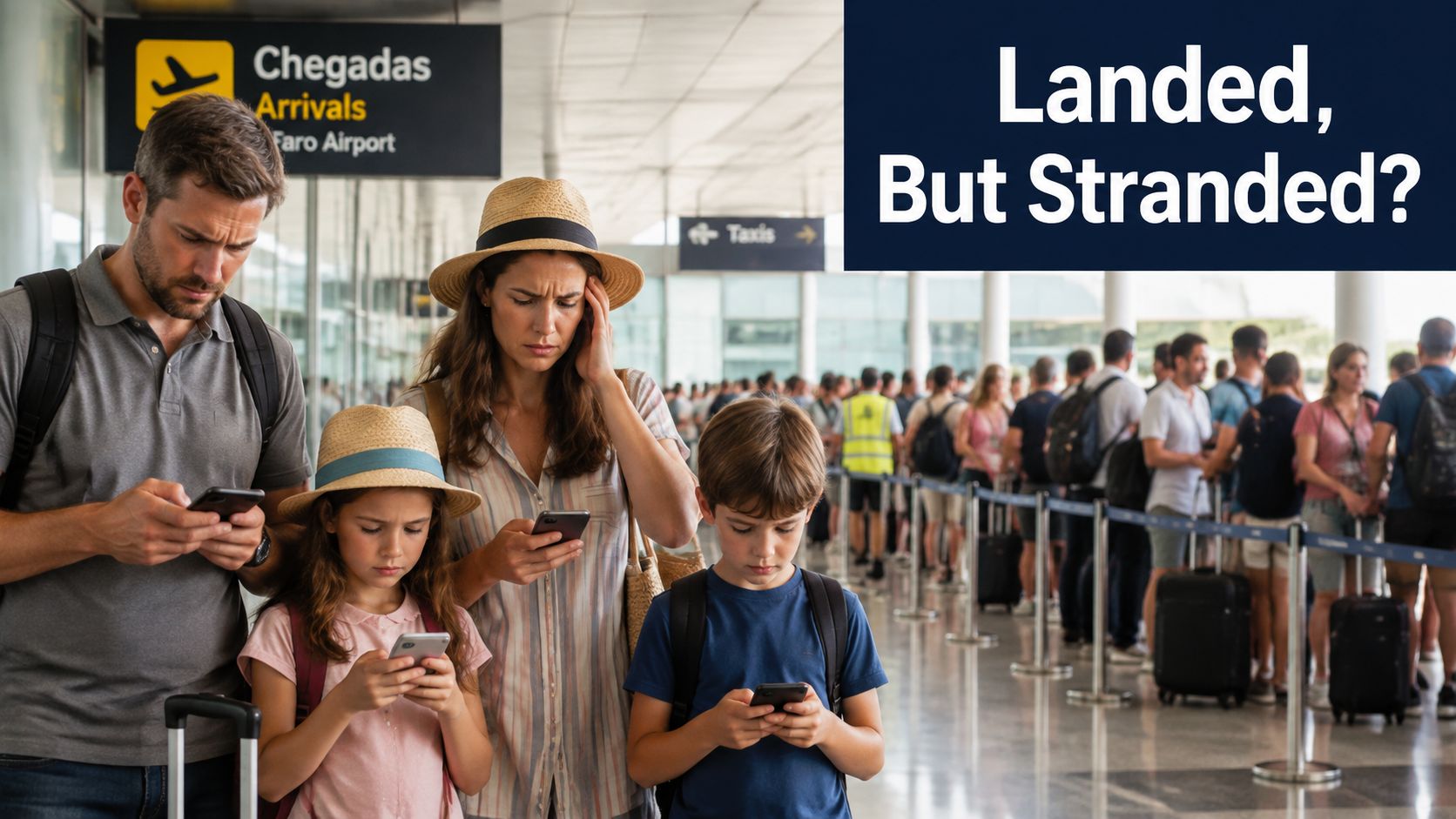
A family arriving from London Gatwick can experience the problem quickly. Their aircraft lands later than planned, the pre-booked shuttle follows the original schedule, and the taxi queue stretches beyond the car-rental desks. By the time they reach the kerb, the transport plan has already fallen apart.
That's why I treat a live flight tracker as a ground-transport planning tool, not an aviation hobby. Most travellers check their flight once before leaving home and then stop looking. They miss later changes such as an altered estimated arrival, a holding pattern, or an early landing, each of which can shift the pickup window at Faro.
Faro Airport's official statistics report 9,640,232 passengers in 2023, up from 8,152,414 in 2022, while October 2024 alone recorded 1,076,792 passengers (Faro Airport statistics). ANAC's quarterly bulletin also recorded 3,378,524 passengers in 2025, compared with 3,125,123 in 2024, and Faro-specific movements rose 9.4% year on year (ANAC data reported by The Portugal News).
In a busy arrival market, the useful question isn't only, “Has the flight landed?” It's, “When will these passengers realistically be ready to meet the driver?” Airport navigation and passenger-flow planning resources, including this guide to improve passenger flow at airports, help explain why movement inside a terminal matters just as much as movement in the air.
For a pre-booked vehicle, provide the flight number rather than relying on a fixed pickup time. A service such as Faro Airport private transfer booking can then align dispatch with the live arrival instead of treating the scheduled time as a promise.
Practical rule: Track the flight, but book the pickup around the passenger's exit from arrivals, not the moment the wheels touch the runway.
How Live Flight Trackers Actually Work
A tracker combines several information streams, much like a postal delivery system that uses a parcel barcode, depot scanners, and the courier company's own records.
The aircraft signal
ADS-B, or Automatic Dependent Surveillance-Broadcast, is the aircraft's own broadcast signal. It communicates information such as position, altitude, speed, and direction to receivers on the ground and, in some systems, to other aircraft. Think of it as a parcel repeatedly broadcasting its location through live barcode scans.
Portugal has a substantial receiver footprint. AirNav Radar lists active coverage sites including Praia do Norte, Torre de Coelheiros, Meirinhas, Areosa, Santa Cruz das Flores, Évora, Ponta do Pargo, Lisbon, and Santarém, with reported maximum ranges reaching 485 nautical miles and coverage scores above 100% at several stations (AirNav Radar Portugal stations). That network supports more detailed live position updates for aircraft serving airports such as Faro.
Radar fills the gaps
Traditional primary and secondary radar provide the ground-based safety net. Radar sweeps the airspace and can help maintain an aircraft's track where ADS-B coverage is limited, including remote areas and stretches over water.
Radar and ADS-B don't always produce identical timing. The tracker has to decide which signal is most useful at a particular moment, then reconcile differences before presenting one aircraft icon on screen.
Airline and airport records add context
The aircraft signal tells you where the plane is. Airline and airport operational feeds tell you what that movement means for passengers. These systems contribute scheduled times, revised estimates, gate information, and status labels such as diverted, estimated, landed, or cancelled.
Airport flight pages for Faro publish estimated arrival and departure times, flight numbers, origins or destinations, and status information through the official Faro flight connections page. The airport also provides a real-time departures search, while independent live-status tools commonly let users search by flight number or scheduled time.
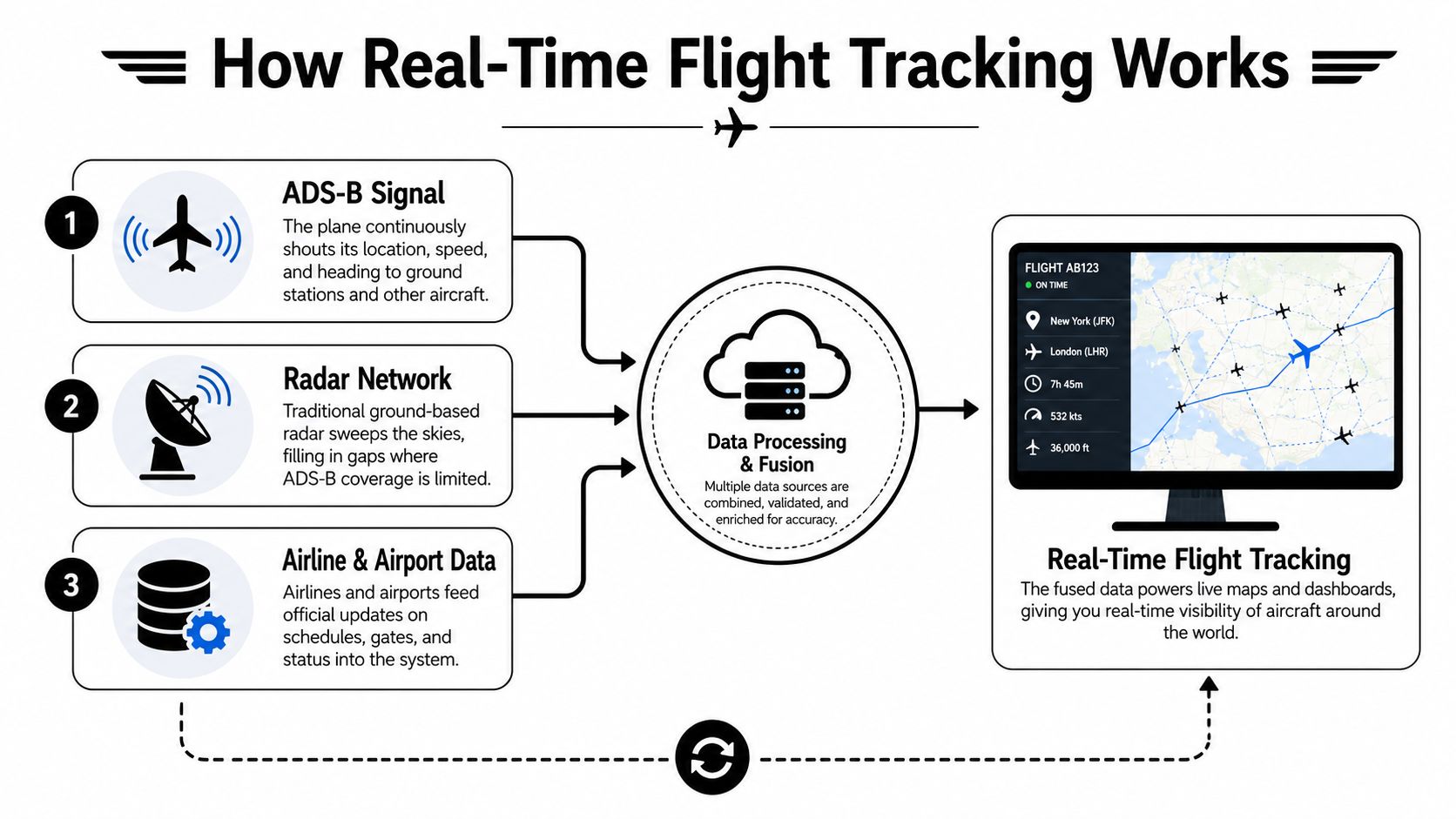
The refresh speed varies. ADS-B position updates can be near-instantaneous, while airline or airport feed changes may take several minutes to appear. No individual source is infallible, so use the tracker as a developing picture rather than an absolute guarantee.
Faro Airport Traffic and Punctuality by the Numbers
Faro's traffic level makes a live tracker useful for transport planning, not just aircraft watching. Official airport figures record 9,640,232 passengers in 2023, up from 8,152,414 in 2022, while 1,076,792 passengers passed through in October 2024 alone (Faro Airport traffic statistics). Those totals describe airport pressure, not the time a passenger needs to reach the arrivals hall. They do explain why several flights can converge on the same meeting point, taxi rank, baggage area, and border-control queue.
The key operational lesson is seasonal concentration. Summer arrivals create tighter clusters of passengers and vehicles, so a small change to one inbound flight can affect pickup timing across the terminal. A tracker helps identify that change early, allowing a driver to adjust arrival time instead of waiting unnecessarily outside.
Portugal's punctuality figures also need careful interpretation. Reporting on 2025 found that 67% of flights in Portugal were on schedule in the first half of 2025, while Faro recorded 82% of flights without disruption, ahead of Porto at 76% and Lisbon at 59% (Portugal airport delay reporting). For a transfer operator, that does not mean every passenger reaches the vehicle promptly. It means Faro's aircraft operations compared well with other major Portuguese airports during the period covered.
Other reporting placed Faro at 79% of flights on time and stated that 36% of roughly 227,000 flights departing Portugal were delayed in 2025, affecting more than 11.6 million passengers (Faro real-time departure information). Different measures can produce different percentages. Use the live status to judge one flight, not a general punctuality figure to promise an exact pickup.
The practical rule is simple. Monitor the inbound aircraft, confirm the latest airport estimate, then allow for the passenger's route through the terminal. That approach reduces wasted waiting time and lowers the risk of sending a driver to Faro before the traveller is ready.
The Hidden Delays a Flight Tracker Cannot See
An aircraft can be marked on time while its passengers remain far from the arrivals exit. The tracker is excellent at showing aircraft movement. It isn't a passport-control system, baggage belt monitor, or personal walking-time calculator.
Recent Portugal reporting gives the clearest warning. Ryanair said that in July 2025 more than 120 passengers missed flights from Porto, Faro, and Lisbon because passport-control waits reached up to 90 minutes (FlightAware Faro Airport information). The aircraft may have kept schedule, but the passenger journey through the terminal still carried serious uncertainty.
What happens after landing
After touchdown, passengers may need to wait for the aircraft to reach its stand, disembark, walk through the terminal, clear border checks, retrieve bags, and locate the meeting point. Non-Schengen arrivals face an extra border-control stage that a flight tracker cannot predict for an individual passenger.
Baggage is another variable. A tracker may show Landed, but the traveller still has no control over when their suitcase appears or whether it arrives on the expected belt. A person travelling with hand luggage may be ready quickly, while a family with pushchairs, sports equipment, or several checked cases will need longer.
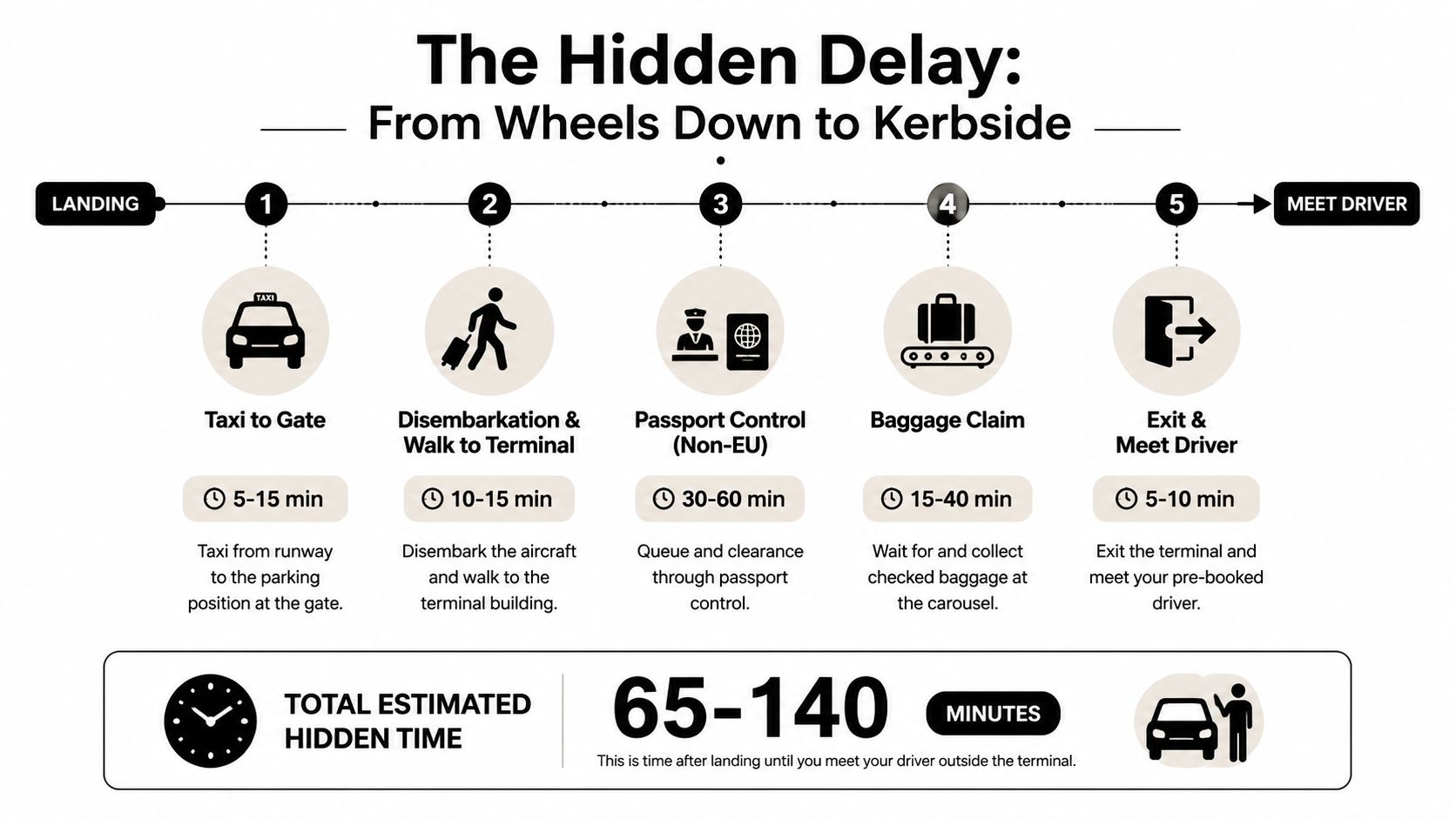
Treat the statuses carefully:
- Landed: The aircraft has reached the airport, but passengers may still be on board or walking to the terminal.
- Arrived at gate: The aircraft has reached its stand, which is more useful for estimating disembarkation.
- Baggage reclaim: The aircraft status won't tell you whether your luggage is already available.
- Arrivals exit: This is the point that matters to the driver and the transfer passenger.
Passenger reality: An on-time aircraft doesn't guarantee an on-time handover at the arrivals hall.
This is why responsible Algarve airport transfers use a flexible pickup window. The operator watches the flight first, then allows for the terminal process. Travellers should send a message once they've exited, rather than assuming that “Landed” means “meet me now”.
How Different Transfer Options Handle Flight Changes
A live flight status has value only if the transport provider can act on it. For a private transfer, a 60-minute delay should trigger a revised pickup window, not a second booking request from the passenger. The operator monitors the flight, keeps the driver informed, and aims for the driver to arrive near the practical meeting time. Confirm the provider's waiting policy before travelling, because flight monitoring and passenger waiting are separate arrangements.
An airport taxi works differently. The driver normally responds to the passenger's actual arrival at the rank, so an early landing may mean joining the queue sooner, while a delayed flight postpones the taxi search. Ride-hailing apps also require action after landing. A nearby driver may accept one request, but availability and the quoted fare can change before the passenger reaches the pickup point.
| Transfer type | Early arrival | Delayed flight, 30 to 60 minutes | Late-night landing | Cost impact of changes |
|---|---|---|---|---|
| Private pre-booked transfer | The operator can bring the pickup window forward after checking the flight | The operator can revise the pickup window and keep the driver updated | A reserved vehicle gives clearer arrangements than waiting for supply | Fixed pricing is easier to assess when delay handling is included |
| Airport taxi rank | You join the queue sooner than expected | You wait until landing, then join the available queue | Supply may be less predictable | Metered pricing applies, with possible waiting or route costs |
| Ride-hailing app | A nearby driver may accept, but availability can change | You may need to request again after landing | Driver coverage and pricing can fluctuate | The quoted fare may change with demand |
| Public bus | An early landing may fit the next departure | Missing a departure means waiting for the next scheduled service | Fewer practical choices may be available | Lower fares come with less flexibility |
| Rental car | Early arrival gives more time for collection | The booking desk and vehicle collection process follow their own rules | Collection procedures may be restricted | Extra time, fuel, tolls, and insurance choices affect the final cost |
Faro's airport taxi guidance places Algarve journeys under Tariff 3, with metered fares required. Published examples include a €3.25 weekday daytime minimum, €0.94 per kilometre, and a €3.90 nighttime or weekend minimum with €1.13 per kilometre, plus small supplements for luggage, pets, and phone dispatch (Faro Airport taxi fare guidance).
Choose a private booking when the driver must be ready for a changed arrival without a new request. Compare a car-hire option at Faro Airport with a door-to-door vehicle, including collection time, fuel, tolls, insurance, and parking before judging the headline price.
Public transport suits passengers with light luggage and flexible plans. Direct buses between Faro and Albufeira are described as taking around 36 to 40 minutes, while cheaper options involving a change can take about 1 hour 15 minutes to 1 hour 30 minutes (Faro to Albufeira transport comparison). Those departures remain fixed when a flight arrives late, so a saved fare can become a long wait at the airport.
A Practical Checklist for Timing Your Faro Airport Pickup
Use a flight tracker as a sequence of decisions, not as a page you open once. The following process works for a private transfer from Faro Airport to Albufeira, a family minivan, a golf-group vehicle, or an Albufeira to Faro Airport return transfer.
Start before travel day
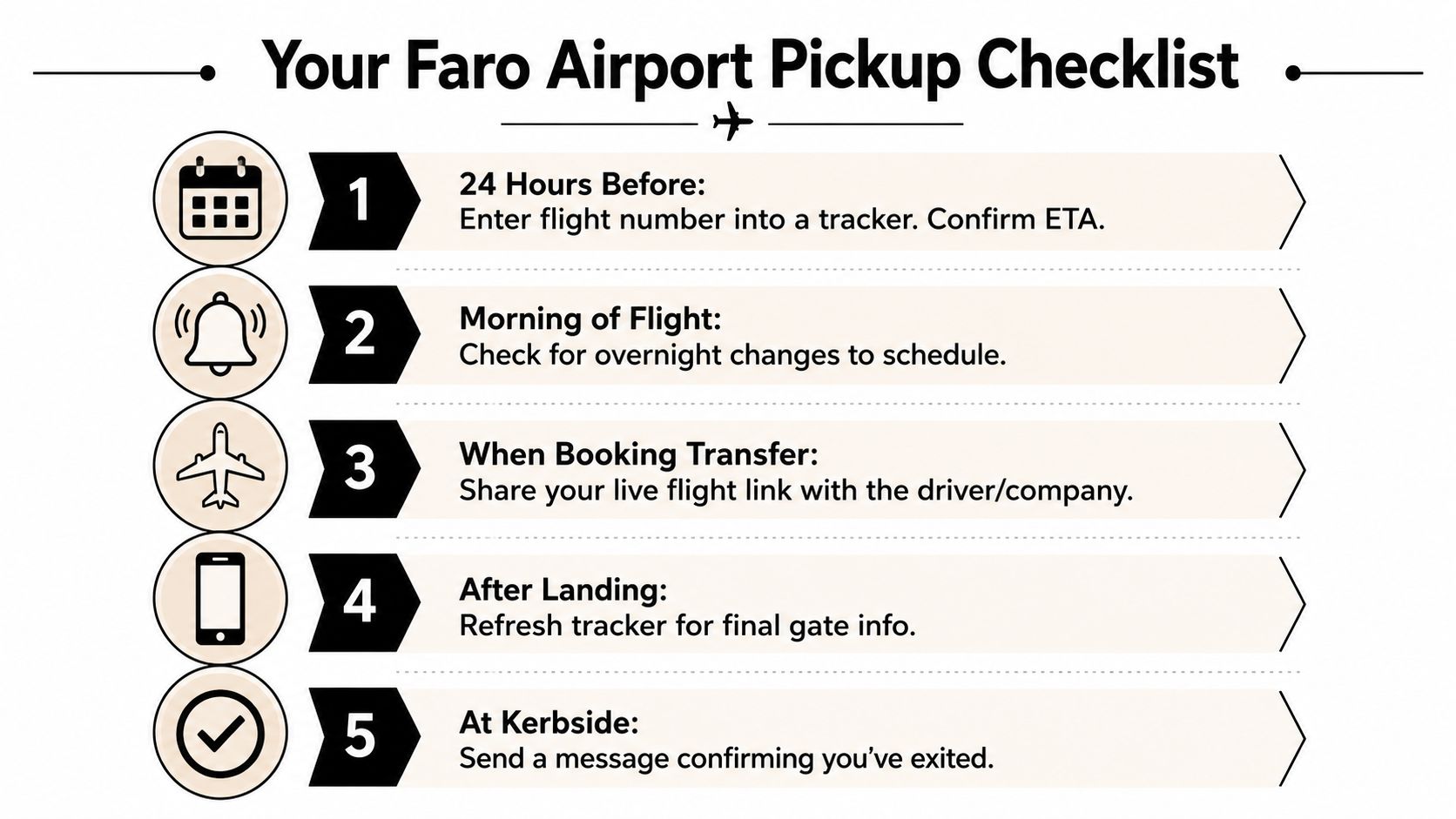
- Enter the flight number 24 hours before departure. Confirm the scheduled route, airport, and baseline estimated arrival. A flight number is more reliable than searching only by destination because multiple services may reach Faro close together.
- Check again on the morning of travel. Look for a changed departure time, aircraft swap, cancellation, or revised arrival. Save the airline's official status page as a second reference.
- Share the flight details with the transfer company. Give the full flight number, arrival date, passenger name, destination, luggage needs, and a mobile number that works in Portugal.
Monitor the journey
- Check at boarding, take-off, and one hour before landing. You're looking for meaningful changes, not constant screen refreshing. A delay before take-off may stabilise, while a later holding pattern can change the estimate again.
- Use a buffer after the estimated landing time. The verified operational guidance supports adding around 30 minutes for Schengen arrivals and around 50 minutes for non-Schengen arrivals to allow for the terminal process. The final pickup should still be coordinated with the operator.
- Escalate major changes. Contact the provider if the flight is diverted or the delay exceeds 90 minutes. Don't wait until the original pickup time has passed.
Confirm the handover
Refresh the tracker after landing, but don't tell the driver you're ready until you've collected your bags and reached the agreed meeting point. “Landed” means the aircraft is down. “Arrived at gate” means it has reached the stand. Neither status confirms that you're in the arrivals hall.
For travellers weighing a bus against a cheap Faro Airport transfer, the Faro Airport bus information is useful for checking scheduled public transport. For a private vehicle, send a short message such as “We've exited arrivals” and look for the driver's name board.
Plan Your Stress-Free Algarve Transfer Today
The reliable approach is simple. Track the inbound flight, then pair that information with a pre-booked operator that actively monitors the flight and adjusts the pickup plan. The aircraft data handles the part that a timetable can't. The driver or operations team handles the human part that the aircraft data can't see.
Faro Airport has now passed the 10 million passenger mark, with reporting linking that milestone to pressure on terminal and ground processes (Faro Airport passenger milestone). That makes advance planning particularly important for families, golfers, wedding groups, and travellers heading directly to Albufeira, Vilamoura, Lagos, Faro city, or another Algarve destination.
Choose the right transfer plan
A useful booking should answer practical questions before you pay:
- Flight monitoring: Will the operator track your inbound flight number?
- Pickup flexibility: Will the driver adjust for a revised arrival rather than follow the scheduled time?
- Meeting point: Will you receive clear instructions for the arrivals hall?
- Vehicle suitability: Is there enough room for luggage, golf bags, child seats, or group equipment?
- Pricing: Is the fare fixed and transparent, or will waiting and demand alter it?
- Driver standards: Is the vehicle licensed, insured, maintained, and driven by a trained professional?
- Availability: Can the service handle an early morning or late-night arrival?
For most visitors, private transfers Faro Airport are the cleanest solution because they remove the taxi queue and avoid the fixed departure problem of public transport. Shared shuttles can suit travellers prioritising a lower fare, while public buses remain reasonable for people with light luggage and plenty of time.
Don't confuse “cheap” with “low total cost”. A low headline fare can become expensive if a delay means a missed bus, a second booking, a long taxi wait, or a stranded group. The best airport transfers Algarve services make the price, vehicle, meeting instructions, and delay process clear before the journey begins.
Enter your flight number, arrival date, and destination when requesting a quote. For an Albufeira Faro Airport return transfer, provide both flight details so the outbound pickup can be planned around your departure rather than a guess based on hotel checkout.
Book your reliable Faro to Albufeira transfer before travel, keep the flight tracker available, and let the operations team manage the moving parts. Your job should be to walk through arrivals, find your name on the board, and start the holiday.
The Algarve Experience provides 24/7 door-to-door Faro Airport transfers, with meet-and-greet service, live flight monitoring, fixed pricing, and vehicles for solo travellers, families, golfers, and larger groups. Enter your flight details and destination through The Algarve Experience to request an instant quote and secure a monitored transfer to Albufeira or anywhere else in the Algarve.
Related posts