
Thinking about driving on holidays in Porto? It’s the classic traveller's dilemma. On one hand, a car gives you that incredible freedom to zip off to the Douro Valley on a whim. On the other, trying to navigate the city itself during peak times like Christmas or the summer months can be a real test of patience, thanks to bumper-to-bumper traffic and parking spots that seem to vanish into thin air.
Should You Drive in Porto During the Holidays?
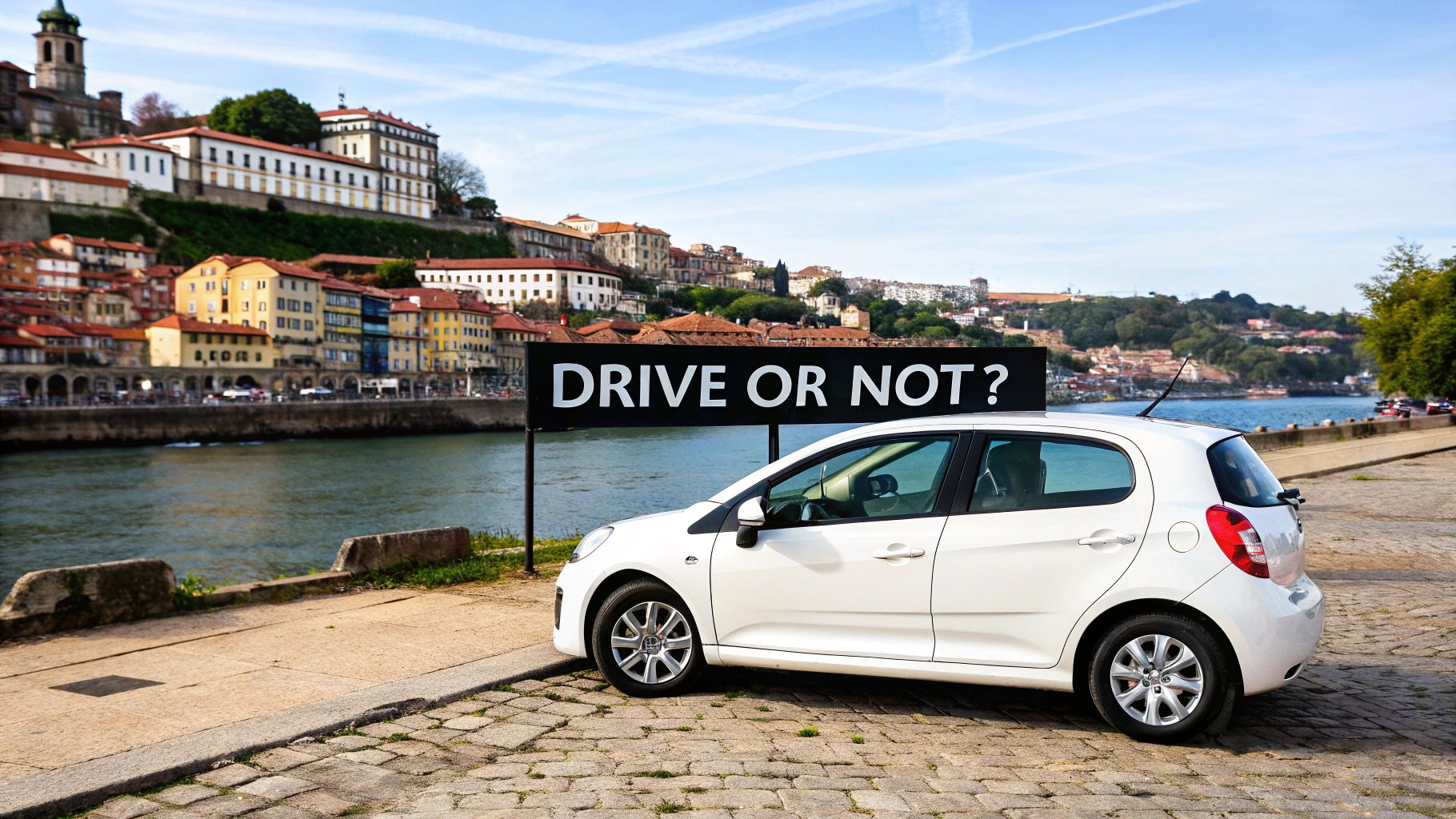
Let’s get right to it—this is the big question. The romantic idea of renting a car and exploring Porto at your own pace is incredibly tempting. But the reality of driving here during a holiday period is something you need to think through carefully. It's a showdown between the convenience of having your own wheels and the city's inherent driving challenges, which get turned up to eleven by festive crowds and a flood of tourists.
Much of Porto's undeniable charm comes from its historic heart, a maze of narrow, winding, and often steep cobblestone streets. They're an absolute dream to walk through but can feel like a nightmare for a driver who isn’t used to them, especially when they're teeming with people. During the holidays, this scene only gets more intense.
Driving in Porto During Holidays At a Glance
So, is a car a brilliant idea or a holiday headache? It really depends on what you have planned. This quick table breaks down the pros and cons to help you decide.
| Aspect | The Upside (Why You Might Drive) | The Downside (Why You Might Reconsider) |
|---|---|---|
| Flexibility & Freedom | Spontaneous day trips to Douro Valley, Guimarães, or nearby beaches. | Inside the city, the car becomes more of a burden than a blessing. |
| Holiday Traffic | You're not tied to public transport schedules for out-of-town trips. | Major roads and bridges get completely clogged, turning short drives into long waits. |
| Parking | Convenient for carrying luggage or shopping from larger out-of-town stores. | On-street parking is a myth; underground car parks are pricey and fill up fast. |
| Navigation | Modern GPS makes getting to the city straightforward. | Confusing one-way systems and restricted zones can easily trap visitors. |
| Cost | Can be cost-effective for groups or families exploring Northern Portugal. | Rental fees, fuel, expensive parking, and potential tolls add up quickly. |
Ultimately, having a car is fantastic for exploring beyond Porto's city limits, but it quickly becomes a liability for getting around the city itself.
A Deeper Look at the Challenges
The numbers don't lie. Porto is a wildly popular destination, clocking in 5.9 million overnight stays in 2023, with August, September, and October hitting peak capacity. The city is well aware of this and is actively pushing for alternatives to driving. They're promoting electric vehicles and have even developed 55 kilometres of cycle paths to encourage greener, less congested ways of getting around.
Here’s the bottom line: a car is often more of a hassle than a help within Porto. It truly shines for excursions, but it’s a pain for daily city exploration.
The best strategy? Go for a hybrid approach. Use Porto’s fantastic public transport system to navigate the city's sights and sounds. Then, only rent a car for the specific days you plan to venture further afield. This way, you get the best of both worlds—a stress-free city break and the freedom to explore the stunning surroundings.
To get a better feel for what makes the city so special, check out our guide on the best things to do in Porto. It’ll help you plan an itinerary that lets you enjoy Porto without the constant headache of traffic and parking.
Understanding Porto's Roads and Holiday Traffic
Getting behind the wheel in Porto, especially during a holiday, requires a bit of a mental reset. Don't picture a neat, modern grid. Instead, think of the city's road network as an old, organic system with layers of history baked right in. You’ve got sleek, multi-lane motorways on the outskirts clashing with ancient, narrow cobblestone streets in the centre, and they don't always play nicely together. Here's the essential briefing you need before you even think about turning the key.
Portuguese road rules are mostly what you'd expect if you've driven elsewhere in Europe, but there are a few local quirks to keep in mind. Speed limits are a big one. On the autoestradas (motorways), you can cruise at 120 km/h (about 75 mph). Once you move onto national roads, that drops to 90 km/h (56 mph), and as soon as you hit the city limits, it’s a firm 50 km/h (31 mph)—often even slower in historic or residential zones.
Roundabouts, or rotundas as they’re known locally, are absolutely everywhere. The golden rule is simple: traffic already in the circle has the right of way. If you’re entering, you must yield. It sounds straightforward, but during peak times, they can feel like organised chaos. The local driving style is assertive but not aggressive; hesitating is often more likely to cause a problem than making a clear, decisive move.
The Holiday Traffic Reality
Now, let's get real about holiday traffic. It transforms Porto's roads into a completely different animal. Think of the city’s main arteries, especially the VCI (Via de Cintura Interna), Porto's inner ring road, like rivers. On a normal day, traffic flows. During a holiday rush—say, the days before Christmas or a sunny August weekend—that river swells up and slows to a frustrating crawl.
This congestion isn't random; it's predictable. The same bottleneck spots jam up time and time again:
- Ponte da Arrábida and Ponte do Freixo: These two massive bridges carry a huge volume of traffic across the Douro River. When holiday travellers mix with daily commuters, you get major slowdowns, particularly in the morning and late afternoon.
- Access to the A1 and A3 Motorways: The junctions connecting the city to the country's main motorways become chokepoints as everyone tries to leave or return at the same time.
- Ribeira and City Centre: The historic riverside area is a magnet for visitors. Its tiny, one-way streets simply weren't built for modern traffic, and during holidays, they’re often gridlocked with drivers hunting for parking spots that just aren't there.
Here’s a pro tip: treat the city centre as a strict no-go zone for your car during peak holiday hours. Seriously. Park on the outskirts and hop on the Metro. The time and sanity you’ll save are worth far more than the convenience of having your car nearby.
Navigating Holiday Road Closures
Another thing you absolutely have to factor in when driving in Porto during holidays is the constant threat of temporary road closures. Porto loves its festivals, street markets, and public celebrations. Major events like the Festa de São João in June or the Christmas markets in December will shut down entire streets and squares, turning them into pedestrian-only zones.
These closures are usually posted on the city council's website, but they can be a nightmare for a visitor to track. A good GPS app with real-time traffic updates isn't just a nice-to-have; it's non-negotiable. It'll be your best friend for rerouting around unexpected blockades and saving you from the frustration of hitting a sudden dead end. The best advice? If you must drive, do it early in the morning—ideally before 9 a.m.—before the city truly wakes up and the holiday crowds take over. A little planning goes a long way in turning potential chaos into a smooth ride.
How to Navigate the Portuguese Toll System
Driving in Porto during the holidays inevitably means you'll run into tolls. For first-time visitors, the Portuguese system can feel a bit baffling on day one, but it’s simple once you know how it works.
Think of it like a subscription service for the motorway. You either pay as you go at old-school booths or get charged automatically as you drive under electronic gantries. Around Porto, you'll find a mix of both, so it pays to be prepared.
Toll Collection Methods
On some motorways, you'll still find traditional toll booths where you stop and pay with cash or a card. Easy enough. But more and more, you’ll see electronic gantries—large metal structures over the road that scan your number plate as you drive underneath at full speed.
These gantries automatically register your vehicle. If you’ve set up a payment method beforehand, the charge is logged to your account. If not, you'll need to sort it out later, which can be a hassle.
- Traditional Toll Booths: The classic stop-and-pay method. You'll need cash or a card ready.
- Electronic Gantries: These scan your plate automatically. No stopping required, but you need a payment system linked to your car.
- Mixed Network: Many routes use a combination of both, so you can’t rely on just one payment type.
Options for Tourist Drivers
If you're visiting, you have three main ways to handle the electronic gantries. Each one suits different trip lengths and budgets, so pick what's best for you.
First, there's the Via Verde transponder. This is a little device you stick on your windscreen, and it's like having an E-ZPass or a monthly subscription for all Portuguese tolls. It works everywhere and is perfect for longer stays or if you plan on driving a lot.
Second, you can grab pre-paid toll cards. You top them up with credit at post offices or service stations, and they function like an electronic wallet for the motorways.
Third is the Easy Toll system, designed specifically for tourists. You link your number plate directly to your credit card at a designated kiosk, often right after you cross the border into Portugal. It’s quick, simple, and great for short trips.
- Get a Via Verde transponder for a €6 monthly subscription, which is ideal for frequent drivers.
- Buy a pre-paid toll card and top it up as you go at post offices.
- Use the Easy Toll system at a border point to link your plate and credit card instantly.
Managing Tolls in a Rental Car
Rental agencies love to offer convenience, and that includes handling your tolls. Most will offer a toll transponder or a service where they cover the tolls for you. But be warned: that convenience often comes with hefty admin fees.
Always ask for the exact rate per day or per trip. It's not uncommon for agencies to charge €0.50 plus VAT on top of each toll transaction, which can add up ridiculously fast on a long drive.
Always confirm the rental agency's toll charges in writing to avoid surprise fees when you return the car.
Before you sign anything, comb through the rental agreement for any mention of toll transponders, service charges, or other hidden fees.
- Inspect your rental contract for toll disclaimers and hidden costs.
- Ask for an itemised list of toll charges before you hand back the keys.
- If possible, pay tolls yourself online to sidestep the extra admin charges from the rental company.
Keep your own records. A quick screenshot of an online payment confirmation can be your best defence against a surprise bill weeks later.
Visualising Your Decision
Sometimes, driving isn't the best answer. This decision tree can help you figure out whether to brave the holiday traffic or just relax and let someone else handle the transport.
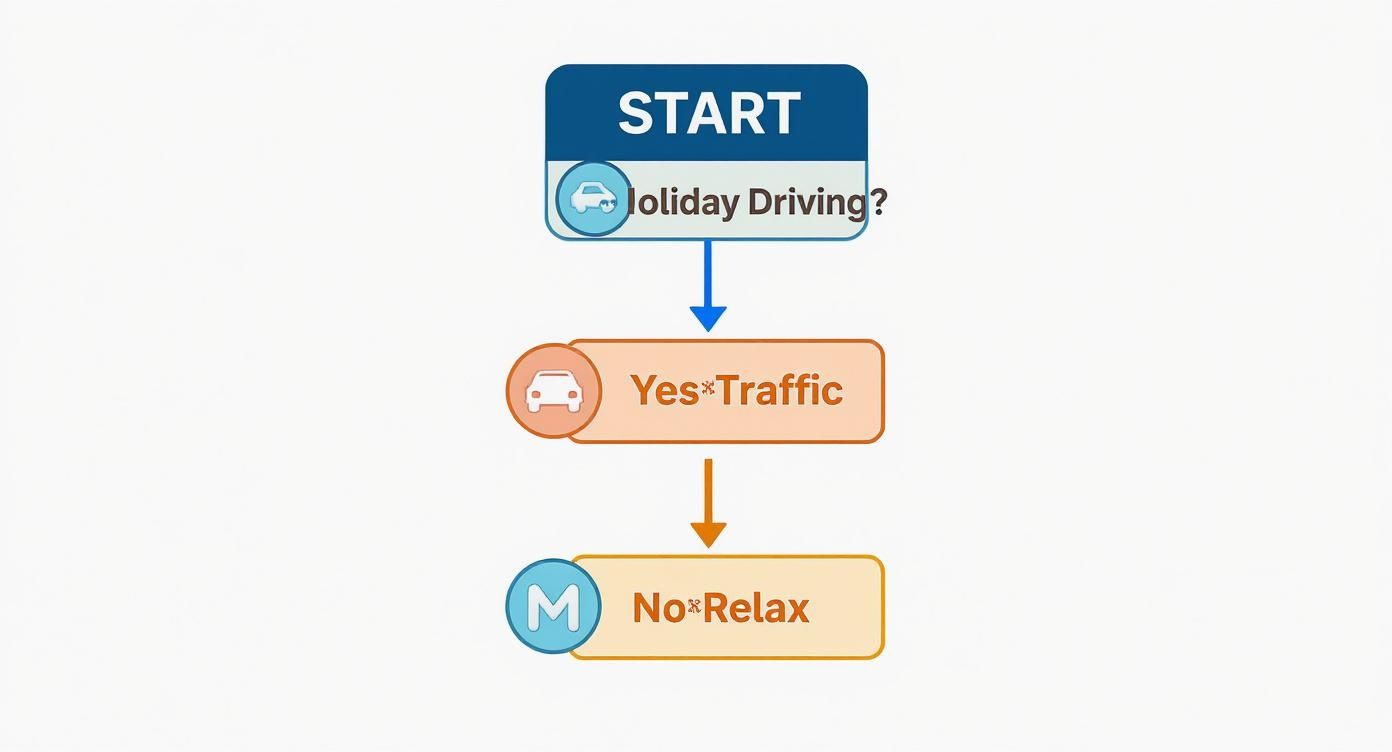
As the chart shows, a whopping 65% of holiday drivers hit significant congestion. If you're heading into the city centre, parking on the outskirts and taking public transport is often a much smarter move.
Mastering the toll system puts you back in control of your budget and schedule. No more guessing games or surprise costs.
A little planning goes a long way. Before setting off for a day trip to Braga or the Douro Valley, map out your route and check the estimated toll costs online. Knowing what to expect means no financial shocks later.
Keep a record of your payments, whether it's a receipt from a booth or a confirmation from an app. This will be invaluable if any disputes arise when you return your rental car.
Ultimately, choosing the right toll option from the start matches your travel style and saves you money. With this sorted, you can cruise Portugal’s motorways like a local, leaving the stress behind.
Now you can focus on what really matters: enjoying the stunning coastal drives, exploring historic towns, and making unforgettable holiday memories.
A Practical Guide to Parking in Porto
Trying to find a parking spot in Porto during the holidays isn’t just a challenge; it’s basically a competitive sport. The city’s charmingly narrow streets, which are already a tight squeeze on a normal day, become almost gridlocked when you're hunting for a place to leave your car. Think of street parking as a game of chance—and during peak season, the odds are definitely not in your favour.
This gets even more intense when you look at how locals travel. Christmas in Portugal has become a time for short getaways, with a huge 65% of Portuguese travellers planning trips in December. The car is the undisputed champion of this holiday migration, especially on the weekends between Christmas and New Year. This creates massive, predictable surges on the roads, making parking in cities like Porto a real headache. You can get the full scoop on these holiday travel trends in Portugal.
That's why your parking plan can't be based on luck. It needs to be a deliberate, smart decision to save you time and frustration so you can get on with enjoying your holiday.
Decoding Street Parking Zones
If you do decide to roll the dice and look for a spot on the street, you need to understand the city's colour-coded system. Porto divides its on-street parking into zones, each with different time limits and costs. You can usually pay at the nearby meters or, much more easily, through mobile apps like Telpark or Via Verde Estacionar.
- Zone I (Red): This is the heart of the city and the most expensive zone. Parking here is limited to a maximum of 2 hours, designed for quick stops, not for leaving your car all day while you explore.
- Zone II (Yellow): A little further out from the absolute centre. You can typically park for up to 4 hours, giving you a bit more breathing room.
- Zone III (Green): Found in less central neighbourhoods. These offer longer stays, sometimes up to 6 hours, and are much easier on the wallet.
- Zone IV (Blue): These are the most peripheral zones, often offering the longest parking durations—sometimes up to 10 hours—at the lowest cost.
But here’s the reality check: during the holidays, even the outer zones fill up in a flash. Circling block after block, burning both fuel and patience, is an all-too-common visitor experience.
The Smarter Choice: Underground Car Parks
The real secret to stress-free parking when you drive on holidays in Porto is to ditch the street search before you even begin. Your best move is to head straight for one of the city's many secure underground car parks, known locally as parques de estacionamento.
Sure, they're more expensive per hour than street parking, but they offer security, shelter from the weather, and most importantly, actual availability. They are strategically located near major attractions, transport hubs, and shopping areas. Expect to pay anywhere from €1.50 to €2.50 per hour, with daily maximums usually landing between €15 and €25.
The best strategy for holiday parking is to treat your car like luggage. Find a secure garage, drop it off, and then explore the city on foot or by public transport. The cost of the garage is a small price to pay for a stress-free day.
Park And Ride: A Budget-Friendly Strategy
For the most strategic and wallet-friendly approach, look no further than the city's Park & Ride facilities. These car parks are located near Metro stations on the outskirts of Porto, like at Estádio do Dragão or Casa da Música.
The concept is simple and brilliant. You park your car for a very low daily rate (often around €5–€7), then hop on the efficient Metro system to travel into the city centre. This move lets you completely sidestep the traffic, the impossibly narrow streets, and the parking chaos of Porto’s historic heart. It's the perfect hybrid solution, giving you the freedom of a car for day trips without the nightmare of using it for city exploration.
To help you decide, here’s a quick rundown of your options.
Comparing Your Porto Parking Options
Finding the right parking spot can make or break your day in Porto. This table breaks down the main choices to help you pick the best fit for your holiday plans.
| Parking Type | Average Cost (Per Hour/Day) | Best For | Holiday Availability |
|---|---|---|---|
| Street Parking | €0.80 – €2.00 per hour | Quick stops (under 2 hours) in less busy areas | Extremely low |
| Underground Garage | €1.50 – €2.50 per hour / €15 – €25 per day | All-day parking, security, and guaranteed spots | Generally good, but can fill up |
| Park & Ride | €5 – €7 per day (plus Metro ticket) | Full-day city exploration without driving stress | Excellent |
Ultimately, choosing an underground garage or a Park & Ride facility from the start will save you a world of frustration, letting you spend less time searching and more time enjoying everything Porto has to offer.
Tips for Renting a Car for Your Porto Holiday
If you’re thinking about renting a car for your Porto holiday, a little bit of planning goes a long way. My number one piece of advice? Book your rental well in advance. Holiday periods are no joke—demand skyrockets, and prices climb right alongside it.
Most travellers flying into Porto want to grab their car keys the moment they land. It makes sense, but you’re not the only one with that idea. Portuguese airports welcomed 4.2 million passengers in January alone, a 5.9% increase from the previous year, with Porto handling a massive 22.4% of that traffic. As reported by Portugal.com, that surge is exactly why you need to secure your vehicle early to avoid disappointment.
Think about where you’ll pick it up, too. An airport collection is convenient, but a city centre location might fit your schedule better and save you a few quid.
Choose the Right Car Size
This might sound obvious, but it’s crucial in Porto. A compact car is almost always the best choice for navigating the city’s narrow, historic streets. Trust me, you’ll thank yourself when you’re squeezing through an alleyway that feels like it was designed for a horse and cart.
Of course, if you’re planning long drives into the countryside with the family, a larger vehicle offers more comfort. Here's a quick breakdown:
- Compact Cars: The perfect mix of fuel economy and manoeuvrability for those tight city lanes.
- Mid-Size Sedans: A bit more legroom and luggage space, ideal for couples or small families.
- SUVs and Vans: The best bet if you’re heading to rural spots or need to haul sports gear.
Don’t forget to check the boot capacity, especially if you plan on doing a big shop or have bulky luggage. And if you're looking for a convenient place to stay right after you land, check out our guide to OPO Airport Hotels at The Algarve Experience.
Understand Insurance Options
Navigating rental car insurance can feel a bit daunting, but it’s straightforward once you know the basics. Rental companies will typically offer Collision Damage Waiver (CDW), theft protection, and other liability coverage.
Always read the fine print to see what’s actually covered and what fees apply. A common question is whether the excess (deductible) can be reduced—it’s always worth asking.
Before you sign anything, confirm all the insurance details and the excess amount. This is your best defence against unexpected costs later on.
Here’s what you need to remember:
- CDW limits your financial risk in an accident but often excludes things like windscreens, tyres, or the undercarriage.
- Third-party liability is usually required by law in Portugal.
- Check if your credit card already provides rental car insurance. It could save you a fair bit of money.
Handle Toll Transponders Wisely
Portugal’s motorways use an electronic toll system, and the fees can add up quickly, especially on popular holiday routes to places like Braga or the stunning Douro Valley. When you rent a car, make sure a toll transponder is included.
| Option | Cost Structure | Best For |
|---|---|---|
| Via Verde Transponder | Around €6 monthly + toll charges | Frequent motorway drivers |
| Pre-paid Toll Card | Top-up as you go | Mid-length trips |
| Easy Toll at Border Kiosk | Links plate to a credit card | Short stays or one-way travel |
The easiest option for a rental is to get the Via Verde transponder from the rental company. Just be sure to compare their daily fee against the cost of other options to make sure you’re not overpaying.
Inspect the Vehicle Thoroughly
Before you even think about driving off, do a full walk-around of the car with the rental agent. Point out every single scratch, dent, and mark you see, both inside and out.
My pro tip? Take timestamped photos or a quick video documenting the car’s condition. This is your evidence if any disputes arise later. Also, make sure the fuel level matches what’s on your agreement and clarify the refuelling policy (full-to-full is usually the best).
A final checklist before you leave:
- Confirm the exact return location and parking procedure.
- Ask about return hours and what to do if you need an off-hours drop-off.
- Keep your contract and photos safe until the final bill is settled.
Prepare Necessary Documents
Get all your paperwork in order before you head to the rental desk. It makes the whole process so much smoother.
You’ll need:
- Your driving licence, passport, and booking confirmation.
- A credit card with a sufficient limit for the security deposit.
- To double-check that any extras like child seats or a GPS are noted on your agreement.
One last thing—before you drive off, find the spare tyre, jack, and warning triangle in the boot. You’ll be glad you know where they are if you ever need them.
Follow these tips, and renting a car for your Porto holiday will be a breeze. You’ll be all set to explore Porto’s beautiful roads and make some fantastic holiday memories. Enjoy the drive
Smart Alternatives to Driving in Porto
After staring down the barrel of holiday traffic and the Hunger Games of parking, you might realise that deciding to drive on holidays in Porto isn't always the brilliant move you thought it was. But here's the good news: ditching the car keys doesn't mean you're stranded. In fact, it often opens the door to a far more relaxed and genuine way to experience the city.
Think of Porto’s public transport less as a backup plan and more as your secret weapon. It’s your personal chauffeur, ready to whisk you away from traffic jams and parking nightmares so you can actually focus on the sights and sounds of your holiday.
Embrace the Metro and Bus Network
The absolute star of Porto’s public transport show is the Metro do Porto. This clean, efficient, and surprisingly widespread light rail system will quickly become your best friend. It connects Francisco Sá Carneiro Airport directly to the city centre in about 30 minutes, saving you from an eye-watering taxi fare or a stressful first drive on unfamiliar roads.
Once you’re in the city, the Metro’s six lines crisscross all the key areas, zipping you from the busy shopping streets around Trindade to the postcard-perfect riverside views at Jardim do Morro in Gaia. It’s the perfect way to glide past the gridlock happening on the streets above.
Working hand-in-hand with the Metro is the comprehensive bus network run by STCP. While the Metro is a champ at covering longer distances fast, the buses are fantastic for pinpointing specific neighbourhoods and attractions that aren't right on a Metro line. Plus, they give you a ground-level view of the city, turning a simple trip into a mini sightseeing tour.
A Journey Back in Time on Historic Trams
For a ride that’s pure Porto charm, you absolutely have to hop on one of the historic trams. They aren't as widespread as the modern bus network, but these beautiful old streetcars run on three routes that are practically made for tourists:
- Line 1: A gorgeous journey hugging the Douro River from Infante all the way to Passeio Alegre in Foz.
- Line 18: Connects the historic Massarelos and Carmo areas.
- Line 22: A circular route that loops through the downtown Baixa district, hitting many of the major sights.
These trams are less about getting somewhere fast and more about the experience itself—a wonderfully nostalgic way to see the city at a leisurely pace.
The Ultimate Day Trip Upgrade: A Private Driver
So what about those non-negotiable day trips to the Douro Valley or Braga? This is where most people think a car is essential, but there’s a much more luxurious and completely stress-free alternative: hiring a private driver.
Imagine a day in the Douro Valley. Instead of one person drawing the short straw as the designated driver—stuck navigating winding roads and sadly skipping the wine tastings—everyone gets to kick back and relax. A private driver turns the journey from a logistical headache into a seamless, high-end experience where your only job is to soak in the scenery and savour every last drop of wine.
Hiring a driver is about so much more than just avoiding navigation. You get a local expert, door-to-door service, and the total freedom to immerse yourself in the day. For groups, the cost is often surprisingly close to what you'd spend on a car rental, fuel, tolls, and parking—but with a hundred times less stress.
Choosing these alternatives means you'll spend less time fuming behind the wheel and more time making unforgettable holiday memories.
Your Top Questions About Driving in Porto, Answered
Got a few last-minute questions before you hit the road in Porto? You're not alone. Here are the quick, clear answers to the things most travellers wonder about. Think of this as your final check-in to make sure you’re ready to drive with confidence.
Most visitors from the EU, UK, US, Canada, and Australia can drive in Portugal for up to 185 days using their valid national driving licence. Simple enough, right? But rules can shift, so it’s always a smart move to double-check the latest requirements with your home country’s authorities before you pack your bags.
While an International Driving Permit (IDP) isn't usually mandatory for those countries, it's a recognised document that provides a translation of your licence. It can be a handy backup to have, just in case.
What Is the Drink-Driving Limit in Portugal?
This one is serious: Portugal has incredibly strict laws on drink-driving. The legal blood alcohol content (BAC) limit is just 0.5 grams per litre. That’s lower than in places like the UK or parts of the US, so don't get caught out.
The rules get even tighter for new drivers (with a licence for less than three years) and all professional drivers. For them, the limit drops to a tiny 0.2 g/l.
Honestly, the only rule you need to remember is the simplest one: if you're driving, don't drink any alcohol. Period. The penalties are harsh, and it's just not worth risking your safety or your holiday.
Are Child Safety Seats Mandatory in Portugal?
Yes, absolutely. Child safety seats are a non-negotiable legal requirement, and the rules are enforced for a very good reason—to keep young passengers safe.
Here's what you need to know: children under 12 years old and shorter than 135cm (that's about 4'5") must be secured in a government-approved child restraint system that’s right for their size.
They also aren't allowed in the front passenger seat. The only exception is for infants in a rear-facing baby seat, and only if you've made absolutely sure the front passenger airbag is switched off. When you book your rental car, always make it a point to request the correct child seat.
If navigating Porto's holiday traffic, rules, and parking sounds like more stress than you want, why not let someone else handle it? The Algarve Experience offers reliable, door-to-door transfers that let you skip the driving drama entirely. Book your seamless airport transfer with The Algarve Experience and start your holiday the moment you land.
Related posts