
If you're searching for the best way to do lisbon to fatima, you probably want a straight answer, not a vague list of options. Most travellers are either planning a meaningful day trip from Lisbon, fitting Fátima into a wider Portugal route, or trying to connect a central Portugal visit with time in the Algarve after flying through Faro.
That bigger itinerary matters more than many guides admit. A Lisbon to Fátima journey is simple enough on paper, but the right choice changes depending on whether you're travelling solo, with parents, with children, or as part of a holiday that also includes beach time in Albufeira, golf, or a Faro airport to Albufeira transfer already booked for the southern leg of your trip.
Your Complete 2026 Guide to Travelling from Lisbon to Fátima
You land in Portugal with a week to work with. Lisbon is on the list, Fátima matters to someone in the family, and the Algarve is where you plan to slow down. That is how this route often plays out, and it changes how I recommend doing it.
Fátima is one of the country’s key pilgrimage destinations, but for many visitors it also sits inside a wider holiday plan. Some go up from Lisbon for the day. Others fit it between central Portugal stops before heading south. Travellers arriving in Faro often build the trip in reverse, starting with beach time, golf, or family days in Albufeira, then adding Lisbon and Fátima later once they are settled.
The route itself has meaning beyond transport logistics. Pilgrims still follow the Caminho do Fátima from Lisbon, and the sanctuary’s importance comes from the 1917 apparitions associated with Lúcia dos Santos, Francisco Marto, and Jacinta Marto, including the event widely known as the Miracle of the Sun. For practical travel planning, what matters is that Fátima draws visitors with very different needs. A solo traveller on a simple day trip needs one answer. A family connecting cities with luggage and limited patience needs another.
There are four workable ways to do Lisbon to Fátima:
- Bus if you want the easiest public transport option
- Train plus a final connection if rail already fits the rest of your itinerary
- Self-drive if you want freedom to add places such as Batalha, Nazaré, or Óbidos
- Private transfer if door-to-door comfort, timing control, and less hassle matter more than price
Each option can be right. The best choice depends on the shape of the whole trip, not only this leg.
That broader view matters even more for Algarve holidays. I often see travellers pair a Fátima visit with time in the south, either before or after Lisbon, and that is where coordinated transport helps. If you are already organising airport and intercity moves, reliable Lisbon airport transfers for a wider Portugal itinerary can make the Lisbon to Fátima leg feel far easier to slot into the trip, especially if you are also arriving through Faro Airport and using the Algarve as your base.
Lisbon to Fátima Transport Options at a Glance
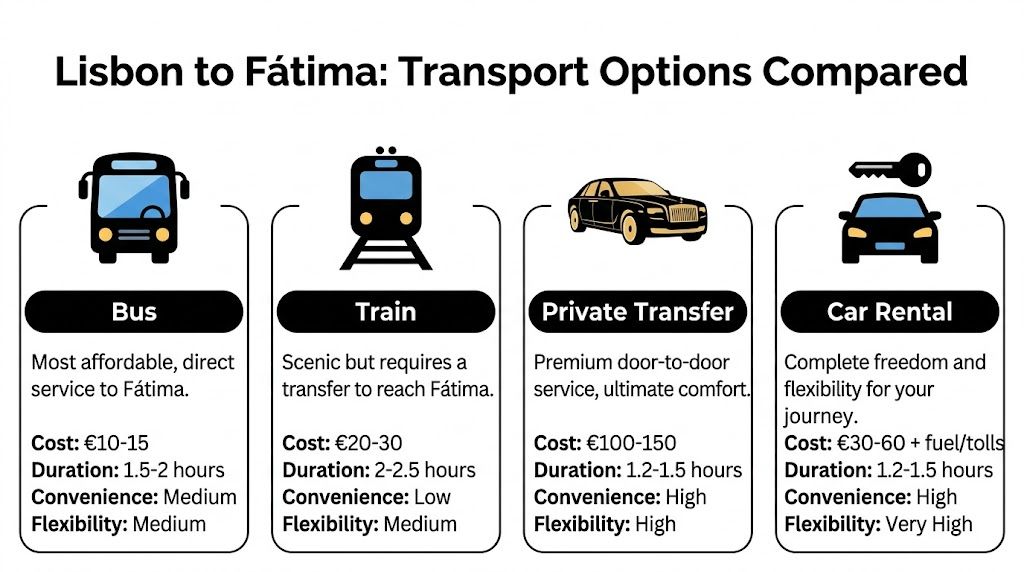
Some travellers overcomplicate this route. In reality, the choice usually comes down to budget, flexibility, and how much friction you're willing to tolerate on the day.
Quick comparison
| Option | Best for | Main strength | Main drawback |
|---|---|---|---|
| Bus | Solo travellers, budget-conscious visitors | Direct and straightforward | Timings can feel rigid on a day trip |
| Train | Travellers already using rail in Portugal | Works for certain wider itineraries | Less direct for Fátima itself |
| Drive | Couples, families, multi-stop itineraries | Freedom to add places like Batalha or Nazaré | Tolls, parking, and motorway focus |
| Private transfer | Families, older travellers, groups, tight schedules | Door-to-door convenience | Higher upfront cost |
What usually works best
For a standard day trip from Lisbon, the bus is usually the easiest public option. It is direct, simple to understand, and avoids the complication of rail connections that still leave you arranging the last part separately.
Driving makes more sense when Fátima is only one part of the day. If you're the sort of traveller who doesn't want to leave central Portugal without seeing Batalha, Alcobaça, Nazaré, or Óbidos, a car gives you control that public transport doesn't.
Private transfer sits in a different category. It isn't just about comfort. It's often the cleanest solution when you're travelling with luggage, older relatives, children, or a carefully timed holiday where one late connection can disrupt hotel check-in, dinner bookings, or the next regional transfer.
Who should choose what
- Choose the bus if you want the simplest low-cost route and don't mind working around scheduled departures.
- Choose the train only if rail fits your wider travel style and you accept the extra steps.
- Choose a car if your priority is independence.
- Choose a private transfer if reliability matters more than shaving the fare down.
For travellers building a broader Portugal plan, it also helps to think beyond Lisbon. If you're comparing airport logistics as part of a multi-city route, a dedicated Lisbon airport transfer service can make the handover between city stays, hotel check-ins, and longer onward journeys much smoother.
The cheapest option on paper isn't always the easiest option once luggage, walking, terminal changes, and return timing enter the picture.
A local planning note
For Algarve visitors, this route often appears in two forms. Either it's a Lisbon to Fátima day trip during a city stay, or it's folded into a larger Portugal holiday after private transfers Faro airport, a Faro airport to Albufeira transfer, and a few days on the coast.
That second group tends to value simplicity more than headline fare. After you've already managed flights, hotel arrivals, and possibly an Albufeira to Faro airport return for the end of the trip, reducing one more layer of travel friction becomes very appealing.
Taking the Bus The Most Common Way to Travel

If you want the most practical public transport answer for lisbon to fatima, take the bus.
The Rede Expressos service from Sete Rios is the most direct link. It takes approximately 1.5 hours, costs around €11.90 for a standard ticket, runs at over 6 departures per hour during peak times, and has 95% reported WiFi uptime, though punctuality can vary by up to 15% during high season (My Portugal Holiday's guide to Lisbon-Fátima bus, train and drive options).
How to do it smoothly
Book ahead if you're travelling on important religious dates
May and October can be much busier, especially around the 13th.Go to Sete Rios, not the wrong terminal
That sounds obvious, but terminal mistakes are common when visitors rely on rushed directions.Arrive with a little margin
Bus travel works best when you remove stress before departure, not after.Keep your day bag easy to access
Water, a light layer, phone charger, and anything you'll want at arrival should stay with you.
What the journey is like
The bus is straightforward rather than glamorous. That's fine. Its value lies in the convenience of boarding in Lisbon and arriving in Fátima without fiddly changes.
On board, expect a standard intercity coach experience. You may get a smooth run, or you may get minor delays depending on traffic and the season. That's one reason I usually tell travellers not to over-schedule the return leg if the day matters to them spiritually or personally.
Best use case for the bus
The bus is ideal if you are:
- Travelling solo
- Watching your budget
- Comfortable with fixed departure times
- Staying in Lisbon and returning the same day
It is less ideal if you're carrying a lot of luggage, travelling with elderly family members, or trying to fold Fátima into a more complex route with multiple stops afterwards.
Take the bus when you want a direct public option. Don't take it if your day only works when every connection goes perfectly.
For many travellers, that's the dividing line.
Driving to Fátima A Flexible Independent Option
A car works best when Fátima is one part of a bigger Portugal trip, not a simple return from Lisbon. That is often the case for visitors who land in Faro, spend time in the Algarve, then head north through Lisbon and central Portugal. In that kind of itinerary, driving gives you control that public transport cannot.
The route itself is straightforward. From Lisbon, most drivers take the A1 toll motorway and leave near Fátima. The drive is usually quick by Portuguese standards, but the easy route can give visitors false confidence. Northbound traffic leaving Lisbon can build fast on weekday mornings, and the final stretch can feel different in cooler months when visibility drops.
When driving makes sense
Driving suits travellers who want to shape the day around more than the Sanctuary alone. You can arrive early, stay for Mass or quiet time without watching the clock, then continue to another stop that fits well with the wider holiday.
That matters if Fátima sits between Lisbon and the Algarve, or if you are linking it with places such as Batalha, Nazaré, Óbidos, or Tomar. I often recommend a car for couples and families doing exactly that, because it turns Fátima from a fixed excursion into a sensible stop within a longer route.
Practical considerations
The trade-offs are simple.
Tolls need planning
Portugal's motorways are efficient, but they are not free. Visitors used to all-inclusive road pricing sometimes forget to factor this in.Timing affects the feel of the trip
Leaving Lisbon at the wrong hour can turn an easy run into a tiring start to the day, especially if the driver is not used to city exits and toll lanes.Arrival is the part people underestimate
On important religious dates, getting into Fátima, parking, and walking in can take much longer than the motorway drive itself.The return may be harder than the outbound leg
After a long visit, the drive back asks more of the driver than many expect, particularly with children or older relatives in the car.
For that reason, self-driving is strongest when independence matters more than simplicity.
Best for travellers building a wider itinerary
Driving is a good fit if you want to connect Lisbon, Fátima, and the Algarve on your own schedule. It also makes sense if you prefer to keep luggage with you, avoid terminal changes, and have the option to detour if the weather or your plans shift.
It is less attractive if you want a fully relaxed day with no tolls, parking decisions, or responsibility behind the wheel. In those cases, a chauffeur-driven option is often the better call, especially for travellers folding Fátima into a broader southbound holiday after Faro Airport. If that sounds closer to your trip, it helps to look at private transfers in Portugal for Algarve and long-distance routes.
One local note. Driving to Fátima is easy on an ordinary day. On major pilgrimage dates, the road is still manageable, but the day runs on crowd conditions, not on map timing.
Private Transfers The Ultimate in Comfort and Convenience

Private transfer is the option people book after they've had enough of stitching a journey together themselves.
That usually happens for one of three reasons. They are travelling with family, they are moving between several bases in one holiday, or they prefer not to have a meaningful visit to Fátima reduced to terminals, queues, luggage handling, and uncertainty about how the return will unfold.
Why it often makes practical sense
Public transport can look cheap at first glance. The problem is that the visible fare isn't always the full travel cost.
Hidden expenses often appear in the form of station taxis, luggage add-ons, and dynamic pricing on peak dates. Public return timing can also be unreliable, which creates risk for travellers on a tight schedule. A pre-booked private transfer avoids those surprises with a fixed, all-inclusive price and door-to-door punctuality (Tickets Lisbon's directions page on hidden costs and private transfers).
Who benefits most
Private transfer is especially useful for:
- Families with children who don't want to wrestle bags through terminals
- Older travellers who value minimal walking and simple access
- Pilgrimage groups that want the day handled properly
- Couples on a wider Portugal route with hotel-to-hotel movement
- Visitors arriving via the south first and trying to link Algarve and central Portugal without transport fatigue
This is also where many Faro-based holidays become more interesting. Travellers who start with Algarve airport transfers, need a reliable Algarve airport shuttle 2026, or want to know how to get from Faro airport to Albufeira without taxi queue often discover that the same preference carries through the whole trip. Once you've chosen organised transport for the airport leg, you're less likely to want a messy DIY day for Fátima.
What good private transport should include
Not all transfer services are equal. For a longer route like this, the basics matter.
- Meet and greet for airport or hotel collection
- Flight monitoring if the transfer connects to an arrival day
- Modern vehicle options for solo travellers, families, and groups
- English-speaking drivers who know the route and local timing issues
- Clear luggage handling
- Fixed pricing before travel
If you're looking at a broader route beyond a simple day trip, dedicated transfers across Portugal are often more useful than trying to force a public transport solution onto a holiday that really isn't built for it.
Good transfer planning isn't about luxury for its own sake. It's about removing the weak points that usually disrupt a travel day.
How this fits an Algarve holiday
Hence, local experience from the south becomes relevant. A lot of Portugal itineraries don't begin in Lisbon at all. They begin with Faro airport transfers for families/groups, a hotel arrival in Albufeira or Vilamoura, and a few beach days before the trip expands north.
For that kind of holiday, private transport isn't only a Lisbon question. It becomes part of a chain:
- private transfer from Faro airport to Albufeira price
- best airport transfers Algarve
- cheap Faro airport transfers
- Albufeira Faro airport return transfer
- then a bespoke central Portugal day or overnight route later in the stay
Once you look at the whole trip, consistency matters. Reliable transport at the start often leads to better decisions later.
What doesn't work as well
Private transfer is not the right fit for every traveller.
If you're solo, lightly packed, and want the cheapest practical way from Lisbon to Fátima and back, the bus will often be enough. But when travellers compare options realistically, private service usually wins on ease, especially once luggage, older relatives, hotel pickups, or onward stops enter the picture.
Planning Your Perfect Fátima Visit and Algarve Holiday
You have a week in the Algarve, a late decision to see Fátima, and a flight home that still leaves room for one meaningful stop. That is where planning matters. Fátima works best when it is placed properly inside the wider Portugal route, not treated as a rushed add-on between hotel check-out and the next transfer.
The first decision is simple. Decide whether Fátima is the main purpose of the day or one stop within a broader itinerary. If it is the main purpose, give it time on the ground. The Sanctuary is large, the atmosphere is quiet but powerful, and a hurried visit usually feels flat, even for travellers who are not visiting for religious reasons.
A few habits make the day easier:
Dress with some care
Light, comfortable clothing is fine, but beachwear from a morning in Albufeira looks out of place here.Carry less
A small day bag is easier than managing suitcases or full holiday shopping bags around the site.Allow proper walking time
Distances inside the Sanctuary area are greater than many visitors expect.Choose the date with intention
Major pilgrimage dates bring a stronger atmosphere, but they also mean heavier traffic, more waiting, and less flexibility.
The busiest periods are usually the anniversary dates linked to the 1917 apparitions, especially May and October. Those days can be memorable, but they are harder to handle logistically. Roads are busier, parking takes longer, and fixed schedules matter more. For families, older travellers, or anyone combining Fátima with hotel moves, quieter dates are often the better choice.
I usually give the same advice to Algarve holidaymakers. If your trip already includes Faro Airport arrival, a resort stay, and a few days built around the coast, put Fátima on a day when you are not also trying to change hotels. The route becomes much easier that way.
This is also where the wider Portugal itinerary matters more than many guides admit.
A common pattern is arriving in Faro, settling into Vilamoura, Albufeira, or Lagos, and only then deciding to include Lisbon or central Portugal. In that case, Fátima fits best as part of a northbound day or overnight plan, not as an isolated transport puzzle. Travellers who are also comparing city excursions can use these day trips from Lisbon in Portugal to build a route that connects more cleanly with the rest of the holiday.
A practical version looks like this:
- Arrive at Faro Airport and transfer to your Algarve base
- Spend several days on the coast
- Travel north with Fátima built into the route, either as a day trip or overnight stop
- Continue to Lisbon, or return south depending on your flight plan
- Finish the holiday without last-minute transport gaps
That structure suits premium door-to-door planning particularly well. For travellers flying into Faro, staying in the Algarve, and then adding Lisbon and Fátima later, one consistent transport setup is often easier than mixing airport shuttles, rail segments, taxis, and bus timetables. That is the core trade-off. Public transport can cost less, but it rarely handles a multi-stop holiday as cleanly as a pre-arranged service.
Budget still matters, of course. If you are balancing where to save and where to spend across several stops, this guide to cheapest hotels in Europe can help when comparing accommodation costs within a longer Portugal trip.
For a visual feel of the destination, this overview helps before you go:
The best final advice is straightforward. Give Fátima its own space in the itinerary. If the Algarve is your base, enjoy the coast properly, then head north on a day that allows calm timing, a proper visit, and an easy return or onward transfer. That is how the trip feels organised from the first airport pickup to the final departure, instead of pieced together as you go.
For travellers who want a smoother Portugal itinerary from the airport onward, The Algarve Experience provides professional door-to-door transport across the Algarve and beyond, including Faro airport transfers, Algarve airport transfers, Albufeira airport transfers, and customized long-distance journeys that help connect the south, Lisbon, and Fátima without the usual travel-day hassle.
Related posts