

You're probably doing the same mental calculation most travellers do in Óbidos. You've enjoyed the stone lanes, the walls, the small-town pace, and now Lisbon is next. The question isn't just how to get there. It's which option will fit your day without turning a simple transfer into a tiring one.
The best answer depends on what matters most. If you want the least friction, door-to-door transport wins. If you want to keep spending tight, the coach is usually the easiest public option to understand. If you like control and don't mind city traffic, self-driving can work. And if you assumed the train would be the obvious middle ground, that's the one many travellers find more awkward than expected.
Your Guide from Medieval Walls to City Lights
Óbidos and Lisbon make a good pairing. One gives you quiet lanes and castle views. The other gives you busy neighbourhoods, museums, business districts, riverfront walks, and late dinners that stretch well into the evening. If you're heading onward after a stay inside the medieval walls, you need a plan that matches your luggage, your timing, and your patience.
For an Obidos to Lisbon trip, think in four practical lanes. You can book a private transfer, rent or use a car and drive yourself, take a bus, or piece together a train journey with extra connections. Each works, but not equally well for every traveller.
A lot depends on what happens after arrival. If you're going straight to a hotel, apartment, meeting, cruise terminal, or airport-related stop, direct transport usually feels easier than anything involving station changes. If you're happy to arrive at a major terminal and sort the last part yourself, public transport can save money.
Practical rule: Decide based on your arrival point in Lisbon, not just the headline travel method.
There's also the bigger Portugal travel context. Travellers often start by comparing this route to airport transfers elsewhere in the country, especially in the south. That's why it helps to keep a broader view of Portuguese transport choices, including transfer planning around the capital and beyond. If Lisbon is only one stop on your itinerary, this guide on where to visit in Lisbon is useful for deciding where you want your driver, bus, or train journey to leave you.
Who should choose what
- Private transfer works best for families, couples with luggage, small groups, and anyone on a schedule.
- Driving suits travellers who want freedom to stop on the way and don't mind handling roads, tolls, and parking.
- Bus is the straightforward budget pick for solo travellers and light packers.
- Train is the option to inspect carefully before committing, because it usually means more than one leg.
The Ultimate Convenience A Private Door-to-Door Transfer
A private transfer is the cleanest solution for Obidos to Lisbon. You get picked up where you are, your bags go in once, and you get dropped where you need to be. That sounds simple because it is simple, and that simplicity matters more than people expect once luggage, children, or fixed arrival times enter the picture.

The main advantage isn't luxury for its own sake. It's removing weak points from the day. No station transfer. No queue for a taxi after a coach ride. No guessing whether your hotel is an easy walk from the stop. For travellers who usually book Faro airport transfers, Algarve airport transfers, or an Albufeira to Faro airport run, this is the same logic applied to a different part of Portugal. Door-to-door works because it cuts out the messy middle.
When private transport makes the most sense
- Families with children: You don't want to drag cases through terminals or negotiate steps and platforms with tired kids.
- Groups with more luggage: Once several bags enter the picture, a direct vehicle is often easier than trying to keep everyone together on public transport.
- Time-sensitive plans: If you've got check-in windows, dinner bookings, business meetings, or onward travel, direct service reduces the chance of a small delay becoming a bigger problem.
- Holidaymakers who value comfort: A calm ride with space, air conditioning, and a direct route is hard to beat.
A private transfer is often less about speed on paper and more about avoiding friction at every stage.
What door-to-door gets right
Private transfers work well because they solve the whole journey, not just the longest leg. That matters across Portugal, whether someone is comparing an Obidos to Lisbon trip with private transfers Faro airport, cheap Faro airport transfers, or a Faro airport to Albufeira transfer after a flight into the Algarve.
Here's what usually works in practice:
- Direct pickup: From hotel, guesthouse, or local address in Óbidos.
- Simple luggage handling: Bags stay with you and your driver from start to finish.
- Fixed planning: You know your departure time in advance.
- Better arrival experience in Lisbon: You reach the exact address, not a terminal near it.
Travellers who want a more premium benchmark can also look at how operators frame executive car service options in other markets. The wording changes, but the traveller need is the same. Privacy, punctuality, and a smoother arrival.
Why this often beats public transport for wider Portugal routes
Professional transfer providers deal with the practical parts that standard listicles skip. Pick-up timing. Vehicle size. Route choice. Luggage volume. Child seats. Hotel access. Those same practical details are why transfer planning is so popular for best airport transfers Algarve, Albufeira airport transfers, and Faro airport transfers for families/groups.
If your wider trip includes the south as well as Lisbon, it helps to look at transport as a national journey rather than isolated rides. This broader Portugal transfer service overview is useful for understanding how travellers piece together door-to-door routes beyond one city pair.
If your priority is simple, private wins. It isn't the cheapest on paper, but it's often the least wasteful in time, effort, and stress.
Taking the Wheel Driving from Óbidos to Lisbon
A lot of travellers like the idea of picking up a car in Óbidos and heading straight to Lisbon on their own schedule. On paper, it looks simple. In practice, driving works well for some trips and becomes a headache for others, especially once you leave the motorway and start dealing with Lisbon traffic, parking, and hotel access.
The route and the timing
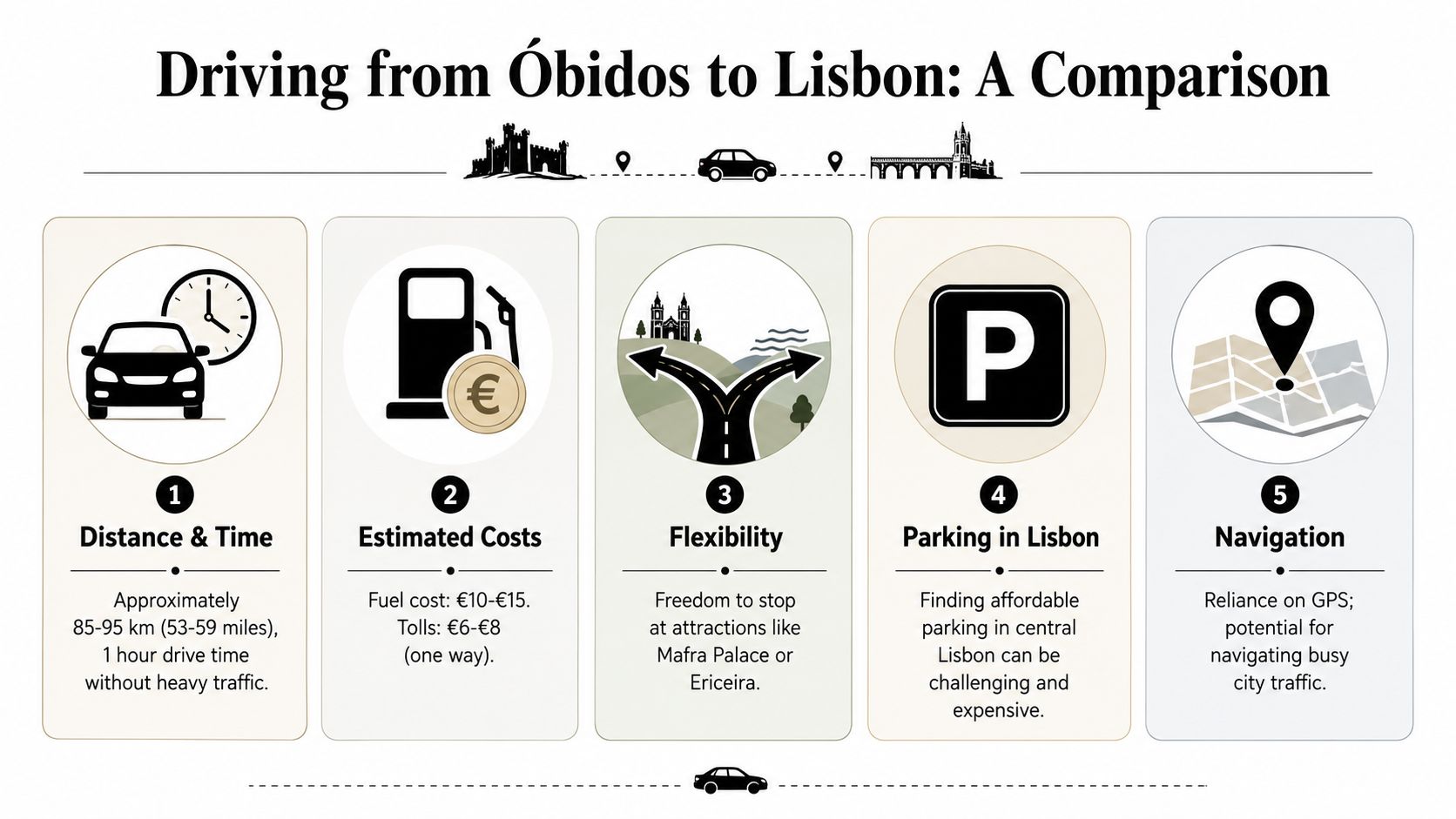
The usual route runs down the A8 motorway toward Lisbon. Rome2Rio route information lists the drive at approximately 178 km and about 1 hour 50 minutes in good conditions. It also notes that summer weekends from June to September can add 35 to 45 minutes near the Rio Maior and Azambuja junctions.
That lines up with what drivers see on the ground. The first part of the trip is usually easy enough. The last stretch is where time starts slipping, particularly if you are arriving on a Friday afternoon, a Sunday return day, or close to an airport or central hotel check-in window.
If you need to be somewhere at a fixed time, build in extra margin. Self-driving looks flexible until traffic removes that flexibility.
Pros and cons of self-driving
| Consideration | What works | What doesn't |
|---|---|---|
| Flexibility | You choose your departure time and can stop along the way | Traffic closer to Lisbon can wipe out that advantage |
| Privacy | Good for travellers who want their own space | You handle the route, tolls, parking, and arrival logistics yourself |
| Route control | Useful if Lisbon is one stop on a wider Portugal road trip | Sat nav can still pull you into slower central routes |
| Arrival | Works well if your accommodation has clear vehicle access | Harder if you are staying in a historic or high-density area |
The real trade-off is the arrival, not the motorway
From a transport provider's point of view, the A8 is rarely the hard part. The hard part is the final 10 to 15 minutes. Lisbon has narrow streets, one-way systems, limited stopping space, and areas where unloading bags is awkward even if you do find parking nearby.
That matters more for families, small groups, and anyone carrying more than a couple of light bags. A hire car gives independence, but it also turns you into the driver, route planner, and luggage handler at the busiest part of the trip.
Self-driving makes the most sense in a few specific cases:
- You are already doing a longer road trip through Portugal
- You are staying outside central Lisbon
- You are comfortable driving in dense urban traffic
- You do not need a tightly timed arrival
For everyone else, judge the car option by the full trip, not just the motorway section. Leaving Óbidos is easy. Reaching the right address in Lisbon without stress is the part that decides whether driving was a good choice.
The Budget-Friendly Choice Travel by Bus
For most budget travellers, the bus is the cleanest public option for Obidos to Lisbon. It's easier to understand than a rail journey with changes, and you don't need to manage motorway traffic or city parking yourself. If you're travelling solo, carrying manageable luggage, and don't mind fixed schedules, this is often the best-value route.
The key with the bus is accepting what it does well and what it doesn't. It gets you into Lisbon without much planning complexity. It doesn't solve the last leg to your hotel or apartment.
How to use the bus well
A practical coach trip usually comes down to a few simple habits:
- Check the schedule before travel day. Public coach timings can shift, and seasonal demand changes how busy departures feel.
- Confirm the departure point in Óbidos. Don't assume every local stop serves long-distance services.
- Arrive a bit early. It removes stress, especially if you're unfamiliar with the boarding area.
- Know your Lisbon arrival point. The bus may get you to a major terminal, but not necessarily close to your final address.
For travellers used to airport transfer planning, this is the same trade-off seen elsewhere in Portugal. A public coach can be economical, but direct transport usually wins on ease. That's clear in the Algarve too. Faro Airport's official guidance states there is no direct public transport network from Faro Airport to Albufeira, so passengers must use the Próximo circuit 16 bus to Faro city bus terminal for €2.25, then continue by Interurbano bus for €3.85 or Express bus for €5.50, with total journey times ranging from 70 minutes to nearly 2 hours, according to Faro Airport transport guidance.
That Algarve example matters because it shows the same pattern. Public transport can be cheaper, but it often becomes a chain of steps rather than one smooth journey.
Who the bus suits best
- Solo travellers: Easier when you only need to manage yourself and one bag.
- Backpackers and light packers: Less hassle during boarding and final transfer.
- Flexible holidaymakers: Fine if arrival time isn't tied to a strict booking or event.
- Travellers comparing costs first: Good when convenience matters less than budget.
The bus is strongest when your budget is tight and your expectations are realistic.
The trade-off after arrival
Once you reach Lisbon, the trip isn't quite finished. You still need to get from the arrival station to your accommodation. Depending on where you're staying, that may be easy or annoying.
That's where some people change their mind about “cheap” transport. The main coach fare can be sensible, but the total effort rises if you add local taxis, metro changes, or a walk with luggage through busy streets. It's the same reason many travellers compare public routes with how to get from Faro airport to Albufeira without taxi queue, private transfer from Faro airport to Albufeira price, or Albufeira Faro airport return transfer before deciding. Cheap is good. Simple is different.
The Train Journey A Multi-Step Alternative
The train catches people out because it sounds like it should be the comfortable middle option. In practice, for Obidos to Lisbon, it's usually the most fiddly choice. The problem isn't rail itself. The problem is getting from where you are to the right rail connection, then sorting arrival in Lisbon afterwards.
If you're travelling light and enjoy managing multi-leg transport, you might still be fine with it. But if you want one simple movement from accommodation in Óbidos to accommodation in Lisbon, the train tends to lose on practicality.
Why it feels harder than expected
The usual issue is that the rail journey isn't a clean start-to-finish ride from your door. You often need to organise an extra local leg first, then the rail segment, then one more transfer once you reach Lisbon.
That means more moving parts:
- First leg: local taxi or bus to the station that best suits your route
- Middle leg: regional rail service towards Lisbon
- Final leg: metro, taxi, or rideshare from the arrival station to your address
This is why many travellers who begin by assuming train is the easiest end up choosing bus or direct road transport instead.
Compare the train with the simpler options
| Option | Best for | Main drawback |
|---|---|---|
| Private transfer | Comfort, direct arrival, groups, families | Higher upfront cost |
| Bus | Budget-conscious solo travellers | Fixed schedules and a final city transfer |
| Driving | Flexible itineraries and road trips | Traffic and Lisbon parking |
| Train | Travellers comfortable with connections | More steps than most expect |
A good way to think about it is this. The train can work if you enjoy transport logistics. It's weaker if your goal is an easy travel day.
The same principle applies in other countries too. If you want an example of how route complexity changes the overall traveller experience, this 2026 guide for Dublin to Limerick travel is a useful comparison. Different country, same lesson. A route can look straightforward until you account for the transfer points, station access, and what happens after arrival.
A practical final choice
Choose the train if you don't mind assembling the journey yourself. Choose the bus if price matters most and your luggage is manageable. Choose driving if you want freedom and can cope with the capital at the end. Choose a private transfer if you want the whole trip handled in one go.
If your Lisbon arrival involves onward rail planning, station choice matters too. This practical look at Sete Rios station in Lisbon helps if you're trying to understand one of the city's key transport hubs before you travel.
For most holiday travellers, the simplest answer is still the best one. Fewer changes. Less guesswork. A smoother arrival.
If you want a reliable, door-to-door transfer anywhere in Portugal, The Algarve Experience is a smart option to check. The company has operated since 2018 and specialises in professional transport with fixed pricing, licensed and insured drivers, meet-and-greet service, flight monitoring, and a fleet that covers solo travellers, families, and larger groups. That makes it useful not only for this route, but also for Faro airport transfers, Algarve airport transfers, Albufeira airport transfers, reliable Algarve airport shuttle 2026 planning, Faro airport to Albufeira transfer bookings, and wider Portugal journeys where a direct, organised arrival matters more than piecing together public connections.
Related posts