

You’re probably planning a Portugal trip that doesn’t fit neatly into one box. You want beach time in the Algarve, but you also want proper surf. You may be landing in the south, sorting luggage, boards, family logistics, and trying to work out whether surf in Cascais is worth the extra travel.
It is.
Cascais gives you something many surf destinations don’t. It combines easy access, a polished seaside town, and a coastline that keeps producing options when other places get messy. That matters if you’re not travelling with unlimited time. It matters even more if your trip starts with Faro airport transfers, a few days in Albufeira, and then a move north for waves.
People searching for Faro airport transfers, Algarve airport transfers, Albufeira airport transfers, or a smooth Faro airport to Albufeira transfer often assume they have to choose between the Algarve and Lisbon’s surf zone. You don’t. With the right planning, a multi-stop route works well, especially if you want private transfers Faro airport, cheap Faro airport transfers that don’t mean hassle, or the best airport transfers Algarve for boards, children, and hotel drop-off.
Your Complete Guide to Surfing in Cascais
You finish a few warm days in the Algarve, the car is loaded with boards, wetsuits, and luggage, and the next question is simple. Do you stay south, or head north for better surf options? Cascais is often the right call if you want a polished base, reliable access, and enough variety on the coast to keep the trip worthwhile.
Cascais sits west of Lisbon and works well for surfers who want more than a single-destination holiday. It is close enough to the city to keep logistics manageable, but the surf trip still feels like a proper coast break rather than an urban stopover. That balance matters. A trip can fall apart quickly once you add airport arrivals, hotel check-ins, board bags, and a longer transfer between regions.
For a Lisbon-only surf trip, Cascais is easy to fit in. For travellers landing in Faro, using Algarve airport transfers, then trying to add several days of surf in Cascais, the plan needs more care. The distance is not the problem. The friction is. Board bags on trains, rental car swaps, delayed pickups, and tired children can eat into the days that were meant for the water.
Three things make surf in Cascais a strong addition to a wider Portugal route:
- It is easy to reach from Lisbon. You can stay organised without committing to a remote surf camp.
- The area offers real choice. If one stretch is poor, you often have another option within a reasonable drive.
- It pairs well with an Algarve itinerary. You can split the holiday between southern beach time and stronger surf planning up north.
The third point is the one many travellers miss. Families starting with Faro airport transfers for families/groups or couples basing themselves in Albufeira often do better by treating the trip as one linked route from the start. That usually means deciding early whether to self-drive, take public transport, or book a private transfer between the Algarve and Cascais. If you are carrying boards and changing accommodation more than once, private transfer is usually the premium option for a reason. It saves energy for the sessions that matter.
My rule is simple. Plan the travel days first, then build the surf around them.
The order that works best is usually this:
- Pick the arrival airport based on the whole trip. Lisbon suits a Cascais-focused stay. Faro suits a split Algarve and Cascais holiday.
- Match the trip dates to your surf level. Softer conditions suit learners. More experienced surfers can be selective and chase better swell windows.
- Choose accommodation with driving times in mind. In Cascais, staying somewhere attractive is not the same as staying somewhere practical for dawn patrol.
- Book intercity transport before flights and hotels lock the route. Many travellers lose flexibility at this stage.
If you are comparing how to get from Faro airport to Albufeira without taxi queue, checking Albufeira Faro airport return transfer options, or planning the move north after a few days in the Algarve, treat Cascais as part of the same itinerary rather than a separate add-on. That is the difference between a rushed transfer day and a Portugal trip that leaves room for good surf.
Why Cascais is a European Surfing Paradise
Dawn in Cascais often starts with a real choice. One side of the coast is picking up more swell. Another is cleaner because the wind is behaving differently. That flexibility is what makes the area so good in practice, especially for travellers trying to fit quality surf into a wider Portugal trip instead of building the whole holiday around one beach.
Cascais sits in a rare position on the Portuguese coast. You have beaches and reefs facing different directions within a compact area, so the call is not whether to surf or not. The call is where the conditions are working best that day. For beginners, that can mean finding a softer bank and avoiding a frustrating session. For experienced surfers, it means there is still a chance of getting punchy Atlantic surf without committing to a long relocation.
That variety matters even more if your trip includes both the Algarve and the Lisbon coast. The Algarve gives you a very different surf rhythm, with its own mix of south and west coast options. Cascais complements it well. After a few days down south, moving north gives you access to a denser cluster of breaks near a proper town, plus quick reach into the wider Lisbon surf zone. Anyone planning to split time between the two regions should also look at this guide to surfing near Lisbon from Cascais and beyond, because the regional context helps you choose where to base yourself.
A coastline that rewards good decisions
Cascais is not a one-wave destination. It is a decision-making destination.
That is why surfers keep coming back. On the same day, one beach can be wind-affected and average while another nearby is clean enough to save the session. Local surfers use that to their advantage all the time. Visitors who treat Cascais as a single surf spot usually miss the point.
A key strength here is range. There are accessible beach breaks, more technical peaks, and corners that handle weather shifts better than exposed open stretches. If the forecast is mixed, Cascais gives you room to adjust instead of forcing a long drive or a lay day.
It works for mixed trips, not just surf missions
Cascais also succeeds because life off the water is easy. The town has enough substance that non-surfing partners, families, and friends are not stuck waiting around a car park while the surfer in the group chases waves. Good restaurants, walkable streets, beaches that still feel like holiday beaches, and fast access to Lisbon all make a difference.
I rate Cascais highly for exactly that reason. Some surf towns are brilliant for scoring waves and poor for everything else. Cascais balances both sides well, which makes it one of the smartest stops on a multi-destination Portugal itinerary.
For travellers coming up from Faro or spending time in the Algarve first, that balance becomes even more useful. You can finish the southern leg of the trip, transfer north, and land somewhere that still feels polished and relaxed while keeping serious surf options close at hand. That is a strong setup for anyone who wants the Algarve’s scenery and pace without giving up the consistency and variety around Cascais.
Why surfers return
The places that earn repeat visits usually offer three things:
- Options across different conditions, so a bad forecast rarely ruins the whole day
- Shorter distances between viable breaks, which helps when you need to adapt quickly
- A town worth staying in, even when the surf is average
Cascais delivers all three. It is one of the few European surf bases that works equally well for a dedicated surf week, a couples trip, or a broader Portugal route that links the Algarve, Lisbon, and the coast in between. That mix of wave quality, flexibility, and travel practicality is what gives surf in Cascais its staying power.
Cascais' Top Surf Spots for Every Skill Level
The best surf trip in Cascais usually comes from choosing the right beach early, not driving around chasing whatever looked good on Instagram the night before. This stretch of coast gives you real range within a short distance, which is exactly why it works so well on a wider Portugal route. You can spend time in the Algarve, come north by private transfer, settle into Cascais, and still have enough variety nearby to surf around the conditions instead of forcing one marquee spot.
A lot of visitors make the same mistake. They hear one famous name, paddle out there regardless of tide, wind, or crowd, and end up having a worse session than they would have had twenty minutes away. Cascais rewards flexibility.
Cascais Surf Spot Cheat Sheet
| Surf Spot | Best For | Wave Type | Best Swell / Wind |
|---|---|---|---|
| Carcavelos | Beginners through advanced | Beach break | Likes decent swell and cleaner north wind setups |
| Praia Pequena | Intermediate to advanced surfers and strong bodyboarders | More sheltered break | Useful when wind protection matters |
| Praia Grande | Intermediate surfers and bodyboarders | Consistent beach break | Often a better call when exposed beaches are messy |
| São Pedro do Estoril | Intermediate to advanced | Faster, punchier wave | Better with quality swell and confident positioning |
| Torre Beach | Advanced surfers in larger swells, also a fallback when exposed coast is too raw | More protected option inside the Estoril area | Handy on bigger or windier days |
| Guincho | Intermediate to advanced on the right day | Powerful, exposed beach break | Best with manageable wind and a tidy swell window |
If you want to compare these breaks with the wider capital region, this guide to surf spots near Lisbon gives useful context.
Carcavelos for range and easy access
Carcavelos is still the most reliable all-round recommendation for a first visit. It is accessible, it has space to spread out, and it can suit very different surfers on the same day.
That does not mean it is always friendly. On a good swell, Carcavelos gets fast, competitive, and crowded, especially around the better peaks. Beginners do better on the shoulders or in a lesson setup away from the main pack. Intermediate surfers can progress quickly here because the wave has enough push to teach timing, take-off choice, and basic performance surfing without the extra intimidation of a heavier reef or point.
Praia Pequena and Praia Grande for cleaner options
These beaches earn their keep when the more exposed coast starts to look ragged. Both are regularly used as backup plans by surfers who know that a clean head-high wave beats a bigger stormy mess every time.
The trade-off is crowd pressure. Protected waves attract locals, surf schools, and travelling surfers on the same call, so the lineup can bunch up fast. Go early, watch for ten minutes before paddling out, and be realistic about your level. If you can hold position and make quick decisions, you will get more from these spots than from a heroic but poor choice elsewhere.
São Pedro do Estoril for sharper surfing
São Pedro is where the margin for error gets smaller. The wave is quicker, the take-off demands better positioning, and hesitation usually means a missed wave or a poor drop.
For capable intermediates stepping up, it is a strong test piece. For advanced surfers, it can be one of the most satisfying sessions in the area when the swell lines up properly. For learners, there are easier places to spend your energy.
Lineup call: The right wave in Cascais is the one that matches your level, the crowd, and the conditions you actually have that day.
Torre Beach for difficult days
Torre does not always get the headlines, but it deserves a place in any serious Cascais plan. On bigger swells or unruly wind days, a more protected option can save the session.
That matters even more if Cascais is the second half of a Portugal surf holiday after the Algarve. Travellers who come north on a fixed schedule do not always have the luxury of waiting three days for a perfect forecast. Having a spot like Torre in the mix gives the trip more resilience.
Guincho for power and exposure
Guincho is the wave a lot of visitors want to surf, and sometimes that instinct is right. It is powerful, beautiful, and capable of excellent surf. It is also one of the quickest places around Cascais to humble people.
Wind is the obvious issue, but not the only one. The beach setup shifts, the paddle can feel longer than expected, and the wave has more force than many intermediates anticipate from the car park view. Strong surfers can score memorable sessions here. Everyone else should treat it as a condition-dependent call, not a box to tick.
The practical advantage of staying in Cascais is that you do not need to force Guincho if it is wrong. That flexibility is what makes this coast so useful for travellers linking regions. After time in the Algarve, where your surf choices may depend more heavily on which side of the coast is working, Cascais gives you a tighter cluster of options and quicker course correction on the day.
Decoding the Seasons Your Guide to Cascais Swell Wind and Tides
You can leave Faro under blue skies, reach Cascais a few hours later, and paddle out into a completely different Atlantic mood. That shift catches people on multi-stop Portugal trips all the time. The Algarve can flatter you into thinking the forecast is straightforward. Cascais rewards a more precise read of swell angle, wind exposure, and tide.
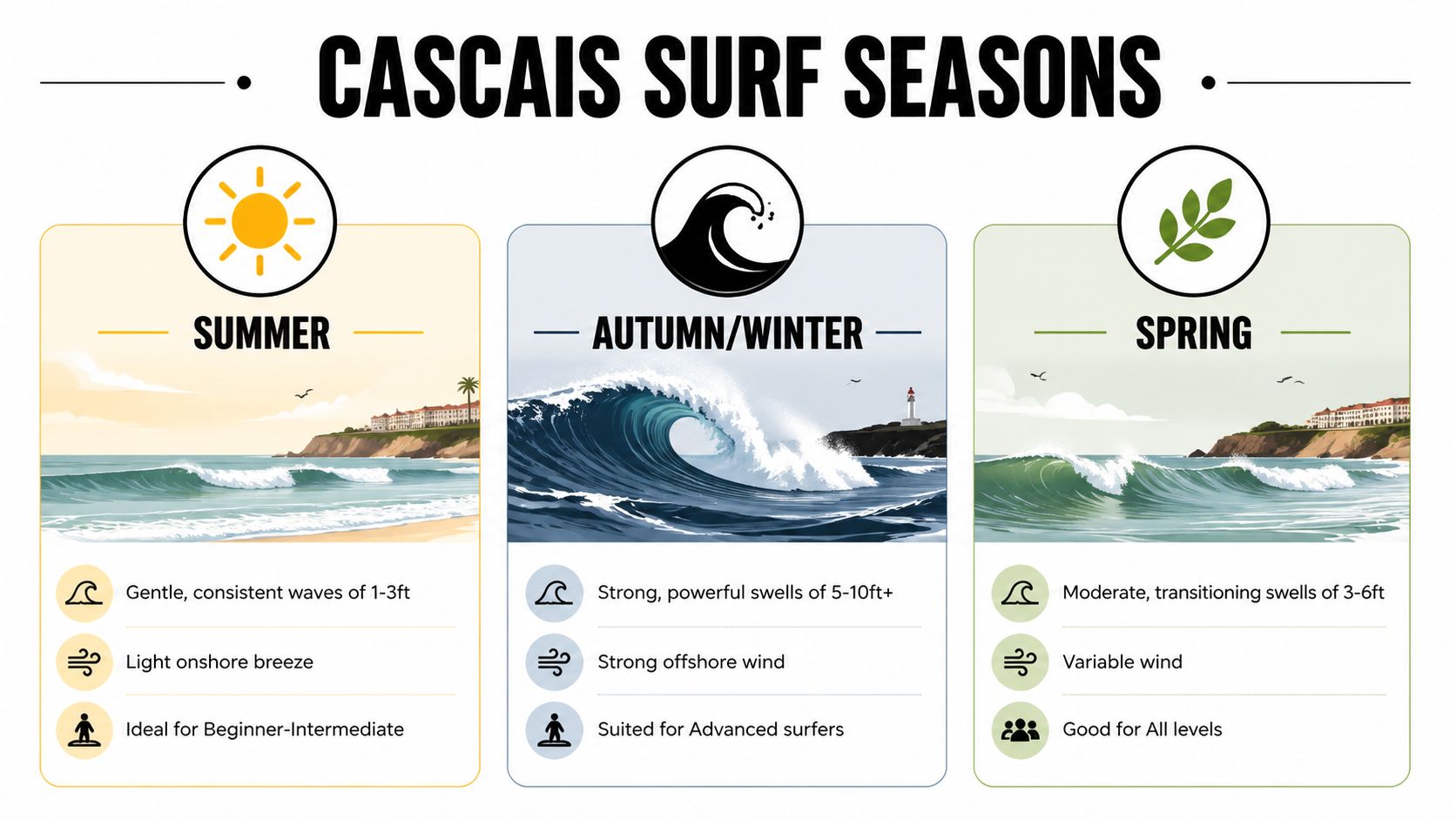
The broad pattern is simple. Autumn usually gives Cascais its best mix of consistency, manageable water temperature, and clean, lined-up surf. Winter brings more size and more consequence. Spring is often more forgiving than people expect. Summer is the easiest season for beginners to stack decent sessions without getting punished by power.
Autumn and winter for quality and power
Autumn is the season I trust most if the goal is good surf with options. Swell becomes more reliable, the banks start to light up, and you can still get days that feel friendly rather than heavy. For travellers linking the Algarve and Cascais in one trip, this is the easiest window to justify the extra mileage north.
Winter can be excellent, but it demands better judgement. Bigger swells, colder water, stronger wind, and the occasional rain event all affect the call. Some days are brilliant if you choose a protected setup. Some days are better spent watching the ocean, eating well in town, and waiting for the next tide.
That is the trade-off. Winter raises the chance of a memorable session, but it also raises the chance that your first-choice spot is wrong.
If heavy rain has moved through, check recent conditions before surfing. Water quality can change quickly near urban areas after runoff, and a strong-looking forecast is not enough reason to ignore that.
This clip helps put the local setup into context before you commit to a plan.
Spring and summer for easier entries
Spring is one of the smarter times to surf Cascais if you want room to improve without dealing with full winter energy. There is usually enough swell to keep things interesting, but fewer days feel intimidating from the shoreline. Intermediates often make better progress in spring than in autumn because they spend more time surfing and less time managing fear.
Summer is more user-friendly, especially for first-timers and mixed-ability groups. That matters if Cascais is part of a wider Portugal itinerary and not a strike mission built around one forecast window. Families, couples, and travellers coming up from the Algarve often need a coast that still works even when surfing is only one part of the day.
Summer also has its own compromise. The waves are easier, but crowds, surf school zones, and lighter swell can limit how much stronger surfers get out of a session.
How to read the forecast without overcomplicating it
Don’t just focus on wave height. In Cascais, that shortcut leads to a lot of bad calls.
Three details matter together:
- Swell direction decides which stretches of coast have real energy.
- Wind direction decides whether the face stays clean or turns to chop.
- Tide and local shelter explain why one beach can be a mess while another is perfectly surfable.
Northwest wind deserves special attention here because it changes the map fast. Exposed beaches can fall apart. More sheltered corners can stay organized and worth the paddle. That is why Cascais works so well for surfers who plan properly. You are not locked into one beach. You are choosing from a compact cluster of options based on the day in front of you.
A better question is this: which part of the coastline is protected right now?
Why this matters for a multi-stop Portugal trip
Cascais is not hard to surf. Cascais is hard to surf well if you arrive with a rigid plan.
That point matters even more if you have already spent time in the Algarve and are travelling on fixed hotel dates. A private transfer between regions gives you the comfortable option, but comfort alone is not the reason to choose it. The main advantage is control. You can leave Faro at the right hour, arrive without a car-rental headache, check in quickly, and still have enough daylight and energy to surf the correct window instead of forcing a poor late session.
That kind of timing improves the trip. On this coast, a clean two-hour window at the right tide is worth far more than a full day spent stubbornly surfing the wrong beach.
Gearing Up Surf Schools Rentals and Your Essential Packing List
Good sessions in Cascais often come down to simple gear decisions made before you leave the apartment. The wrong board wastes energy. The wrong wetsuit shortens the session. If you are linking Cascais with time in the Algarve, this matters even more because every extra bag, board tube, and wet item affects how easy the transfer day feels.
For beginners, local rental usually makes more sense than hauling cheap or unfamiliar gear across Portugal. The better surf schools around Carcavelos, Guincho, and Praia da Poça can match volume and shape to the day, which is far more useful than turning up with one board that only works in one type of wave. Intermediate and advanced surfers usually get the best balance by travelling with one trusted board and renting a second option if the forecast changes.
Wetsuit choices that make sense
Cascais is surfable year-round, but the Atlantic keeps the water cool enough that suit choice matters. Summer can be comfortable in a lighter full suit for many surfers. Spring and autumn usually call for a proper full suit. In winter, a warmer suit is the safer call, especially on windy mornings or longer sessions at exposed beaches.
Pack for the coldest session you are likely to do, not the warmest afternoon you hope for.
If you run cold, add boots. If you are surfing dawn patrol in winter, a hood is not overkill. I have seen plenty of visitors cut sessions short because they packed for Lisbon sunshine rather than a wind-exposed beach in Cascais.
Choosing a school or rental setup
A good surf school does more than hand out foam boards. It times lessons around conditions, separates true first-timers from nervous improvers, and moves beach if the original plan is poor. That flexibility matters on this stretch of coast.
Look for schools and rental shops that offer:
- boards sized by skill level, not just whatever is left on the rack
- wetsuits in good condition with working zips and seals
- local guidance on where to surf that day
- easy pick-up and drop-off if you are travelling without a car
- beginner lessons at sheltered beaches when Guincho is too wild
If your trip includes Lisbon before or after Cascais, arranging private transfers from Lisbon Airport can make the gear side much easier, especially if you are carrying a board bag and do not want to start the holiday wrestling through stations and taxis.
What to bring and what to rent
Bring the items you care about and rent the awkward ones when that improves the trip.
A practical split looks like this:
- Bring your own leash, fins, wax, changing towel, rash vest, and any small repair items you trust
- Travel with your own board if you are particular about performance and plan to surf several days in a row
- Rent locally if you are a beginner, if you want a backup board for different conditions, or if you are combining Cascais with other Portugal stops and want lighter travel
- Carry a separate wet kit bag so one post-surf change does not soak the rest of your luggage
This is one area where honest trade-offs matter. Airline board fees, damaged rails, and dragging a coffin bag from the Algarve to Cascais can outweigh the benefit of having your favourite board under your feet. For a short multi-stop trip, many surfers are happier bringing one daily driver and renting anything else.
Packing list for a Cascais surf trip
Keep the packing list tight and functional:
- Surf gear. Board, fins, leash, wax, day bag
- Wetsuit setup. The right full suit for the season, plus boots or hood if you know you will surf colder or windier days
- Post-surf comfort. Dry towel, warm layer, water, snacks, sandals or sturdy footwear
- Travel basics. Waterproof pouch for valuables, charger or power bank, copies of bookings, and a bag for wet clothes
- Skin and recovery items. Sunscreen, lip balm, ear drops if you use them, and simple first aid for cuts or fin knocks
Small comforts make a bigger difference than many surfers expect. A warm hoodie, dry socks, and an organised bag can rescue a cold afternoon and keep you fresh for the next session. On a Portugal trip that runs from Faro to Cascais, that kind of planning saves hassle every single day.
From Faro to the Lineup Your Complete Transport Guide
If Lisbon is your entry point, reaching Cascais is straightforward. If your holiday starts in the Algarve, transport becomes the part that either keeps the trip smooth or drains it. Here, many people underestimate the hassle of moving surfboards, family luggage, and hotel check-ins across regions.
For travellers arriving in the south, the main decision isn’t whether Cascais is worth visiting. It’s how to connect the Algarve and Cascais without turning one travel day into three smaller problems.

Lisbon arrivals versus Faro arrivals
If you’re landing in Lisbon, local onward travel is simple enough. You can build the trip around Cascais from the start and stay light.
Faro is different. A lot of visitors begin with Faro airport transfers, spend several days on the southern coast, then decide they want Lisbon and Cascais as well. That’s a smart route, but only if the transport matches the trip.
Public transport can work for solo travellers with one bag and no board. It becomes far less appealing when you add:
- Board bags and wet kit
- Children and car seats
- Golf bags or mixed holiday luggage
- Multiple hotel stops
- Return planning such as Albufeira to Faro airport
That’s why people often search for private transfer from Faro airport to Albufeira price, reliable Algarve airport shuttle 2026, Faro airport transfer with child seats, or best private transfer Faro airport for surfboards before they even finalise accommodation.
Why private transport suits a multi-destination trip
A Portugal trip with both the Algarve and Cascais has one weak point. The long connection between regions. The smoother that part is, the better the whole holiday feels.
Private, door-to-door transport solves the exact problems that usually create friction:
- No station changes
- No taxi queue on arrival
- No argument about luggage space
- Clear pickup and drop-off planning
- One organised route from airport, villa, or hotel to the next stop
That’s useful if you need how to book Faro airport transfer online, door to door Algarve airport transfers, or a private Algarve transfer for golf groups and families. It’s even more useful if the route needs flexibility because the coast doesn’t always cooperate.
Surf conditions can affect transport planning too
Transport and surf planning aren’t separate on this route. They overlap. According to the wave guide at SeaTemperature.info’s Cascais forecast page, wave heights above 1 metre are dangerous for swimming, above 1.5 metres swimming is forbidden, and rough sea conditions fall in the 4 to 6 metre range under WMO sea state classification.
For travellers, the practical takeaway is simple. On rough-sea days, a professional transfer operator coordinating a coastal visit may need to adjust plans. That could mean changing beach timing, choosing a more sheltered stop, or avoiding a wasted journey to a poor location.
If you’re looking at onward travel from Lisbon later, this page on Lisbon airport transfer options is the relevant route connection to compare.
What to prioritise when booking the journey
If your trip starts in Faro and ends with surf in Cascais, look for transport with these basics:
- Door-to-door pickup
- Enough vehicle space for boards and luggage
- Flight monitoring if the trip starts at the airport
- Fixed pricing instead of improvised last-minute fares
- Support for families, groups, and return legs
That’s how you avoid the classic holiday mistake. Saving effort on the booking, then paying for it in stress on the day.
Local Etiquette Safety and Enjoying the Vibe
A good session in Cascais often starts before you touch the water. Stand on the sand for five minutes and watch who is getting waves, where the takeoff spot is, and how surfers are paddling back out. That short read saves a lot of bad decisions.
Cascais is welcoming, but the lineup has a clear pecking order, especially when the swell is clean and the better peaks are obvious. Visitors who settle in quickly, wait their turn, and surf to the standard of the break usually get a better reception than the surfer who paddles straight to the top of the queue.
The lineup rules that matter most
These are the habits that keep things smooth:
- Respect priority. The surfer in the best position, deepest and already committed, has the wave.
- Do not drop in. If someone is up and riding, the shoulder is not yours.
- Paddle wide. Going straight through the impact zone is the fastest way to annoy everyone.
- Watch before entering. Currents, sets, and local rhythm are easier to read from shore than from the inside.
Avoid this common mistake: paddling for the empty shoulder without understanding why it is empty. In Cascais, that patch of water might be a closeout section, a channel, or the line surfers need for a safe exit after the ride. What looks open is not always available.
Water rule: If you are unsure whether it is your wave, leave it.
Staying safe when the conditions change
Cascais can switch character fast. A spot that felt playful in the morning can get heavy with more tide push, more wind, or a tighter crowd. The practical move is to treat every paddle-out as a fresh check, not an extension of the session you had two hours earlier.
If the exposed beaches look disorderly, choose a sheltered option or call it for the day. There is no prize for forcing a poor session. I have had some of my best Cascais days by backing off the headline break and surfing the cleaner, less obvious corner instead.
Travel fatigue matters too. This section of coast often comes after a longer Portugal itinerary, and that changes judgement more than people admit. If you have come up from the Algarve, had an early airport run, or spent half the day on the road from Faro, surf one level below your maximum, not at it.
A few habits that improve the trip immediately
Small decisions shape the whole stay:
- Check the crowd twice. First for numbers, then for behavior.
- Warm up properly. Cold water and a long drive can leave you stiff and slow.
- Keep one easy day in the plan. Cascais works well with coffee, coastal walks, and a lighter schedule.
- Stay flexible. If the surf is average, use the day well instead of chasing a weak forecast.
If you are splitting time between Lisbon and Cascais, this two-day Lisbon itinerary for a short city break fits neatly around a few surf windows.
Enjoying the place, not just the surf report
Cascais rewards surfers who slow down enough to enjoy the town. Have lunch after the session. Walk the promenade. Save some energy for the next day instead of burning through every tide change.
That matters even more on a trip that links two very different parts of Portugal. The Algarve gives you the warm-weather holiday rhythm. Cascais gives you variety, access to Lisbon, and a wider range of surf moods within a short stretch of coast. If you plan the transfer well and keep your surf decisions sensible, the two regions work brilliantly together.
If you’re building a Portugal holiday that starts in the south and includes surf in Cascais, The Algarve Experience is worth checking for reliable, door-to-door travel between Faro Airport, Albufeira, Lisbon, and beyond. Their service is built around the needs most travellers have, including Faro airport transfers, Algarve airport transfers, Albufeira airport transfers, meet-and-greet pickup, flight monitoring, fixed pricing, and vehicle options for families, groups, and extra luggage. If you want a smoother Faro airport to Albufeira transfer, an easy Albufeira to Faro airport return, or a more comfortable multi-stop route across Portugal, it’s a practical place to get your quote and book ahead.
Related posts