

You're on São Miguel, the weather looks good, and the tour page says beginner-friendly. That's exactly when people get it wrong. Canyoning São Miguel isn't a single easy outing, it's a spectrum of water flow, rope work, jumps, and fitness demands, and the honest answer depends on the route, the season, and how comfortable you are in moving water.
If you want the short version, São Miguel deserves its reputation. Canyoning on the island started in 2004, and the academic record shows São Miguel quickly became one of the archipelago's main centres, with the strongest concentration of practitioners on São Miguel, Flores, and São Jorge (University of Lisbon repository). That matters because the island didn't become a hub by accident. It became one because it offered enough technical descents to support real progression, not just one photogenic gorge.
Why São Miguel Became Portugal's Canyoning Capital
Stand at the lip of a São Miguel canyon and the reason shows itself fast. The island is big, wet, steep, and heavily cut by water, so there is room for multiple canyon lines instead of a single showcase gorge. São Miguel is the largest island in the archipelago, measuring 62.1 km long, up to 15.8 km wide, with 744.7 km² of area and 137,856 inhabitants recorded in 2011 (VisitAzores).
That size matters because canyoning needs more than a waterfall. It needs drainage, gradient, access, and enough terrain variety for different descents to coexist without crowding each other out. The island's interior also gets roughly 1,500 mm of annual precipitation in the central highlands, which helps keep water moving, while inland canyon water temperatures sit around 16°C to 20°C in summer and about 13°C in winter (VisitAzores). In practice, that gives São Miguel a long working season, and it explains why operators can run more than one style of trip without the island feeling like a short, fragile niche.
Route density tells the real story
São Miguel earned its status through route density, not hype. Scholarly research and route documentation show that by the time of publication, 18 itineraries had already been explored on São Miguel alone, including Pico da Vela with a 460 m descent, 9 rappels, and a maximum rappel length of 40 m, Nascentes with 300 m, 5 rappels, and 15 m max rappel, and Três Voltas inferior with 490 m, 3 rappels, and 30 m max rappel (University of Lisbon repository).
That route inventory matters because it separates São Miguel from islands that only work for one narrow type of visitor. The island is a foundational canyoning destination in Portugal because it combines an early start in the sport's national history with a documented network of real descents. Routes with that kind of vertical range are exactly why trained canyoners keep coming back, even when the commercial market leans toward easier half-day products.
Practical rule: If a destination has multiple named routes with real vertical profiles, it can support both first-timers and trained groups. São Miguel does.
Broader adventure coverage places canyoning in the same national context, describing the sport as descending watercourses with steep gradients and noting that, in Portugal, it is mainly practised in the northwest mountain ranges, Madeira, and Flores, São Jorge, and São Miguel (Desnivel). That fits the island's position exactly. São Miguel is not an accidental add-on to Portugal's canyoning map, it is one of the places that made the map worth taking seriously.
Best Canyoning Routes and What to Expect
The best São Miguel routes are not the hardest ones. The best route is the one that matches your actual fitness, confidence with heights, and willingness to follow instructions under spray, cold water, and rope tension. For most visitors, the island's commercial canyoning market is built around short-to-moderate waterfall descents, not expedition lines, and that's a strength when you pick correctly.
Side by side, the differences are obvious
Here's the honest comparison.
| Route Name | Difficulty | Duration | Max Rappel | Max Jump |
|---|---|---|---|---|
| Ribeira dos Caldeirões | Introductory | About 3 hours on site | 8 m | 6 m optional |
| Another São Miguel experience | Beginner-friendly | Varies by operator | 6 m | 6 m |
| Pico da Vela | Technical | Route-based | 40 m max rappel | Not specified |
| Nascentes | Technical | Route-based | 15 m max rappel | Not specified |
| Três Voltas inferior | Technical | Route-based | 30 m max rappel | Not specified |
The introductory Ribeira dos Caldeirões product is the clearest first choice for most travellers. One listed version allows a 20-minute approach walk, a 2.5-hour canyon descent, abseils up to 8 meters, and optional jumps up to 6 meters (Manawa). That's a controlled, sensible format. It lets novices experience the sport without forcing them into long vertical exposure.
What each route type suits
If you're a first-timer, pick the route with the shortest approach, the fewest rappels, and the clearest safety briefing. Ribeira dos Caldeirões fits that brief. If you already climb, scramble, or rappel comfortably, the longer technical lines may be more satisfying, but only if you're prepared for sustained rope work and stronger water movement. The route names in the research, especially Pico da Vela, Nascentes, and Três Voltas inferior, show the island has enough variety to justify a proper skill-based choice (University of Lisbon repository).
For most travellers, the mistake is chasing the biggest drop. You want the route with the right rhythm. A solid canyoning day should feel controlled, progressive, and fun, not like a rescue course with scenery.
Choose the canyon, not the hype. On São Miguel, the commercial products are often deliberately shorter and safer than the island's technical routes. That's good, but only if you understand what you're buying.
Seasonality and Weather Planning
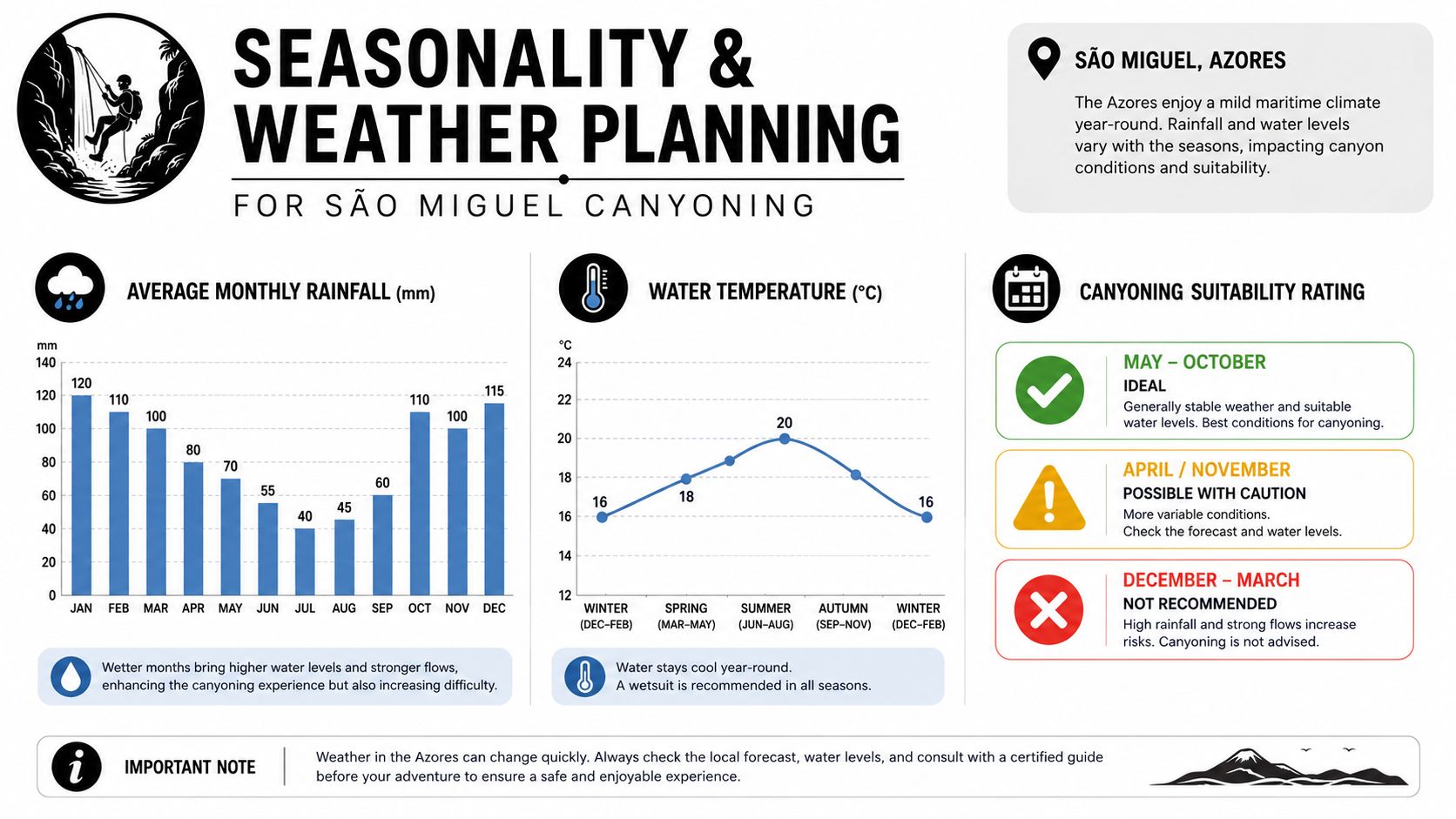
Canyoning on São Miguel works best when you respect the weather instead of arguing with it. The usual sweet spot is April to October, which the island guide identifies as the most consistent period for canyoning conditions (VisitAzores). That doesn't mean the other months are impossible, it means the margin for disruption gets thinner.
The main reason is water. São Miguel's central highlands receive about 1,500 mm of annual precipitation, and winter rainfall can lift flows enough to force temporary closures when the water exceeds safe thresholds (VisitAzores, ToursXplorer). Most glossy listings skip this reality. A canyon that looks friendly at breakfast can be too powerful by lunch if the rain has been heavy.
Water temperature and comfort
Temperature matters too. Inland canyon water is roughly 16°C to 20°C in summer and about 13°C in winter (VisitAzores). That is cool enough that the wrong kit or a long wait at the start can make a short route feel miserable. A good operator manages that with timing, wetsuits, and route selection. A poor one just tells you to “bring a towel.”
If you're planning a broader island trip, keep your canyon day flexible. I'd book it early in the stay, not at the end, so you can shift other plans if the weather turns. Same-day logistics vary between routes, meeting points, and pickup options, especially around Ribeira dos Caldeirões and Salto do Cabrito (ToursXplorer).
How to reduce cancellations
Use these rules.
- Book with flexibility: Choose operators that handle last-minute weather changes clearly, because winter rainfall can close routes without much notice.
- Keep a backup activity: Have a land or sea option ready for the same day.
- Avoid overpacking the day: Don't stack canyoning with a rigid ferry, flight, or long transfer.
- Treat April, November, and winter differently: Those shoulder and wet-season periods are possible, but less forgiving.
For broader travel context, it helps to compare São Miguel's weather-driven planning with other island activities that also depend on temperatures and conditions. A useful external reference is this guide on water temperature planning in Albufeira, which shows how travel comfort often comes down to the same basic issue, timing around conditions.
Honest Assessment of Skill and Fitness Requirements
The biggest gap in canyoning São Miguel content is the mismatch between the word beginner and the actual route conditions. A route can be beginner-friendly and still punish anyone who dislikes heights, tires quickly, or freezes when water is moving around their legs. Academic work on Azorean canyoning points to gaps in safety practice, staff qualification, and client profiling, and that is why you should ask harder questions before you book (ESHTE virtual library PDF).
What you should be able to do
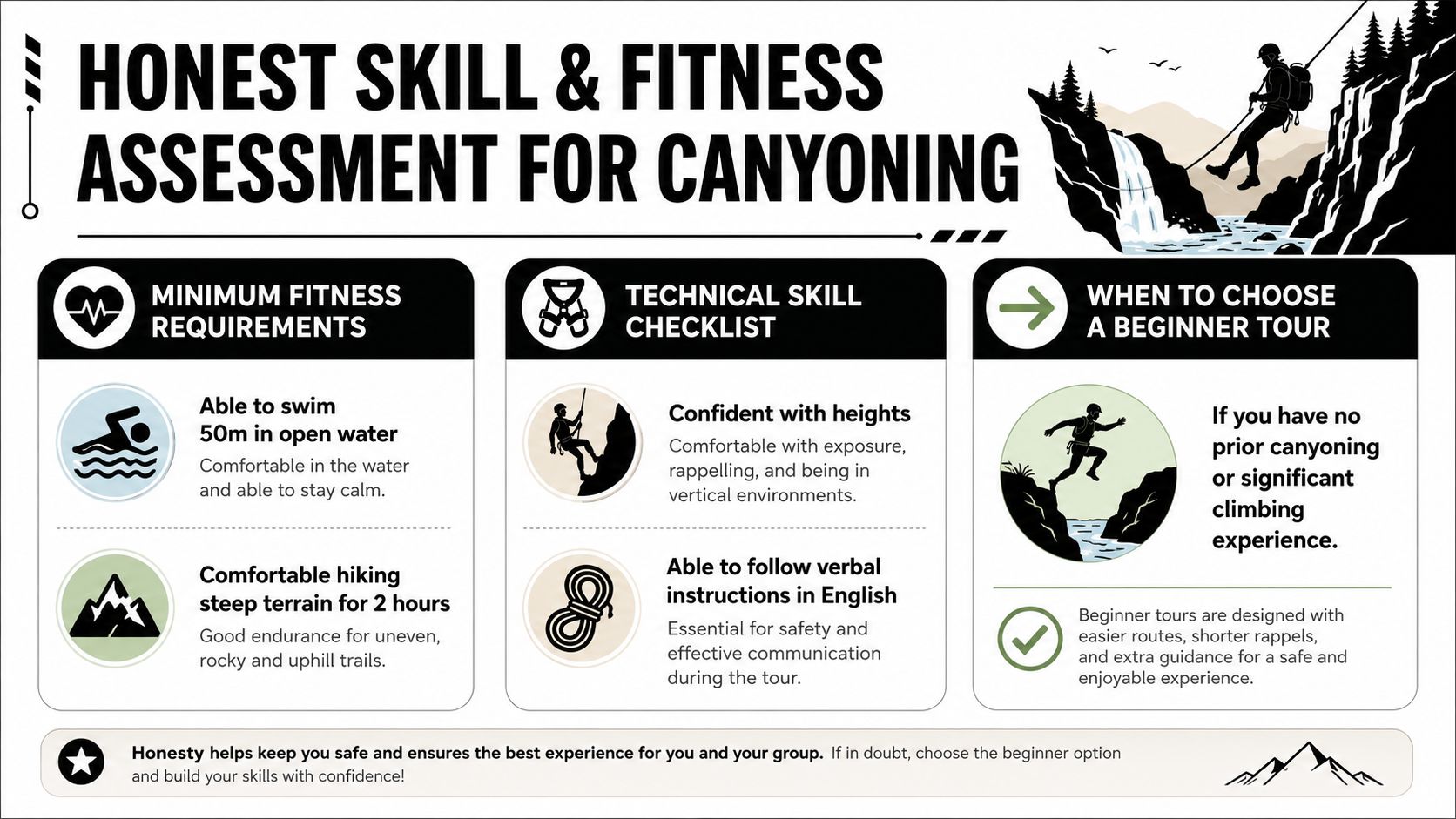
Forget the brochure language. You should be able to swim confidently, move on uneven ground, listen in noisy conditions, and follow rope instructions without freezing up. If you feel sore after moderate hiking, get nervous on ladders, or hesitate about jumping into cold water, choose the gentlest option or skip the sport.
A sensible beginner should fit this profile.
- Comfort with open water: You do not need to be an athlete, but you should stay calm in water and handle a wetsuit and helmet without panic.
- Comfort on steep terrain: Short approaches can still feel strenuous because the ground is wet, uneven, and slippery.
- Tolerance for instruction: Guides give verbal commands, sometimes in noise and spray, so you need to respond quickly.
- Confidence with heights: Even short rappels feel bigger when you are clipped into a rope and stepping backwards over rock.
If you are returning to sport after a break, general conditioning helps. Pair the trip with sensible recovery and mobility work beforehand, and use the athlete recovery tips from MEDISTIK as a practical reminder to prepare your body the right way.
Do not book based on optimism. Book based on what you can do on a wet, cold, slippery day, not what you could do on a dry trail in perfect conditions.
What to ask before you pay
Ask the operator these questions.
- Who is guiding the trip, and what are their canyoning qualifications?
- What is the actual rappel height on this route?
- What happens if the water level rises overnight?
- How many guests are in the group?
- What is your policy if a guest freezes or wants to skip a jump?
The market often labels routes as easy or moderate without explaining the operational side. That is the problem. A safe tour should tell you where the route sits, what the guide expects, and whether the day suits your fitness and confidence. If you want a wider view of how active-day planning works in the region, compare the setup with Algarve water sports options, where conditions and supervision shape the whole experience.
Essential Gear and What Operators Provide
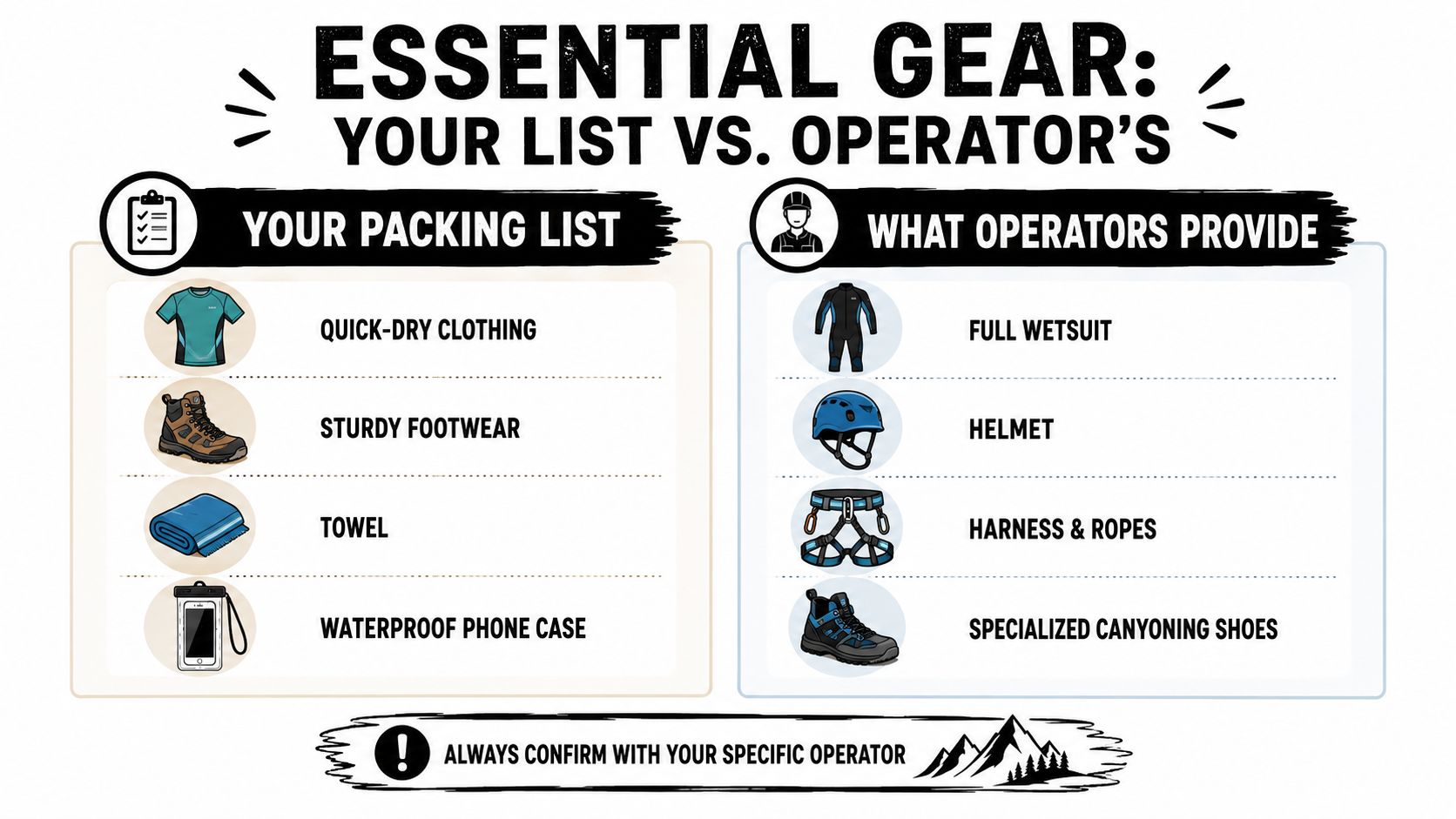
The gear question is simple. Good operators should provide the technical kit, and you should arrive with the personal items that keep you comfortable before and after the descent. On São Miguel, that usually means a wetsuit, helmet, harness, and ropes from the operator, while you bring your own clothing, towel, and dry bag basics.
Pack for comfort, not style
Bring quick-dry clothing, sturdy footwear, a towel, and a waterproof phone case. You'll also want dry clothes for after the activity, because standing around in damp kit on a cool island is a bad way to end a day outdoors. If your operator asks you to bring shoes that can get wet, take that seriously. Bad footwear ruins foot placement, and foot placement matters in canyoning.
Operator kit should be non-negotiable
Professional canyoning operators should supply a full wetsuit, helmet, harness and ropes, and, in some cases, specialised canyoning shoes (Picos de Aventura background source). That source also describes certified and carefully maintained technical equipment, which is the standard you should expect from any serious provider. If the gear looks tired, mismatched, or poorly adjusted, walk away.
Bring less than you think, but never compromise on footwear.
A few practical extras make the day smoother.
- Hair tie or cap: Keeps things out of your face under a helmet.
- Waterproof storage: Useful for keys, but not for valuables you don't need.
- Post-canyon layers: Dry base layers beat a bulky sweatshirt.
- Sunscreen: The island can still be bright even when the route is shaded.
For a broader look at water-sport logistics across the region, this internal guide to Algarve water sports is a helpful complement if you're comparing adventure days.
Booking Guide and Recommended Operators
Booking canyoning on São Miguel should feel like risk reduction, not a scavenger hunt. Start by choosing the route type, then verify who runs it, what the briefing covers, and whether the operator is clear about cancellations and weather decisions. The right choice is the one that answers your questions directly before you hand over money.
What to confirm before you reserve
You need specifics, not reassurance. Ask about guide ratios, group size, water conditions, transfer options, and whether pickup from Ponta Delgada is available. Also ask whether the tour includes all technical gear, because “included” sometimes means everything except the one item you assumed would be there.
Look for evidence of route adaptation and safety culture. Operators in the research describe assessment of weather and water flow before each descent, and that's the right mindset for São Miguel canyoning (Picos de Aventura background source). If an operator can't explain how it handles changes in flow, it's not ready for your booking.
How to compare options without wasting time
Use a simple filter.
- Best for beginners: Short approach, low rappel height, optional jumps.
- Best for mixed groups: Clear briefing, flexible pacing, strong safety supervision.
- Best for experienced canyoners: Higher rappels, more technical movement, honest fitness requirements.
- Best for families: Controlled route, simple access, straightforward logistics.
If you want to compare broader private transport and tour logistics in mainland Portugal as part of a larger trip, the internal page on private tours in Portugal is a good reference for the sort of pre-booked, door-to-door thinking that also works well for island adventure planning.
My booking advice
Book early in your trip, not late. Choose the route first, then the operator, then the day. That order keeps you from forcing a canyoning day into a bad weather window or an exhausted final itinerary. If a provider offers vague descriptions, limited safety information, or no clear cancellation policy, move on.
The best operators make the decision easy. They tell you what the route really demands, who it suits, and what happens if the weather changes. That's the standard you should demand on São Miguel.
Sample Day Plans for Different Travelers
A good canyoning day is built around the person in front of you, not a generic difficulty label. On São Miguel, that means the day plan for a first-timer, a confident mover, and a family group should look completely different. The island gives you enough route variety to do that properly.
First time canyoner
For a first outing, keep it clean and simple. Late breakfast, an early pickup, a proper briefing, and a route like Ribeira dos Caldeirões is the right structure. The goal is confidence, not intensity, so I'd keep the rest of the day light, with a relaxed lunch and no tight afternoon commitment.
Experienced adventurer
If you already handle exposure well and have done rope-based activities before, choose a more demanding route with longer rappels and a stronger physical demand. That's where São Miguel's technical side becomes worthwhile, because the island isn't limited to beginner water-play. You'll get more from the day if you treat it like a proper adventure and not a sightseeing add-on.
Family group
For families, the best plan is the one that protects energy and enthusiasm. Keep the route controlled, leave room for snacks, and don't force jumps just because they're available. Kids and mixed-ability groups do best when the operator's briefing is clear and the day has a calm pace.
Good family canyoning is paced canyoning. If the guide is rushed, the group will feel it.
A few simple combinations work well.
- Beginner day: Short canyon, picnic lunch, easy scenic stop afterwards.
- Adventure day: Technical canyon, late lunch, then a light walk or viewpoint.
- Family day: Gentle route, riverside snack, then an easy local visit.
If you want a partner who can handle the ground side of adventure travel with the same attention to timing and comfort, visit The Algarve Experience. They focus on reliable, door-to-door transport, which is exactly the kind of planning mindset that keeps adventure days smooth when your itinerary has to work.