

You've landed in Lisbon, the weather is bright, and Cascais looks close enough to visit without much planning. That instinct is right, but the best Lisbon to Cascais day trip isn't built around ticking off every attraction. It's built around choosing the right departure, protecting your return time, and using the railway as a flexible coastal spine.
The Lisbon to Cascais urban rail corridor is a 25.4-kilometre electrified, double-tracked line. CP says the first section opened in September 1889, making it one of Portugal's oldest suburban railways, and the route later reached Cais do Sodré. (CP Cascais Line) That history matters less than its practical advantage today: you can leave central Lisbon, reach the coast, and return without committing to motorway traffic or a rigid tour timetable.
Why Cascais Is the Easiest Day Trip from Lisbon
Cascais works because the journey behaves like a commuter trip, not a special excursion. Trains leave Lisbon's Cais do Sodré for Cascais throughout the day, with CP schedules showing departures roughly every 20 minutes for much of the day, increasing to approximately every 10 to 15 minutes at peak periods. (CP published timetables) You don't need to gamble the day on one departure or reserve a seat weeks ahead.
The railway also removes the biggest uncertainty of driving along the coast. Traffic, parking and route changes can turn a simple seaside outing into an exercise in logistics, particularly when Lisbon and the coast are busy. On the train, you can get off at Estoril, continue to Cascais, or return earlier if the weather changes.
A flexible coastal connection
Cascais is the obvious base for a relaxed day beside the Atlantic, but the railway gives you more than a direct connection to the town centre. Estoril, Carcavelos, Oeiras and other coastal stops sit along the same corridor, so your itinerary can respond to the day rather than forcing every sight into a pre-booked sequence.
The journey typically takes roughly 33 to 45 minutes, depending on the stopping pattern, according to recent publicly available rail information. (Aman Alliance rail information) That range is useful for planning, but don't treat it as a promise to the minute. Allow room for boarding, walking from the station and the fact that a beach day rarely runs perfectly on schedule.
Practical rule: Leave earlier than your first instinct suggests. An early arrival gives you quieter streets, more choice at cafés and enough time to adjust the plan without sacrificing the return.
For a broader menu of ideas beyond Cascais, browse this guide to Lisbon day trips. For the Cascais outing itself, take the train unless you have a strong reason not to. That single decision keeps the day inexpensive, flexible and pleasantly uncomplicated.
Train, Car, or Transfer
For most visitors, the train wins. It's the right choice for solo travellers and couples who want a straightforward coastal day without parking decisions. The other options become useful when luggage, children, surf equipment or a late return changes the practical calculation.
| Option | Cost one-way | Time | Best use |
|---|---|---|---|
| Cascais Line train | About €2.55 | Roughly 33 to 45 minutes | Solo travellers, couples and flexible day trips |
| Private car transfer | Qualitative, usually a premium over rail | Road time varies | Families, luggage and specialist equipment |
| Rental car | Variable | Road time varies | Cascais combined with remote western coast stops |
| Taxi or rideshare | Variable | Road time varies | Late returns or door-to-door convenience |
The rail fare is a short urban journey on a four-zone structure. A 2026 adult single fare is reported at about €2.55, with a return costing roughly €5.10 when charged as two singles on a Navegante card. (Cascais Portugal Tourism fare information) That low cost makes the train especially attractive when you want to keep the day open.
When a car earns its place
A rental car only starts to make sense if Cascais is one stop in a wider western-coast route. Guincho and Cabo da Roca are much easier to combine by car, although you'll trade rail simplicity for parking and navigation. Don't rent a car just to reach central Cascais. You'll spend the day managing a vehicle when the railway already does the important work.
A private transfer is a comfort decision, not a budget transport option. It suits a family carrying beach equipment, a group with bulky luggage, or travellers who want to be collected at their accommodation. If you're comparing broader road options, this guide to transfers in Portugal gives useful context.
Uber or Bolt can help after a late dinner, but availability and pricing can change with demand. My rule is simple: train for the day, car or transfer only when your equipment or itinerary requires it.
Riding the Cascais Line from Cais do Sodré
Start at Cais do Sodré, the Lisbon terminus connected to the Green Line metro. Follow signs for the suburban railway rather than the metro platforms. The station is central, and reaching it by metro, tram, taxi or on foot is usually easier than arranging a vehicle for the entire coastal journey.
If you don't already have a transport card, use the yellow ticket machines. Buy a Viva Viagem card, then load it with a zapping balance or select a single journey for Cascais. The fare structure covers the suburban route, and you should validate the card at the first entry gate. Keep the card accessible because you'll need it again for the return.
Reading the platform and route
Take a train marked Cascais. The route passes through the following stations:
- Cais do Sodré
- Alcântara-Mar
- Belém, served by a separate station
- Algés
- Cruz Quebrada
- Caxias
- Paço de Arcos
- Santo Amaro
- Estoril
- São João do Estoril
- Alapraia
- Parede
- Carcavelos
- Oeiras
- Santo António
- Cascais
Check the destination display before boarding. Services marked Cascais are the safe choice for this day trip, while trains terminating earlier won't take you to the town. You don't need a seat reservation, and return travel follows the same corridor in reverse.
The line has dense service, but late-night planning still matters. CP-aligned information indicates that the final return window can extend past midnight on weekdays, while Sunday service finishes earlier. Check the current timetable on the day, especially if dinner in Cascais is central to your plan. A late meal shouldn't become an avoidable taxi journey because you assumed every night runs on the same schedule.
Half-Day and Full-Day Itineraries You Can Actually Follow
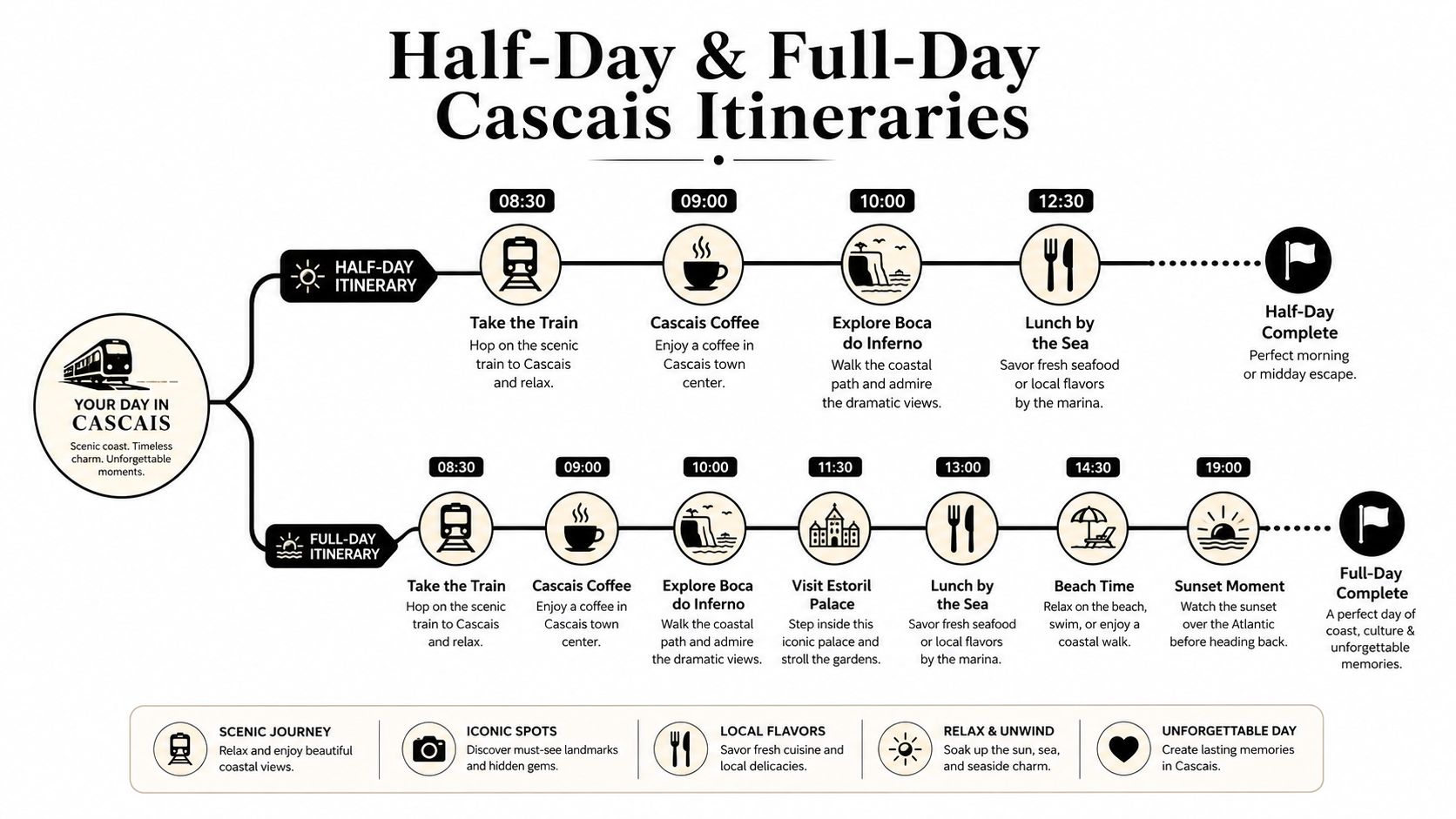
A half-day works best when you accept that Cascais is a coastal walk with stops, not a competition. Take an early train from Cais do Sodré, arrive in Cascais, and begin with coffee in the old town while the lanes are still calm. From there, walk towards Boca do Inferno, keeping the sea on your side and allowing time for viewpoints rather than rushing directly to the cliffs.
Return towards the centre for lunch near the marina, then spend the warmer part of the afternoon at Praia da Rainha. If you board a return train around the middle of the afternoon, you'll have enjoyed the old town, the coastal path, a dramatic viewpoint, lunch and beach time without pretending you can fit the entire region into one morning.
A fuller coast-to-coast day
For a full day, get off at Estoril first. Walk the promenade, look around the casino gardens and continue along the coast before taking the train onward to Cascais. A brief visit to Casa de Santa Maria fits naturally once you reach town, followed by lunch at Casa da Guia, where the setting gives the meal more character than a rushed stop in the centre.
After lunch, use a taxi or bus to reach Guincho. Watch the surfers, explore the dunes and account for the wind before deciding whether to continue to Cabo da Roca. A sunset stop at either the western viewpoint or Guincho can work, but trying to do both while also visiting every museum and beach creates a tight schedule.
Finish with dinner in Cascais and aim for a return train around the evening. The exact departure should depend on the current timetable and how long you want to linger over dinner. The winning itinerary has buffers built into it, because the coast is better enjoyed slowly than experienced as a series of rushed arrivals.
Must-See Sights in Cascais and Along the Coast
The best way to visit Cascais is by grouping sights according to walking logic. Start near the station and work through the historic centre before following the shoreline west. This avoids zigzagging and leaves the more distant beaches for a deliberate taxi, bus or car decision.
The central walking cluster
Begin with the Cidadela and Praia da Ribeira, then wander through the old fishermen's quarter. Casa de Santa Maria, the Condes de Castro Guimarães museum and Marechal Carmona Park form a natural cultural cluster. You can see the architecture, pause in the park and return to the water without repeatedly crossing town.
Continue towards Boca do Inferno. The cliff formation is the dramatic finish to the walk, and the café terrace nearby makes a surprisingly sensible lunch stop when you want a view without turning the meal into a major production. Wear shoes with grip and keep away from exposed edges when the sea is rough.
Estoril works as a separate stop. Get off for the cliff promenade and casino gardens, then continue to Cascais if you want the historic centre and Boca do Inferno in the same day. Guincho and Cabo da Roca belong to the western-coast extension, reached by road transport rather than treated as casual additions to the town walk.
For inspiration beyond Portugal, bespoke vacation spots can help you compare Cascais with other distinctive coastal destinations. If surf is the priority, use this guide to surf in Cascais before choosing your beach and transport.
One important correction saves wasted time: Pena Palace is in Sintra, not Cascais. It belongs in a Sintra itinerary, and forcing it into this route will leave you with too little time for the coast.
Best Beaches Near Cascais by Train or Short Drive
Choose the beach by mood, not reputation. The small town beaches are convenient and better for an easy swim between sightseeing stops. The western beaches offer more space and scenery, but they also demand extra transport and a willingness to accept Atlantic conditions.
| Beach | Access from Cascais | Vibe | Best for |
|---|---|---|---|
| Praia da Rainha | Walkable from the centre | Small and sheltered | Couples and a quick swim |
| Praia dos Pescadores | Walkable from the centre | Central and lively | Families wanting convenience |
| Praia da Conceição | Walkable or a short town connection | Accessible and practical | First-time visitors |
| Praia do Guincho | Bus, taxi or car | Windy, open and surf-focused | Surfers, dunes and Atlantic views |
| Praia do Tamariz | Estoril station and promenade | Boardwalk atmosphere | A beach stop linked to rail |
| Praia da Adraga | Short drive from the Cascais area | Wild and scenic | Photography and dramatic coast |
| Praia Grande | Short drive through the Sintra-Cascais area | Broad and exposed | Groups wanting space and scenery |
Match the beach to your group
For families with young children, start with Praia da Rainha, Praia dos Pescadores or Praia da Conceição because they keep the day simple. Couples who want a compact, attractive stop can choose Praia da Rainha, then continue towards the old town and Boca do Inferno.
Guincho is the clear choice for surf atmosphere, lessons and dune scenery. Conditions can change quickly, and the wind can make the beach feel cooler than the sunshine suggests. Surf schools often fill after late morning during the busiest summer period, so decide early if you want a lesson rather than just a walk.
Praia da Adraga and Praia Grande are better treated as a separate western or Sintra-coast outing. Summer water is brisk, and lifeguard coverage varies by beach and section, so check local conditions before swimming. Don't choose a remote beach just because it looks impressive online. Choose it when you have enough time for the transport involved.
Timing, Crowds, and Common Day-Trip Mistakes
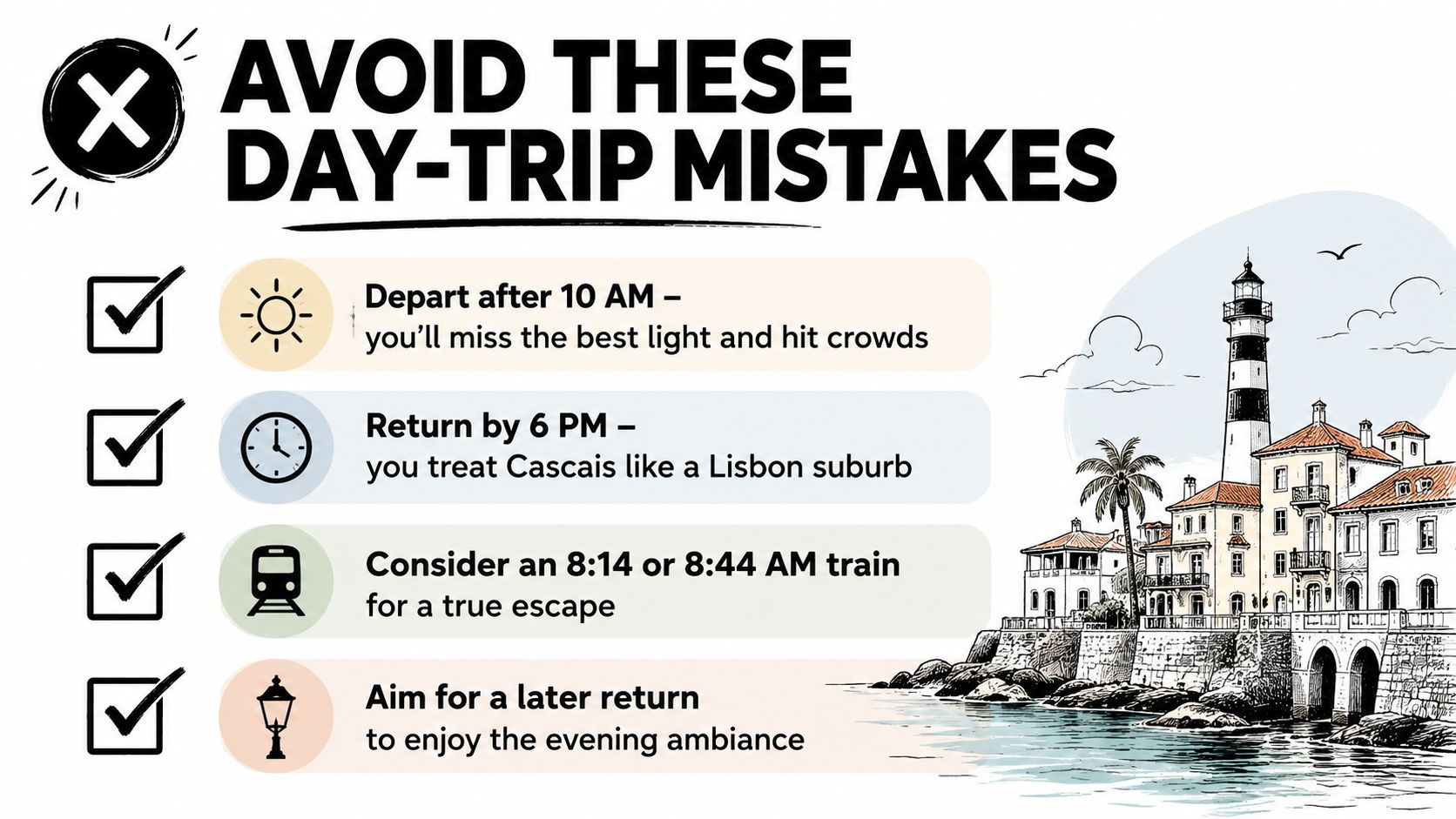
The standard late-morning departure is the quickest way to make Cascais feel like an overcrowded extension of Lisbon. Leave on an early train, ideally around 8:14 or 8:44, and you'll gain quieter streets, better light and more choice at the coast. The railway's frequent service makes this easy to do without turning the day into a rigid military operation.
A later return gives the town a different atmosphere. In summer, I'd avoid returning at the first convenient late-afternoon opportunity unless you have another Lisbon commitment. Stay for the evening, eat in town and return when your plan is finished, but check the current Sunday timetable because the late service window is less generous.
Mistakes that cost you the day
- Sleeping through the morning: Arriving around midday leaves less room for beaches and the western coast.
- Eating only at the marina: The waterfront is convenient, but the old town often gives you a more memorable sense of place.
- Adding Cabo da Roca to a half-day: The distance and transport time make this a poor fit for a short visit.
- Assuming the final train suits your dinner: Weekday and Sunday late services don't operate identically.
- Ignoring Guincho wind: Bring an extra layer, even when Lisbon feels warm.
Shoulder-season travel, particularly outside the busiest summer weeks, makes the coastal route easier to enjoy. The central lesson is simple: timing affects the quality of the day more than adding another attraction.
Booking Tips and Final Verdict for 2026
For a practical 2026 plan, take an early Cais do Sodré train, carry a Viva Viagem card with zapping credit, and set a return window rather than a single inflexible departure. A return between early evening and later evening works well unless you've chosen to dine late in Cascais, in which case check the live timetable before sitting down.
You don't normally need to book trains in advance. Groups should still organise themselves before travelling, particularly when several people need to board together during busy periods. If your plan includes Sintra or the more remote western beaches, a rental car becomes more defensible. For a Cascais-only day, rail remains the cleaner option.
Recent information describes the corridor as a heavily used coastal commuter link, with fares around €2.55 for adults and €1.30 for children on the Navegante system, and journey times generally within the 33 to 45-minute range. (Cascais Portugal information) Treat future timetable or fare changes as possibilities rather than guarantees, and verify the official CP schedule before travelling.
| Option | Best departure | Return window | Best season | Ideal for |
|---|---|---|---|---|
| Rail and central Cascais | Early morning | Evening | Any season | Most visitors |
| Rail with Estoril | Early morning | Evening | Spring through autumn | Walkers and culture-focused travellers |
| Car with western coast | Early morning | Flexible | Clear-weather days | Drivers adding Guincho and Cabo da Roca |
| Private road transfer | Flexible | Flexible | Any season | Families, groups and bulky equipment |
My decision rule is firm: take the train for a normal Lisbon to Cascais day trip, leave early, keep the central sights walkable, and add a car only when the western coast is the main event.
The Algarve Experience specialises in reliable, door-to-door transport across Portugal, including organised transfers for airport arrivals, families and groups whose travel plans extend beyond Lisbon. Visit The Algarve Experience to arrange dependable transport for your Algarve journey and keep the road connections as straightforward as the Cascais railway.