
You step off a coach at Campanhã with a suitcase in one hand and a backpack digging into your shoulder, and the station immediately tells you this is not a simple bus stop. It's a transfer point where rail, metro, and bus all collide, which is exactly why people get confused the first time they arrive. If you want the honest version of porto Campanhã bus station, here it is, the place works well when you know what to do, and wastes time when you don't.
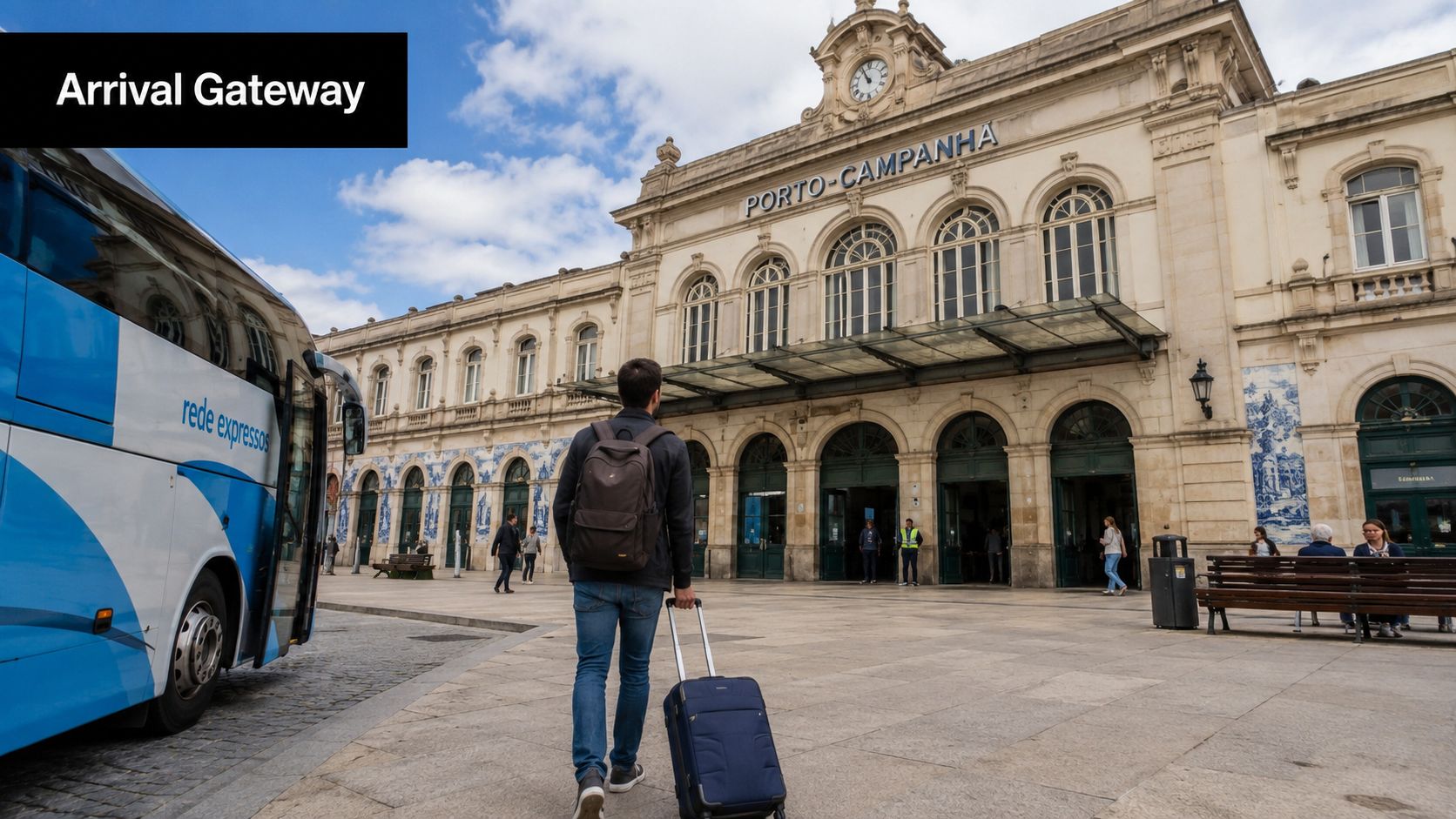
This guide is for the moment after arrival, when you're trying to figure out whether to walk, tap a metro card, find a coach bay, or just get out fast because your next connection is tight. Campanhã is one of Porto's most important ground-transport hubs, and the difference between an easy transfer and a messy one usually comes down to luggage, timing, and choosing the right mode on the spot.
Stepping Off at Campanhã
A lot of first-time visitors arrive expecting a neat little bus station. That's not what Campanhã is. You get a broad interchange, a moving crowd, signs that matter more than you'd like, and a station that behaves like a coordination point, not a destination.
That matters the second you step down with luggage. If you're catching a rail service, boarding a long-distance coach, or trying to reach central Porto quickly, you need to decide fast, because standing still is how Campanhã starts feeling bigger and more confusing than it really is. The good news is that once you understand the layout, the place becomes straightforward.
Practical rule: don't treat Campanhã like a normal bus depot. Treat it like a transfer machine, choose your mode first, and then follow the signs to that mode.
What makes the arrival experience unusual is that the station is carrying serious volume. Porto's Campanhã Intermodal Terminal handled more than 10 million passengers in 2024, and official reporting says it has seen around 20 million users and 400,000 buses since 2022, which explains why the place feels busy even outside obvious rush periods (InvestPorto). You are walking into a high-throughput interchange, not a sleepy suburban stop.
That also explains the article's focus. The core question is never just “where is Campanhã?”, it's “how do I get through Campanhã with luggage and not lose time?” If you're arriving late, transferring to the Algarve, or just trying to reach the centre without dragging bags across the wrong platform, the details matter more than the label on the building.
Where Campanhã Actually Is
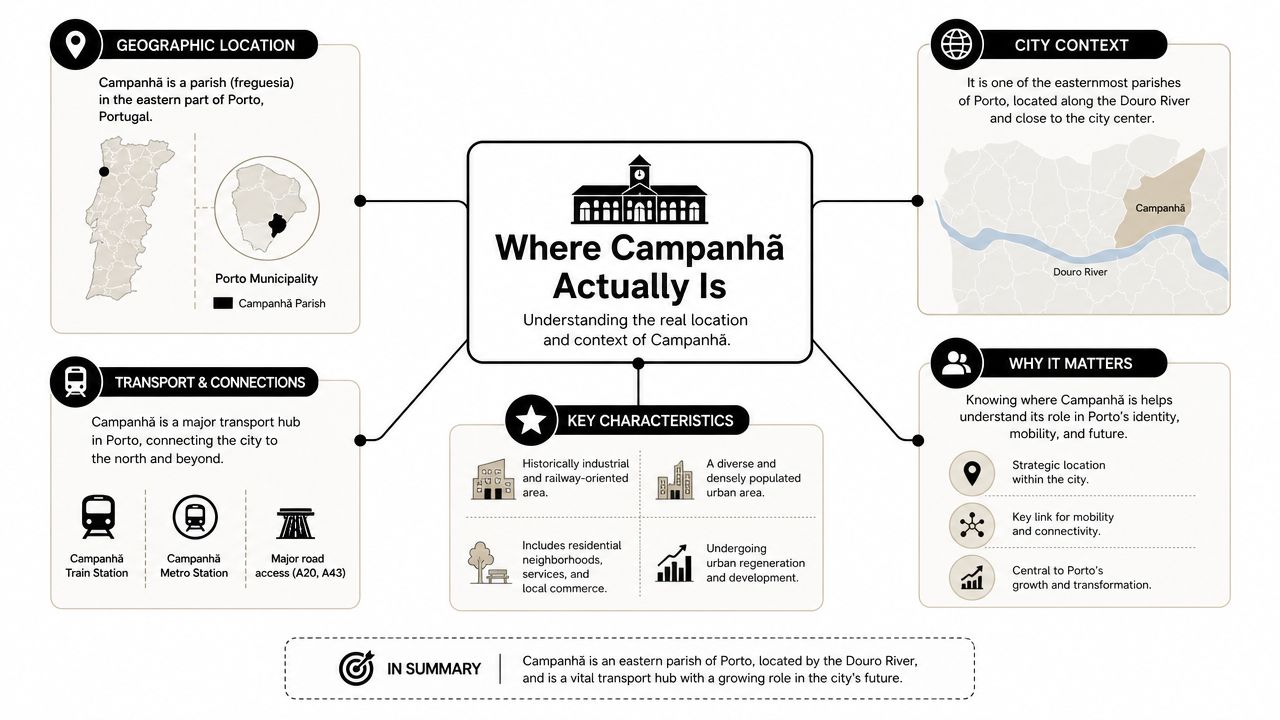
Campanhã sits in Porto's Campanhã district, and the transfer complex is split across a few access points, with Visit Porto placing the TIC – Terminal Intermodal de Campanhã on Rua de Bonjóia and other transport references pointing travellers toward Rua da Estação (Visit Porto). That looks inconsistent on a map, but on the ground it is the same place, just approached from different sides depending on whether you are arriving by coach, rail, or metro.
The station sits on Porto's east side, roughly 2.5 km from the historic centre, so treat it as close-in urban infrastructure, not a detached outpost. For travellers with luggage, that matters more than the label on the building. Campanhã is the city's east-side gateway, and it works best when you use it as a transfer point rather than a place to linger (Seat61).
Use the complex like a local
If you are heading for a long-distance coach, go straight for the terminal bays and read the carrier signs first. If you are taking rail, use the station entrance and follow the platform boards. If you are using the metro, handle Campanhã as one connected transfer node, not as separate buildings that require a fresh plan every time you switch modes.
The layout only feels confusing when you assume the bus, train, and metro are spread far apart. They are not. Campanhã works as a real intermodal station, so the smartest move is to decide your mode before you arrive, then walk straight to the right part of the complex instead of hunting around with bags.
Campanhã's scale explains the traffic. The place handles a heavy flow of people and vehicles, so wayfinding matters more here than at a small station. If you want the trip to stay simple, focus on finding the correct carrier area first, then work outward from there. For airport-side planning and a cleaner handoff into Porto, use The Algarve Experience transfer advice for Porto. For broader city-trip planning, Explore Effortlessly Porto planning is a useful companion once you have sorted the transfer itself.
Getting to and from Campanhã
The station is plugged into Porto's urban network properly, which is why the easiest answer is often the metro, not a taxi. Campanhã is served by Metro lines A, B, C, BX, and E plus STCP bus routes 205, 206, 207, 400, and 403, so you're dealing with a genuine interchange rather than an isolated stop (Moovit).
Pick the mode that matches your luggage
If you've got one backpack, use the metro and stop overthinking it. If you've got a suitcase plus hand luggage, the metro still works fine if you're not in a rush. If you've got kids, awkward bags, or an onward transfer lined up, the right answer may be a private pickup or a direct coach, depending on where you're going.
| Mode | Frequency | Approx. Time to Centre |
|---|---|---|
| STCP bus 206 | Every 15 minutes | About 4 minutes to D. João IV |
| Metro do Porto to 24 de Agosto | Every 5 minutes | About 4 minutes |
| Campanhã urban connections overall | Frequent | Roughly 5 to 11 minutes to central Porto |
Those short times are the point. Rome2Rio reports that Campanhã to central Porto takes roughly 5 to 11 minutes, with STCP bus 206 running every 15 minutes and taking about 4 minutes to D. João IV, while the Metro do Porto service to 24 de Agosto runs every 5 minutes and takes about 4 minutes (Rome2Rio). In other words, Campanhã is close to the centre, but the mode you choose matters more than the distance.
For a useful city planning resource after you've sorted arrival, Explore Effortlessly Porto planning is worth a look because it helps with what happens once you're in the city. And if you're mapping the wider Algarve side of your trip, the transfer patterns discussed in this Porto airport transport guide are useful context for understanding how Portuguese rail and transfer timing tends to work.
My advice: if your next stop is central Porto, don't book a taxi out of habit. The metro is usually the cleaner move unless you're overloaded with bags or arriving at a bad hour.
Long-Distance Carriers and Destinations
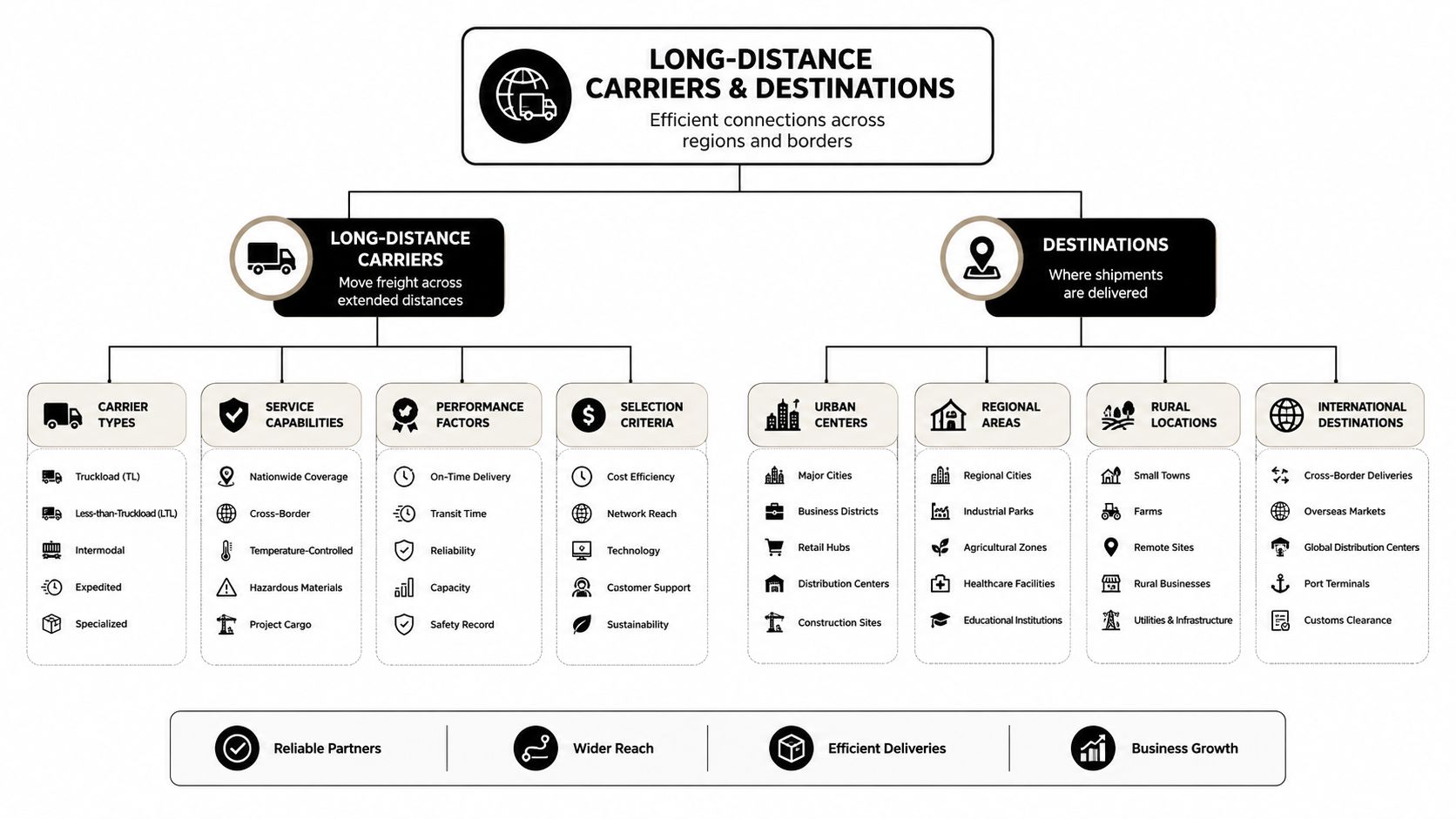
Campanhã is where you sort the long-haul part of a Porto trip. That matters because travellers often assume every departing service works the same way, then get caught out by the wrong platform, the wrong operator, or the wrong kind of ticket. Some services are urban STCP routes, some are rail, and some are long-distance coaches for much bigger journeys.
Know what you're actually booking
If your destination is another city in Portugal, decide first whether rail or coach is the cleaner choice. For Lisbon and other major routes, rail is usually the first thing to check. For regional places and some cross-country journeys, a coach can make more sense. For short hops inside Porto, the local network is what matters.
Campanhã is widely described as Porto's main rail station for long-distance and international trains, and the station layout reflects that role. It is the sort of place you use for serious onward travel, not a casual stop where every departure feels interchangeable.
The practical split is straightforward. Rail suits travellers who want station-to-station travel with fewer moving parts. Urban buses suit anyone heading into Porto's centre with lighter luggage. Coaches suit point-to-point intercity travel where rail does not fit the route or the schedule. If you are unsure, check the carrier first, then decide whether the journey belongs on the train network or the coach network.
Campanhã also works well as a no-car interchange. The station area lets you shift between train, metro, and bus without building the trip around a taxi or private transfer, which is exactly why so many travellers pass through the same complex. That mix is useful, but only if you choose the right carrier for the last mile and do not assume every connection is equally convenient.
For a Porto-to-Lisbon rail context, this Lisbon to Porto train time guide is a practical reference if you are comparing route choices and deciding whether rail or coach makes more sense for your trip.
Tickets, Booking, and Payment
Buy your ticket before you start guessing at the station. That's the safest rule at Campanhã, especially if you're arriving with luggage and the clock matters more than the scenery. A ticket bought in advance removes queue stress, while a walk-up ticket only makes sense when you've got margin.
What actually works in practice
For STCP buses, the big shift is payment ease. Porto's bus system uses Andante validation and contactless payment on most services since 2023, so you don't want to arrive unprepared and end up fumbling for change when you're tired. If you're using the city network, tap in, validate properly, and move on.
For coach or rail ticketing, the trap is time of day. Campanhã's opening window is long, but ticket-office and service hours are narrower and vary by ticket type, so late arrivals can arrive to find a desk closed even while the station itself remains open. That's where people get stuck. They assume a big station means every service point is fully staffed all the time, and it doesn't.
A simple fallback plan helps:
- Book online if possible.
- Use contactless on STCP where allowed.
- Carry a backup payment method.
- Check whether your carrier has an unattended machine or app option.
If you're arriving late and expecting to buy a same-day onward ticket, don't rely on one desk being open. The smarter move is to book earlier or choose a mode that accepts on-platform validation or contactless payment. Campanhã rewards preparation and punishes improvisation.
Station Facilities and Accessibility
Campanhã is functional, not luxurious. That's the honest read. You can get through it comfortably, but you shouldn't expect the kind of polished waiting experience you'd get at a smaller, tourist-focused terminal.
What matters when you're carrying bags
The main issue is walking distance inside the complex. Several travellers mention long walks between parts of the station and signage that's not especially helpful for bus-only passengers. I agree with that criticism. If you're carrying luggage and you don't know the layout, the station can feel more tiring than it should.
Luggage storage, toilets, food, and seating are the things people care about most here, and planning ahead helps. Don't assume you'll find everything right where you need it. Arrive with water, charge your phone before you enter, and sort the platform or bay first, because wandering around with a bag in search of a coffee is how simple transfers turn annoying.
Useful rule: if your connection is tight, don't spend time hunting for the “best” waiting spot. Go straight to the correct mode area and stay near your departure point.
If you're travelling with reduced mobility, kids, or oversized luggage, you should think of Campanhã as a place where clarity beats comfort. It's workable, but it rewards people who already know the route they're using. For travellers who want a smoother door-to-door handover after arrival, the kind of service offered by The Algarve Experience is the opposite model, fixed pickup, driver meet-up, and no need to drag bags across a station complex, though that's a transfer choice rather than a station feature.
For a broader look at vehicle-based arrival and pickup logic, the Algarve transfer travel guide is useful background if you're comparing station pickup with road transfer options.
Onward Transfers and When a Private Pickup Makes Sense
Many assume the smartest choice is always the cheapest public option, or always the private one. It isn't. The right answer depends on how much luggage you've got, how late you've arrived, and whether you want to manage a transfer or just finish the journey.
Match the transfer to the traveller
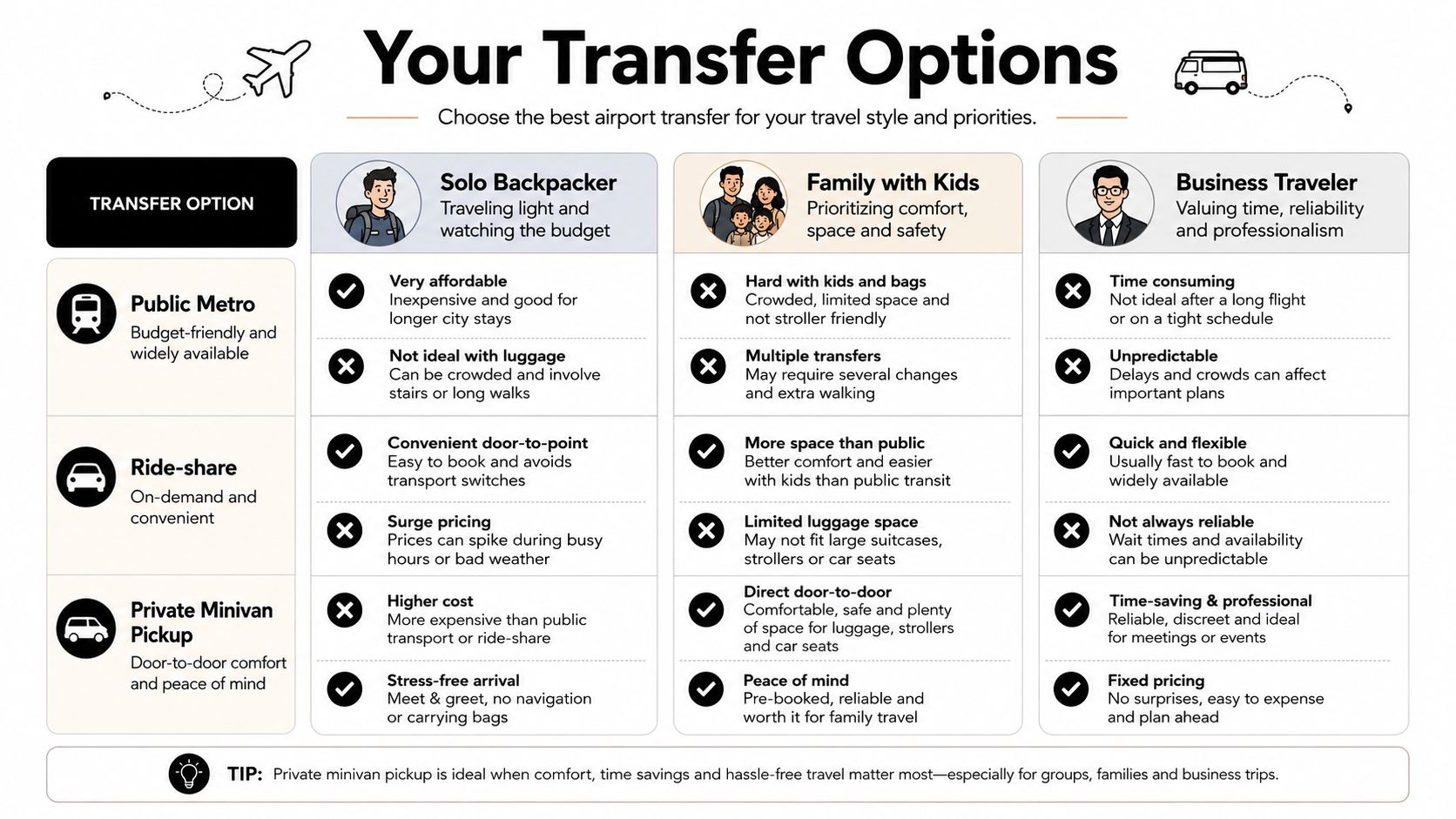
A solo backpacker with time to spare should take the metro. It's frequent, fast, and the station-to-centre hop is short enough that paying extra rarely makes sense. A family with kids heading onward to the Algarve or another region should look hard at a private minivan pickup, because luggage space and direct door-to-door movement matter more than squeezing into multiple public steps. A business traveller with a tight schedule should make the same calculation, but for different reasons, since time certainty matters more than the fare.
Private transfers make the most sense when the next stage is complicated. That includes late-evening arrivals, multiple bags, children, or an immediate onward drive to another Algarve destination. A service like The Algarve Experience operates as a booked transfer option with licensed drivers, fixed pricing, and flight monitoring, which is useful when you want the handover to happen without guessing at the station rank. Public transport still wins for solo, light-luggage, centre-city movement.
For broader transfer comparison reading, EC Minibus' cruise port transfer guide London is a decent example of how door-to-door logic changes once luggage and timing become the main problem. Campanhã works the same way. The station is efficient when your route is simple, but the second your trip becomes multi-leg, a private pickup can be the cleaner choice.
Timing, Safety, and Common Questions
If your coach is late, stay where the mode you need is obvious and keep your booking confirmation ready. Campanhã is busy, so don't assume someone will come looking for you. Late services happen, missed connections happen, and the fix is usually to move quickly to the next valid option rather than wait and hope.
Campanhã is a sensible place to wait during the day, and it's busy enough that you're rarely isolated. At night, use the main station areas and avoid wandering off with luggage just to kill time. The practical question isn't whether the station exists after hours, it's whether your ticket office or chosen carrier desk is staffed, and that varies by service.
If you miss a connection, the fastest move is to re-check your mode options, then head for the correct rail, metro, or coach point without drifting between them. Keep your phone charged, carry your ticket offline if possible, and don't bank on being able to sort everything at the last minute.
If you want a smoother Campanhã transfer, The Algarve Experience arranges door-to-door transport with fixed pricing, meet-and-greet pickup, and vehicles sized for different luggage needs. For travellers heading from Porto into the Algarve or connecting onward after a rail arrival, visit The Algarve Experience and book the transfer that lets you skip the station scramble.
Related posts