

You can do everything right in Lisbon and still waste half a day in Sintra and Cascais if you treat the transfer like an afterthought. The palaces, cliffs, and coastal views are the easy part. The difference between a smooth day and a frustrating one is knowing how to move between the two towns without getting trapped by waiting, detours, or a schedule that falls apart the moment the crowds build.

Why Sintra and Cascais Belong on Your Portugal Itinerary
A lot of travellers treat Sintra as the storybook stop and Cascais as the polished coastal finish, then try to squeeze both into one neat day. That instinct is right. Sintra carries the formal protection and cultural weight of the UNESCO-listed Cultural Area of Sintra (UNESCO), while Cascais brings seafront energy, a historic waterfront, and a much lighter pace.
The pairing works because each place fixes what the other lacks. Sintra gives you layered history, steep terrain, and the kind of built-and-natural setting that rewards an early start and a disciplined route. Cascais gives you light, air, and a calmer finish, which is exactly what most visitors want after climbing around palaces and hills all morning.
The mistake is assuming the two towns naturally fit into a clean loop. They don't. There is a practical transport gap between them that catches even experienced travellers off guard, and that gap matters even more when you are trying to make the route work in one day.
Practical rule: If your plan depends on spontaneity, you will lose time. If you start with transport, the rest of the day gets easier.
What makes the pairing work
Sintra and Cascais are not just two pretty stops near Lisbon. They sit inside a broader coastal-mountain system shaped by heritage, protection, and geography. The Sintra-Cascais site is a Natura 2000 area coded PTCON0008 with 16,631.88 ha total surface, split into 8,110 ha terrestrial and 8,522 ha marine area, and EUNIS reports 73 species and 27 habitat types under the Nature and Habitats Directives (ICNF).
That mix is why the area feels so varied over a short distance. One minute you are in a heritage centre with layered royal history, the next you are facing coast, cliffs, or a cooler pocket of terrain. Cascais also works as a natural counterweight to Sintra's intensity, with beaches, harbourfront walks, and a stronger seaside identity. If you want a coastal add-on that matches that mood, surfing in Cascais fits the area far better than another rushed monument stop. It is also why generic “just drive around” advice is weak here. The terrain deserves a plan.
The local contrast is sharper than most guides admit. Sintra's scale, with 385,654 inhabitants in 2021 and 395,528 inhabitants in 2023, gives it unusual demographic weight in the Lisbon region (Sintra data). Cascais, with 214,158 residents in 2021 over 97.4 km², brings a denser coastal municipality feel (Cascais data). Those numbers do not just describe population. They explain why Sintra feels administratively and physically busier than the postcard version suggests.
For travellers, that means one simple truth. Sintra and Cascais belong together on an itinerary, but not on autopilot.
How to Get Between Sintra and Cascais Without Wasting Time
The biggest planning mistake is assuming the transfer is a quick rail hop. It isn't. There's no direct train between Sintra and Cascais, so you'll need to use a bus, car, taxi, or private transfer. That's the hidden friction point most day-trip write-ups gloss over, and it's exactly where people lose time.
Compare the real options
The bus sounds easy because one commonly cited route takes about 30 minutes (travel discussion). In practice, you still have to line up timing, deal with boarding, and accept that the trip is only as smooth as the day's crowding. That matters a lot if you're carrying luggage, travelling with children, or trying to keep an older relative comfortable.
A private car or taxi is faster on paper and simpler in motion, because it removes the transfer puzzle altogether. Door-to-door transport is the cleanest option when you want predictable timing rather than a cheap but messy connection. If you're also arriving from the south, the logic is even stronger, because Faro Airport transfers, Algarve airport transfers, and Faro airport to Albufeira transfer planning already teach you the value of pre-booked, direct transport.
| Transport Method | Travel Time | Approximate Cost | Best For |
|---|---|---|---|
| Bus | About 30 minutes | Lower, but variable | Solo travellers who don't mind waiting |
| Taxi | Faster than the bus in practice | Higher | Small groups that want flexibility |
| Car | Flexible | Depends on parking and hire costs | Travellers comfortable driving |
| Private transfer | Direct and door-to-door | Fixed and predictable | Families, groups, and tight schedules |
What I'd choose in each case
If you're travelling light and don't care about a bit of friction, the bus is acceptable. If you've got bags, kids, or a packed schedule, don't pretend the bus is efficient just because the ride itself is short. Waiting time is part of travel time.
If you're coming from the Algarve, the broader transfer mindset matters. People looking for private transfers Faro airport, cheap Faro airport transfers, or the best airport transfers Algarve usually want the same thing: no queues, no guesswork, and no awkward connection points. That same standard makes sense for Sintra and Cascais too.
For travellers who want a simple route back to Lisbon planning, the practical anchor point is Sete Rios. The transfer logic around a hub like that is easier to control than trying to improvise between smaller endpoints, so keep the move clean and intentional. If you want to understand the Lisbon side of the connection, this Sete Rios station guide is useful context.
Don't choose the cheapest option first. Choose the option that keeps your day intact.
Recommended Itineraries for Every Trip Length
A bad Sintra day happens when people visit in the wrong order. Start in Sintra early, then finish in Cascais if you want the day to feel organised rather than frantic. The reverse can work for a coastal-only plan, but it usually wastes the best morning light on the wrong place.
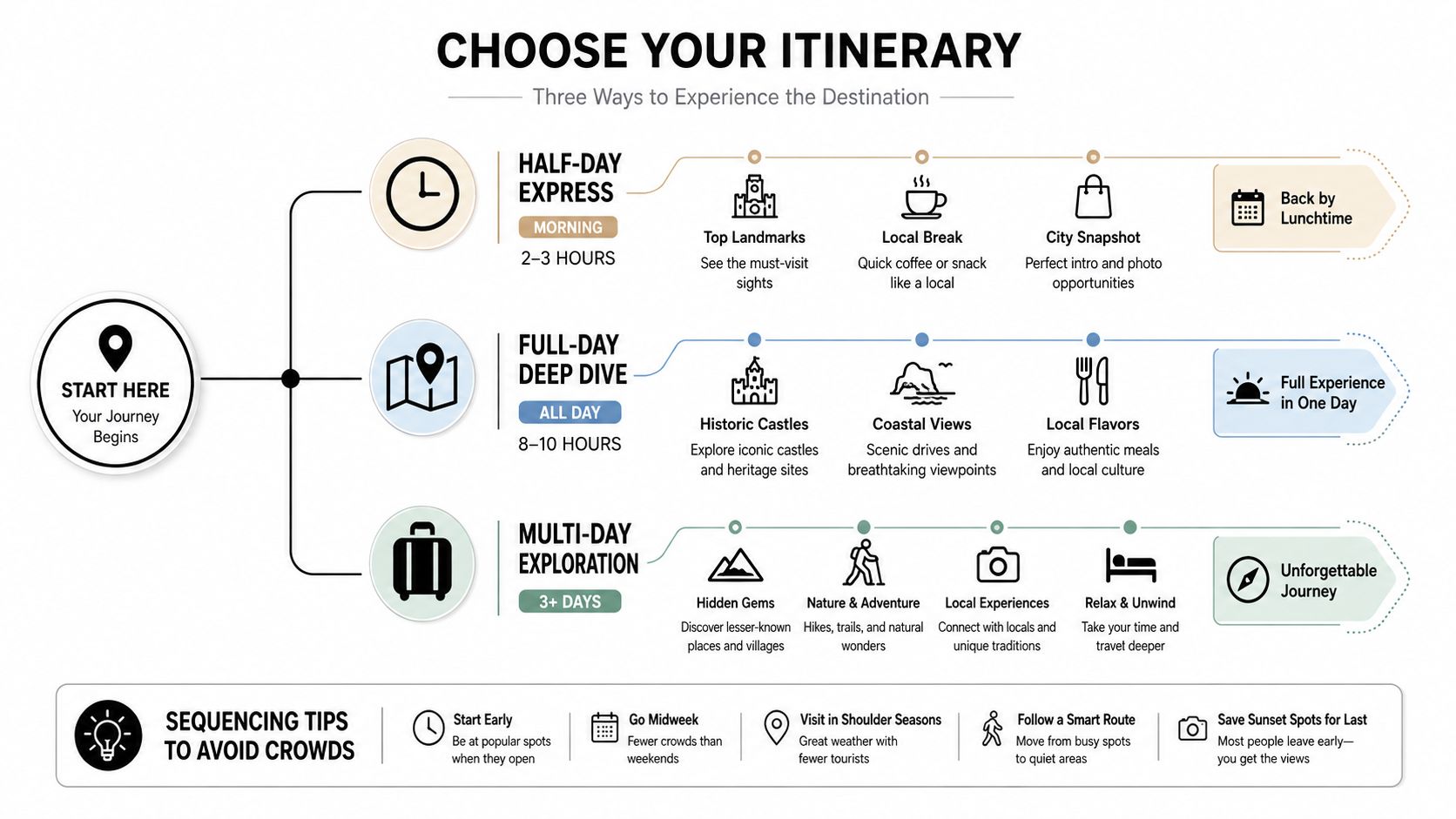
Half-day express
This is the stripped-down version for travellers who want the headline sights and nothing more. Begin with one major Sintra stop, then move on before fatigue and queues snowball. If you only have a few hours, stop pretending you can “see everything” and choose one palace or one walk.
A sensible half-day rhythm looks like this.
- Early arrival in Sintra: Get in before the tour flows build.
- One main site: Pick Pena Palace or another top draw, not three.
- Short lunch or coffee break: Keep it light and local.
- Transfer to Cascais: Finish by the water rather than backtracking uphill.
This is also where sequencing matters for people comparing day-trip options with wedding day timeline ideas. The logic is similar, a good day works because the order is deliberate, not because every activity gets equal time.
Full-day deep dive
A full day is the sweet spot for most visitors. Use the morning for Sintra's most demanding terrain, then move to less strenuous stops after lunch. That gives you energy when you need it and avoids wasting prime hours on transport.
A stronger full-day pattern is simple. Start with the most crowded or physically demanding site, move to a quieter cultural stop, then end with the coast. If you're visiting with children or older relatives, this is the version that keeps the day humane. Build in pauses. Sintra punishes rushed walking.
The Sintra-Cascais Natural Park has varied geology and slope conditions, so short-distance movement can feel more demanding than the map suggests (LNEG park map). That's another reason to avoid overloading the middle of the day. If one site feels steep or crowded, don't stack two more right after it.
Multi-day exploration
If you have 3 or more days, stop treating the area as a checklist. Use one day for Sintra's core palaces, one for the coast and heritage edge, and one for slower inland or park-based exploration. That approach is far better for travellers who care about scenery, photography, or avoiding the same path as everyone else.
A multi-day trip also makes it easier to include lesser-visited areas and calmer pacing. It's the right choice if you hate rushed lunch breaks and want room for weather changes. It's also the version most families prefer because nobody has to sprint between transport nodes.
For a different pacing model around local sightseeing, the Sintra hop-on hop-off option can help visitors understand how to separate movement from sightseeing rather than mixing both into one stressful block.
When to Visit and How to Avoid the Crowds
Sintra has a reputation for being beautiful and busy, and both parts are true. A tourism study on Sintra recorded 136,498 guests in 2013 and 289,850 overnight stays, with visitors mainly from Portugal, Spain, and France, and found that 55% of tourists chose Sintra for cultural tourism while 67% cited monuments and museums as the main activity (Sintra tourism study). That tells you why the classics get crowded, the demand is built into the destination.
Best timing beats best intentions
The safest rule is to arrive early and travel on a weekday when you can. Summer weekends are the worst combination, especially in the historic centre and around the headline sites. If your schedule is flexible, shoulder periods are the smarter choice because they usually give you enough weather without the same crush.
The area's climate and elevation also affect comfort. Sintra sits against the Atlantic and has higher ground than many visitors expect, so wind and cooler conditions can change how long people want to linger. That makes timing more important than usual. A cloudy morning can still be a good morning if you've organised your sequence correctly.
What to skip when the crowds peak
Don't try to do every famous stop at peak demand. That's how you end up spending more time in line than inside the place you came to see. Choose one major monument, one easier cultural stop, and one coastal finish.
A calmer strategy is this.
- Arrive before 9 AM: You gain breathing room before the buses stack up.
- Use weekday travel: The difference is obvious in the busiest places.
- Limit major ticketed stops: One or two serious visits is enough for a day.
- Move off the obvious path early: The closer you stay to the main flow, the more time you lose.
The route from Sintra to Cascais is also where congestion can feel more frustrating than scenic. It's a classic “looks simple, eats time” move. If your group values calm over box-ticking, the coast-first or coast-only variant can be the better call on crowded days.
My blunt view: if you're visiting in peak season and hate queues, don't build your day around the most photographed order. Build it around the least crowded timing.
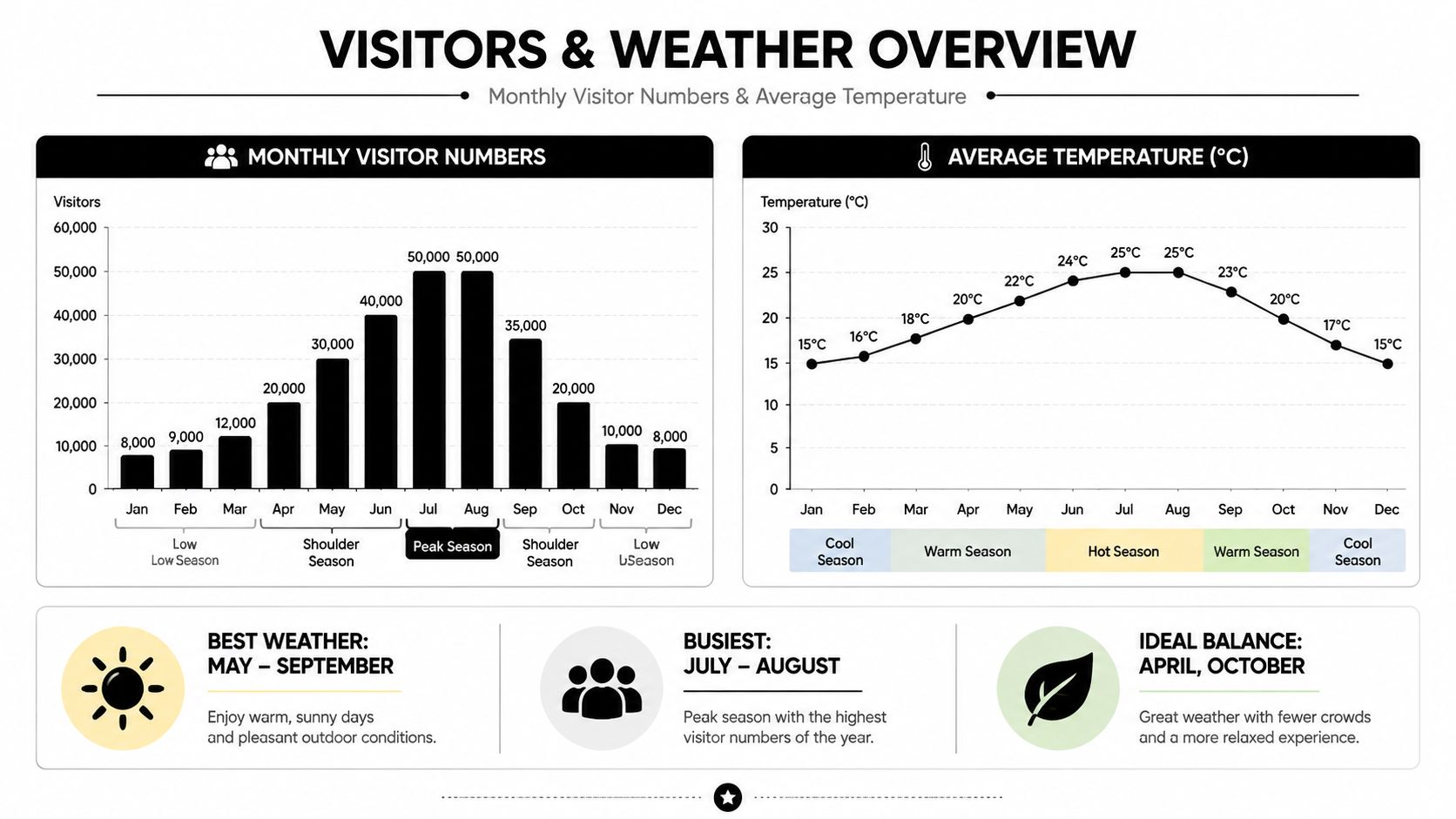
For a visual reminder of how timing shapes the day, the crowd-versus-weather pattern is worth keeping in mind. The best balance is usually the period that gives you reasonable temperatures without pushing you into the busiest flows.
Why Pre-Booking Transfers and Tickets Saves You Hours
People lose time in Sintra and Cascais for one simple reason, they confuse availability with convenience. Tickets may exist, but not at the time you want. Transport may exist, but not in a way that fits your luggage, energy, or group size. Pre-booking fixes that.
A public bus or taxi can get you there, but a pre-arranged transfer removes the friction of decision-making on the day. That matters most if you're arriving from Faro Airport, because travellers looking for Faro airport transfers for families/groups, an Albufeira Faro airport return transfer, or a private transfer from Faro airport to Albufeira price already know how much smoother a fixed plan feels than improvising after landing. The same principle applies to Sintra and Cascais.
Tickets are only half the battle
Pena Palace and the Moorish Castle are the obvious examples where people regret not planning ahead. Demand concentrates around the same headline attractions, so a walk-up mindset creates stress before the visit even begins. Pre-booking protects your schedule, especially when your day has a chain of moving parts.
Transport works the same way. A meet-and-greet style transfer means you're not hunting for a vehicle, translating instructions, or hoping the next connection lines up. If your trip includes a flight, a hotel check-in, and a heritage visit, that kind of certainty is worth more than a small theoretical saving.
Fixed price beats on-the-day improvisation
The case for private transfer is simple. You know who's collecting you, where they're going, and what the trip costs before you set off. You also avoid the common taxi stress points, especially when you're tired, carrying bags, or travelling with children.
The other practical benefit is time protection. If the transfer starts late or gets messy, the rest of the day loses quality. That's why pre-booked transport isn't a luxury add-on, it's the thing that stops the day from sliding off its rails.
Book the movement first, then buy the sights.
Your Complete Sintra and Cascais Planning Checklist
Use a clean plan and you'll enjoy the area far more. Use a vague one and you'll spend the day reacting to queues, hills, and transfer gaps. The checklist is basic because the basics are what keep this trip working.
The smartest order is straightforward.
- Book transportation. Arrange the car, train, or private transfer before you leave your accommodation.
- Reserve tickets. Secure entry for Pena Palace and the Moorish Castle before the day starts.
- Plan your route. Decide whether you're doing a half-day, full-day, or multi-day version.
- Pack essentials. Comfortable shoes, water, and layers are essential.
- Check the weather. Wind and cloud change the experience more than most travellers expect.
If you're packing for a family trip, this family vacation packing list is a handy reference for the basics you don't want to forget. Families and groups should over-prepare for snacks, water, and flexible timing, because slowdowns are more common than guidebooks admit.
My final advice is blunt. Start early, pre-book the transfer, and don't overload the day. Sintra rewards patience and Cascais rewards a relaxed finish. The combination works best when you stop pretending it's a spontaneous stroll.
If you want a cleaner way to handle Sintra and Cascais without wasting hours on logistics, The Algarve Experience can help you plan the transfer side properly. Visit The Algarve Experience to arrange reliable door-to-door transport and take the friction out of the day before it starts.
Related posts