

You're in the right place if you've just come out of the Lisbon buzz and want a proper breather without ending up in some random park that looks better on a map than in real life. Parque Keil do Amaral is the one I'd send a friend to when they want trees, space, and a clean escape inside Monsanto, not another cramped city square with too many benches and not enough shade. If you're also planning a Portugal trip that starts or ends in the Algarve, this is the kind of Lisbon stop you can fit in without making transport a headache.
Welcome to Parque Keil do Amaral
On a quiet morning, the park feels like Lisbon has stepped back and let the forest take over. You come in via Alameda Keil do Amaral, and the noise drops fast, replaced by long paths, open green slopes, and the bowl of the open-air amphitheatre sitting in the southern sector of Monsanto. That's the bit that matters most, because this isn't a decorative pocket park. It's a real piece of the city's larger green network, and it works best when you treat it as a destination, not a quick photo stop.
Parque Keil do Amaral is described as a 10-hectare area within the southern sector of Parque Florestal de Monsanto in Lisbon, with access via Alameda Keil do Amaral and an amphitheatre on site (bibliotecacosmos.com). That scale is exactly why it feels calm instead of cluttered. You've got enough room to walk, sit, and spread out without the place turning into a bottleneck.
Practical rule: if you only want one green stop in western Lisbon, pick this one and arrive with a clear plan, not just vague curiosity.
It suits families with strollers, joggers who want a proper circuit, and concert-goers or casual visitors who like open-air spaces. It also suits travellers who've just arrived from Faro and want to break up a Lisbon stay with something outdoorsy before diving back into the city. If you want a broader nature reference point before heading here, the Hoh Rainforest trail information is a useful reminder of how good a well-planned forest visit can feel when the paths and entry points are clear.
History and Design of the Park
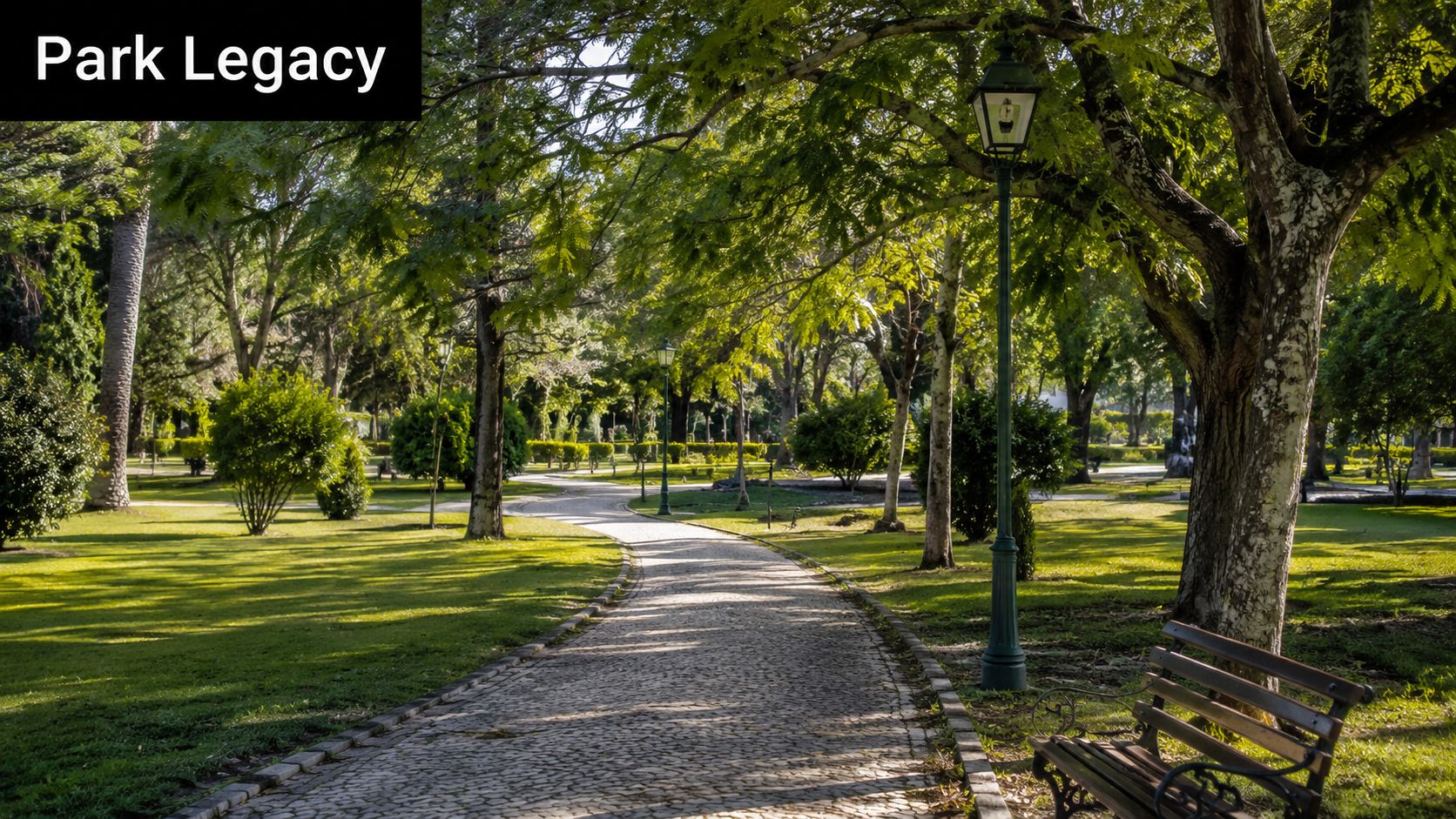
Start with the name, because people mix up two different places all the time. Parque Eduardo VII in Lisbon is the project most closely associated with Francisco Keil do Amaral, and the park in its current form was designed from 1942 onward. Portuguese cultural sources describe its 26-hectare layout, with a central lawned avenue and a 100-meter-wide Portuguese pavement promenade dividing the park into two major green zones. That ordered, civic feel is one of the clearest signs of his urban design thinking (e-cultura.pt).
What to notice on arrival
The design is not decorative filler. It brings together the Estufa Fria, Lago Grande, sports facilities, a playground, an amphitheatre, and the Pavilhão Carlos Lopes, which shows the park was built as a multifunctional civic space, not just a green lawn in the middle of Lisbon. Look at how the spaces connect. The layout guides movement and leaves room for culture, leisure, and everyday use (e-cultura.pt).
The smaller Jardim Alfredo Keil do Amaral is a different place entirely, and it helps to keep that straight. A separate historical article says it was built in 1881, has a lake and twelve unique tree species, and includes a monument to Alfredo Keil erected by Lisbon City Council in 1930 (lifecooler.com). That garden is useful context, but it is not the same as the Monsanto sector people usually mean when they talk about Parque Keil do Amaral.
The best way to read this park is as civic design architecture first, green leisure space second.
Once you see it that way, the site makes more sense. You are not wandering through leftover land. You are walking through a planned urban forest edge that was meant to handle people, performances, and everyday recreation without losing its sense of order.
Top Things to See and Do
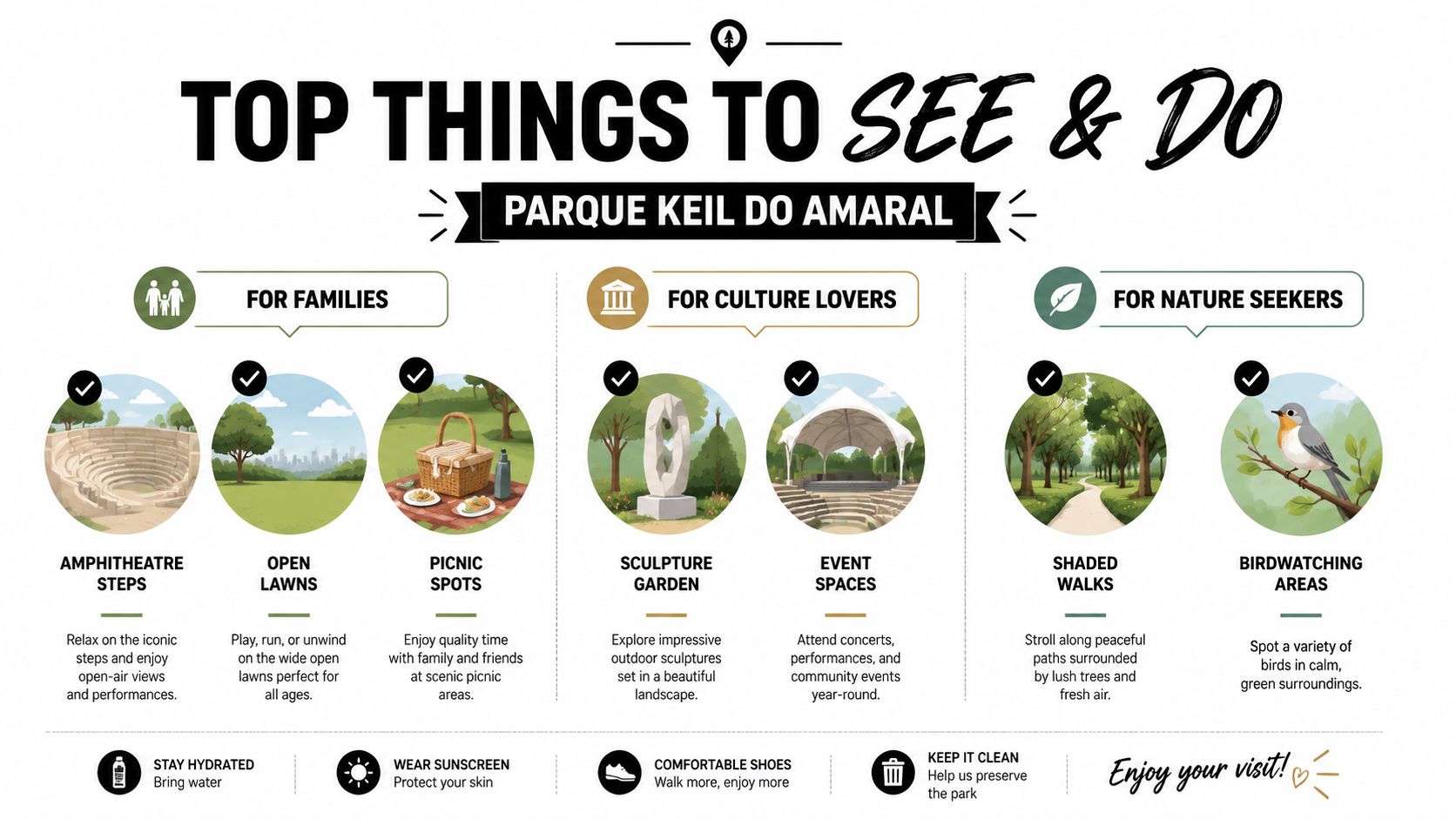
If you're with kids
Go straight to the amphitheatre steps and the open clearings. That's where children can move without you hovering over them every second, and it's where the park feels most forgiving. If you've got a stroller, stick to the broader paths and keep it simple. Don't try to turn it into an expedition.
If you're there to walk
Use the approach from Alameda Keil do Amaral and let the forest edge do its job. The wider Monsanto setting means you can keep going without feeling boxed in, which is the whole point of choosing this park over a tighter city green. The surrounding forest network also gives you a better sense of Lisbon's west side than a small urban garden ever will.
If you care about events and atmosphere
The open-air amphitheatre is the main feature to watch. It makes the park useful for performances and informal gatherings, and it gives the place a purpose beyond passive lounging. When something is happening there, the park feels alive. When it isn't, the amphitheatre still gives the site a strong centre of gravity.
If you just want a quiet pause
Skip the urge to “see everything” and sit somewhere with a bit of distance from the main flow. The park works best as a breathing space, not a checklist attraction. If you want a broader Lisbon green reference point with built-in civic scale, the Lago Grande and other features in the wider Monsanto complex are the kind of thing that show how Lisbon handles public green areas when it gets it right.
Local advice: arrive with one goal, not five. This park rewards people who slow down and stop trying to optimise every minute.
Getting There From Faro, Lisbon, or the Airport
| Option | Best For | Approx. Time |
|---|---|---|
| Driving | People with luggage, families, flexible schedules | Depends on traffic and starting point |
| Metro plus bus | Lisbon visitors already in the city centre | Depends on connections |
| Walking from nearby areas | Locals or visitors staying close by | Short to moderate, depending on where you start |
| Private door-to-door transfer | Algarve travellers, groups, families, heavy luggage | Fastest stress-free option for long-distance arrival planning |
If you're already in Lisbon, driving is straightforward enough if you know exactly where you're going, but Monsanto is not the place for aimless circling. Public transport can work, though it often means layering one connection on top of another, and that gets old fast when you've got bags or children in tow. Walking only makes sense if you're already nearby and don't mind a bit of uphill effort.
For travellers arriving through Faro Airport, I'd be blunt. If your trip includes a Lisbon stop and you don't want to mess about with train stations, metro changes, or luggage drag, private transfers Faro airport are the cleaner move. That's especially true if you're looking for Faro airport transfers, Algarve airport transfers, or Albufeira airport transfers as part of a longer Portugal itinerary, because the door-to-door option saves time and leaves you with a lot less friction.
If you're comparing options, start with this practical guide to the Faro Airport bus to Lisbon. It helps you judge whether the bus-style route makes sense for your schedule, or whether a Faro airport to Albufeira transfer and onward planning is the better play.
My take: if you're travelling with family, golf bags, or a hard checkout time, book the transfer and stop pretending the cheapest route is always the smartest one.
That's the difference between a smooth Lisbon side trip and a day spent dragging luggage between platforms.
Accessibility, Family Details, and Safety
Alameda Keil do Amaral is listed as open 24 hours a day, which gives the park a lot of flexibility for early walks and late visits (lisboa.pt). That freedom is useful, but it also means you're responsible for your own timing. Early mornings are calm, evenings can be fine, and dark hours need more common sense than daylight does.
What to plan for
- Families: bring water, sun hats, and light layers. Forest shade helps, but it doesn't replace basic comfort.
- Strollers and mobility: stick to the main routes and avoid expecting every corner to be perfectly level. For anyone planning adapted transport elsewhere in Portugal, this guide to adapted vans for wheelchairs is worth keeping in your browser.
- After dark: use the main circulation routes, keep to areas with better visibility, and don't assume every edge of the forest is equally well lit.
- Amenities: look for toilets and cafés in the wider Monsanto area rather than expecting them at every turn.
The park's technical strength is also its practical limit. An open, forest-edge space supports informal recreation and outdoor performances, but it needs proper route maintenance and a bit of crowd awareness around the amphitheatre. That's not a defect. It's how a real park works when it isn't sealed off and over-managed.
If you're visiting with kids, the sort of advice in Parents' national park adventures fits here too. Pack for mess, motion, and unpredictability, then relax a bit and let the place do what it does best.
Don't overthink accessibility. Use the main paths, keep the visit daylight-heavy, and treat the forest like a park, not a mall.
Best Times to Visit in 2026

Spring is the safest bet if you want comfort and easy walking. Summer works if you go later in the day and don't mind livelier weekends around the amphitheatre. Autumn is my favourite pick for a calmer feel and better light, while winter suits people who want a quiet Lisbon break without much foot traffic.
Weekdays are the obvious win if you hate crowds. Tuesdays and Wednesdays are the sweet spot for a slower visit, especially if you want space for photos or a longer pause. Weekend visits are still fine, but they're only worth it if you're there for the atmosphere rather than empty paths.
For Algarve travellers, the cleanest move is to pair the park with a Lisbon stop on the same trip instead of trying to squeeze it into a beach day. That keeps the holiday rhythm intact and avoids turning a simple green space into a rushed detour.
Nearby Attractions and Easy Algarve Connections

If you're already in western Lisbon, this park pairs neatly with other city stops that sit comfortably inside the same half-day rhythm. You don't need a huge itinerary here. Pick one nearby Lisbon attraction, keep the pace easy, and use the park as the reset button rather than the main event.
For visitors heading south afterwards, the bigger point is this. A Lisbon stop only works smoothly if your transport is sorted before you arrive, especially when the next leg is Albufeira airport transfers or broader Algarve airport transfers. That's where a Faro airport transfer setup makes sense, because you can move between the Algarve and Lisbon without juggling separate local links and baggage stress. If you're planning a longer stay, the Algarve things to do guide is a good way to build the rest of the trip around the same practical logic.
Best call for Algarve travellers: book a door-to-door ride, keep Lisbon as a clean stop, and stop trying to force public transport into every part of the journey. That's how you protect your time and your energy.
If you want the easiest way to make a Lisbon stop work alongside an Algarve holiday, The Algarve Experience handles the boring parts properly, including luggage, flight timing, and direct hotel drop-off. Visit The Algarve Experience and sort your transfer before you travel, so the day runs smoothly instead of turning into a queue-and-connections mess.
Related posts